
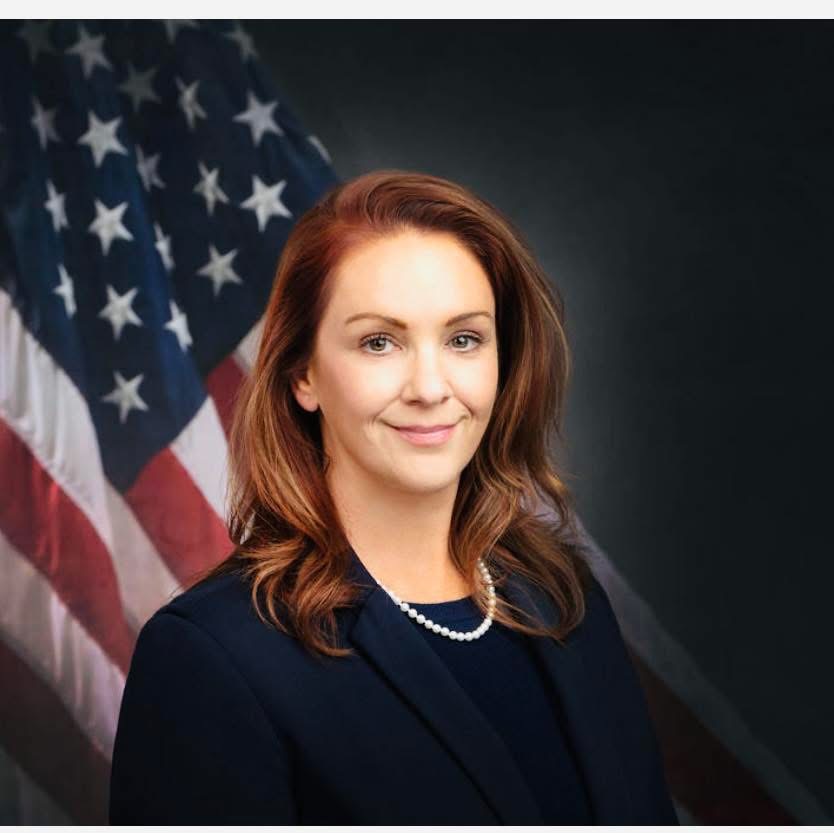
A Harris County public defender who narrowly lost her primary race for a judicial seat will be on the November ballot for a different criminal court following a late Tuesday vote by Democratic precinct chairs.
Democrats tapped Katie Wilson, a former prosecutor in Colorado, to be the party’s nominee for the 486th District Court in November. The felony court seat opened in May after a Republican judge, Aaron Burdette, announced he was resigning to pursue private practice.
READ MORE: A Harris County judge was absent from court for most of 2026. She’s still earning nearly $218,000.
Burdette’s departure triggered a new election for his court in the packed midterms — and a rare opportunity for party precinct chairs, not voters, to select a judicial candidate.
Article continues below this ad
Burdette stepped down after the March primaries, when voters selected Republican and Democratic candidates to compete in the November general election. Texas election law requires precinct chairs to select a nominee for an unexpired term that falls between the primary and general elections.
Former judge Aaron Burdette is shown in the 486th District Court on Friday, March 20, 2026, before his resignation in May.
Raquel Natalicchio/Houston Chronicle
Precinct chairs carried out the same type of vote in 2024 to choose a nominee to replace U.S. Rep. Sheila Jackson Lee following her death. Former mayor Sylvester Turner, who later died in office, was chosen.
MORE COVERAGE: ‘It’s been an honor’: Harris County Judge Aaron Burdette resigns from criminal court bench
Article continues below this ad
Gov. Greg Abbott, who initially appointed Burdette before he won the court in 2024, has not appointed anyone to fill Burdette’s spot. Republican precinct chairs are expected to pick Wilson’s challenger next month in a similar process.
‘A poorly run meeting’
Tuesday’s voting process took place over Zoom after Democratic leaders canceled an in-person meeting at the Wheeler Avenue Baptist Church in Third Ward following concerns over rain and potential flooding in the Houston area.
When precinct chairs started logging on around 5 p.m., some expressed relief that they didn’t have to drive anywhere even as blue skies and sunshine could be seen over some parts of Houston. One precinct chair could be seen drinking a glass of wine.
The vote didn’t happen until four hours later, near the end of a meeting marked by delays and complaints about transparency.
Article continues below this ad
Officials spent half that time trying to figure out who was a precinct chair and who wasn’t out of more than 600 participants on the call. That number declined as the night dragged on. Around 180 observers marked as non-voting members, including several elected judges, were repeatedly booted from the Zoom so precinct chairs could be isolated and their votes on several matters could be counted.
One precinct chair, Cameron Campbell, said he missed the vote because his iPad died and it took too long to get back on the Zoom call.
Wilson and the other candidates were given two minutes to make their case.
Wilson sat in front of a computer with her daughter, mother and the family dog behind her as she declared that the jail has become a mental health facility. She expressed concern that some defendants may be accepting plea agreements, not because they’re guilty but “because that plea is their ticket to get out of jail.”
READ MORE: A Houston lawyer spoke out on a judge’s viral outburst. Can the judge force him to appear in court?
Article continues below this ad
“That plea has lifelong permanent consequences,” said Wilson, who specializes in defending people with mental health issues.
Wilson defeated Carvana Cloud, an associate judge for the city of Houston’s Municipal Courts Department, with 58% of the vote in a runoff. The other candidates included criminal defense attorneys Juan Aguirre, Cynthia Rayfield-Aguilar and Allison Mathis, as well as a prosecutor, Michael Abner.
A second prosecutor, Joseph Sanchez, was interviewed ahead of the vote, but he wasn’t nominated in time to be considered. He blamed logistical problems caused by party organizers and their use of teleconferencing.
“I did not just lose the nomination last night for the 486th District Court, I was never even given the chance to be considered or the chance to be heard due to a poorly run meeting that occurred virtually on Zoom, and due to a reductive child-like application of Robert’s Rules of Order,” Sanchez said in a Facebook post.
The Harris County Criminal Justice Center is photographed in Houston, Friday, Feb. 13, 2026.
Raquel Natalicchio/Houston Chronicle
Rating the candidates
Harris County Democratic Party chair Traci Gibson, who was elected in March, said the meeting had a quorum of precinct chairs to proceed with the vote, but she did not respond to the Houston Chronicle’s request for comment on how many precinct chairs voted.
Article continues below this ad
The precinct chairs were given a June 12 memorandum with a roster of seven candidates who were scored by two to three criminal defense attorneys on topics ranging from legal knowledge, judicial temperament and Democratic commitment.
“The person we nominate will preside over serious violent offenses, make bail and bond decisions that affect public safety, manage hundreds of pending cases, and do all of it under public scrutiny and political pressure,” Gibson’s memo read.
MORE COVERAGE: After mounting criticism and mysterious calls, this ousted judge is asking voters for second chance
Wilson scored the highest, followed by Cloud and then Mathis, according to the memo.
Gibson told precinct chairs in a May 28 email that at least five stakeholders from Houston’s legal system, including the Harris County District Attorney’s Office, would participate in the screening.
A representative from District Attorney Sean Teare’s office was asked to participate, but that participation never happened due to “scheduling constraints,” said Damali Keith, a spokesperson for Teare.
An ‘opaque’ process?
Gibson’s office did not identify the screeners who rated the candidates, even when asked by the Chronicle in the days leading up to the vote or when pressed by at least one precinct chair during the meeting.
The candidates, however, identified their screeners as criminal defense attorneys Justin Harris, Andrew Salinas and Genesis Draper, a former misdemeanor judge who leads the Harris County Public Defenders’ Office, where Wilson works.
Draper did not participate in Wilson’s screening, Wilson said.
Of the three screeners, only Salinas previously worked as a prosecutor — for one year in New York City, according to his LinkedIn account. Gibson, a former Harris County prosecutor who left the office in 2022 after two years, observed the interviews, but she did not score the candidates.
A precinct chair, Alan Guttman, characterized the process as “opaque” ahead of the vote.
Gibson disagreed and said the screening was optional. The alternative, she said, was to do nothing at all and let precinct chairs nominate and vote on candidates without any intel to know whether that candidate was qualified.
“You had many weeks to research candidates, candidates had many weeks to campaign, and therefore you can make decisions about what you want to do with your vote,” Gibson said.
When reached by phone, Harris said he and other screeners signed a non-disclosure agreement and could not discuss the interview process further other than to say “nothing nefarious” happened.
A separate group, the Houston Progressive Caucus, held their own interview process for the candidates for precinct chairs to also consider.
One of the interviewers, former 14th Court of Appeals justice Meagan Hassan, said she and the other screeners did not sign confidentiality agreements.