
WASHINGTON, June 18, 2026: The U.S. Supreme Court is expected to rule on birthright citizenship as early as today as its current term nears its end. There are 20 matters the Court is expected to rule on. Among them includes the issue of birthright citizenship. Donald Trump issued an Executive Order on the first day of his second term that prohibits federal agencies from recognizing U.S. citizenship for children born in the country to parents that are is not citizens or permanent residents. Under Trump’s order, at least one parent must be a U.S. citizen or permanent resident for the child to be considered a citizen.

The Fourteenth Amendment, ratified in 1868, guarantees U.S. citizenship on anyone born within the borders of the United States without regard to the citizenship status of the parents. The Amendment makes the U.S. one of 35 countries that offers unconditional citizenship by birth. Other countries offer birth citizenship with various limits. Most of the countries that allow unrestricted citizenship by birth are in the Americas.
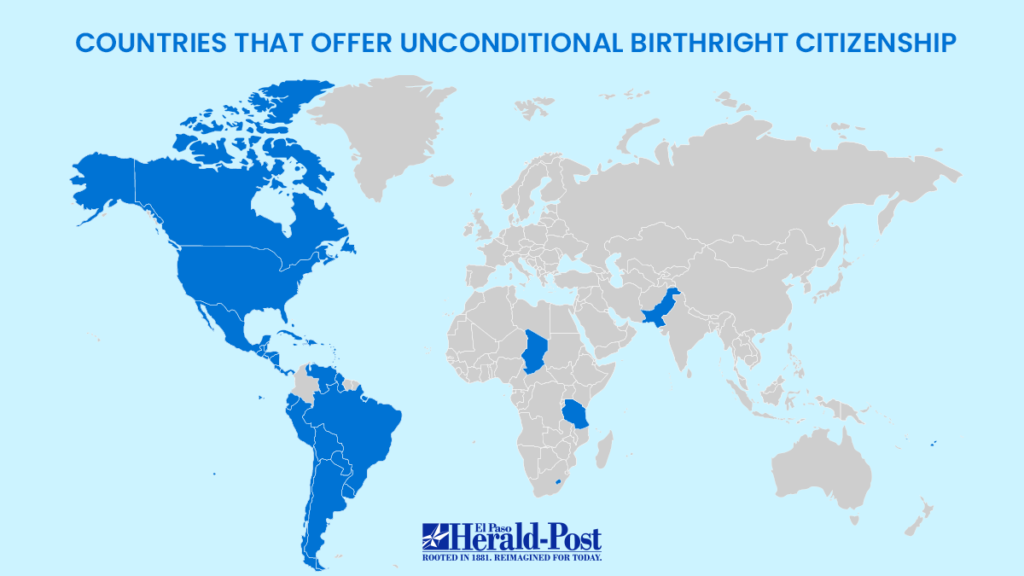 Map of countries that offer unconditional birthright citizenship as of June 15, 2026, Martín Paredes/El Paso Herald Post.
In addition to jus solis (right of soil) that children born in the country receive U.S. citizenship, children born to at least one U.S. citizen irrespective of where they are born also receive U.S. citizenship through what is known as jus sanguinis (right of blood).
Those opposed to birthright citizenship argue that the phrase “subject to the jurisdiction thereof” does not apply to parents who are temporarily in the country, including those visiting the country or being undocumented. Proponents of birthright argue that the Fourteenth Amendment explicitly conveys U.S. citizenship to those born within the boundaries of the country. The practice enjoys long-standing legal precedent.
Ending the Fourteenth Amendment would require Congress to pass an amendment that would then need to be ratified by thirty-eight states, if Congress is able to pass the legislation with two-third votes in the House and the Senate.
An April Reuters/Ipsos poll found that 64% of Americans polled opposed ending birthright citizenship.
The Supreme Court has addressed U.S. citizenship numerous times before, including the 1804 Murray v. The Charming Betsy case where the Court affirmed that Jared Shattuck was a U.S. citizen even though he lived outside of the country most of his life.
In 1884, the Court found in Elk v. Wilkins that Native Americans were not extended U.S. citizenship because they “were not subject to the jurisdiction” of the U.S. The ruling said that because American Indians who were born on tribal land owed their allegiance to their tribe, they were not under the jurisdiction of the U.S. and therefore did not qualify for birthright citizenship.
The exclusion of American Indians from citizenship was eliminated in 1924 through the Indian Citizenship Act of 1924.
Citizenship by birth was affirmed by the Court in the 1898 United States v. Wong Kim Ark where the Court affirmed that although Wong Kim Ark’s parents were not citizens, Wong Kim Ark was a citizen because of his birth in California. The ruling affirmed that anyone born in the country was a citizen regardless of ancestry, color or race.
Notwithstanding the Court ruling, federal officials again jailed Wong Kim Ark when he entered the U.S. through El Paso from Juárez in October 1901. Immigration officials in the U.S. kept him in jail for four months until he could again prove his citizenship.
Immigration with Wong Kim Ark did not end there. His eldest son was deported in 1910 after an immigration panel ruled that Wong Kim Ark did not prove the son was legitimately his. But his children’s attempts to enter the U.S. as citizens did not end there. In 1924, his third son was admitted as a citizen after the son appealed the ruling that he was not a U.S. citizen. His second son was also admitted in 1925 as a citizen. Both children were ruled citizens even though they were born outside of the country but were children of Wong Kim Ark, a citizen the Supreme Court had ruled by name as a citizen after he was detained in El Paso.
Many expect the ruling to keep the birthright citizenship doctrine intact. However, because the case is related to the power of lower courts to issue nationwide blocks, the Court’s ruling may be too broad to show that birthright remains intact.
Other Matters Before the Court
Among the other 20 pending matters before the Court, include whether the president has the power to remove the head of independent agencies established by Congress. The case stems from Trump’s attempt to fire the head of the Federal Reserve’s Board of Governors, Lisa Cook, last August. Cook remains in place after a lower court ruled that she can keep her office while the challenge of her firing makes its way through the court system.
In immigration-related cases, the Court may issue a ruling on whether Trump can end protections against the deportation for Haitians and Syrians, and if the federal government can impose limits on asylum seekers by lining the border to block their entry into the U.S. A lower court ruling requires the federal government to process asylum seekers who present themselves at the border. The Trump administration wants the Court to rule that the federal government can limit access to asylum seekers.
On the election front, the Court may issue a ruling on whether mail-in ballots that arrive within five days of Election Day can be counted. Republicans are asking the Court to reject grace periods for late ballots. The Republicans also want the Court to end limits on the amount a political party can spend in coordination with candidates running for office. Currently political parties are limited on how much they can spend on the candidate’s behalf if they coordinate the expense on campaign expenses like advertising.
Gun rights, transgender athletes and cancer claims are also on the docket. The Court does not notify the public ahead of time of when it will release a ruling on a pending matter.
We will continue to monitor the birthright ruling and report as new information becomes available.
Like Us and Follow Us On Our Social Media!
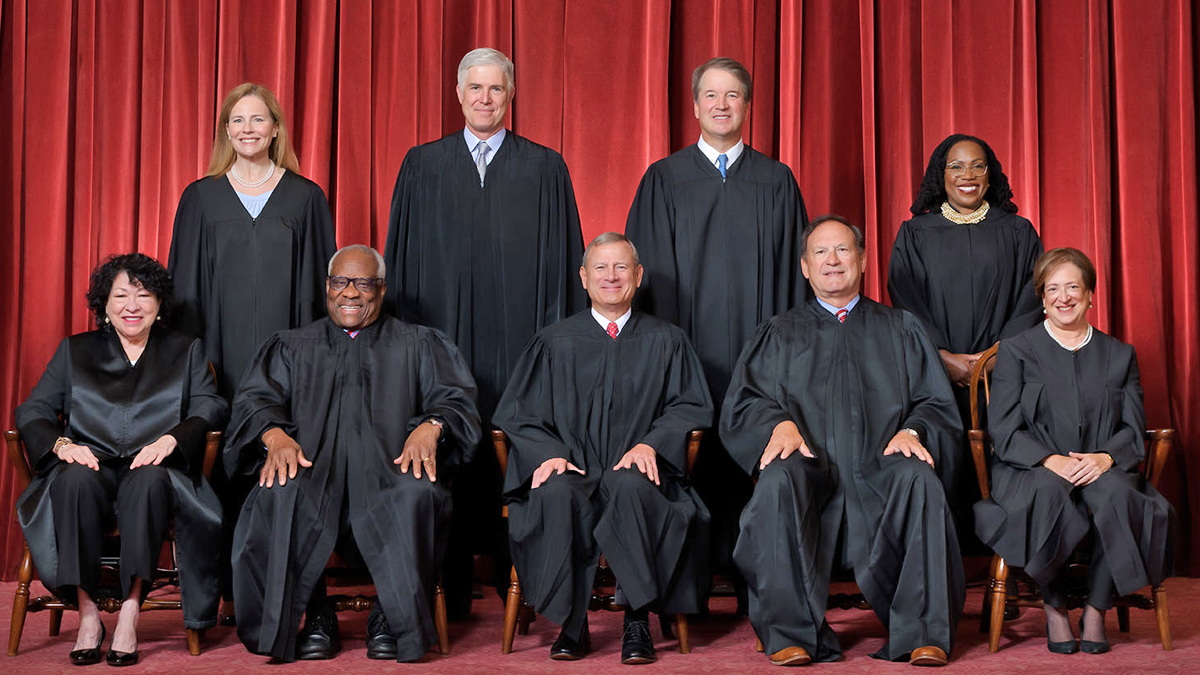
Cover photograph: Fred Schilling, Collection of the Supreme Court of the United States, June 30, 2022. Front row, left to right: Associate Justice Sonia Sotomayor, Associate Justice Clarence Thomas, Chief Justice John G. Roberts, Jr., Associate Justice Samuel A. Alito, Jr., and Associate Justice Elena Kagan. Back row, left to right: Associate Justice Amy Coney Barrett, Associate Justice Neil M. Gorsuch, Associate Justice Brett M. Kavanaugh, and Associate Justice Ketanji Brown Jackson.