
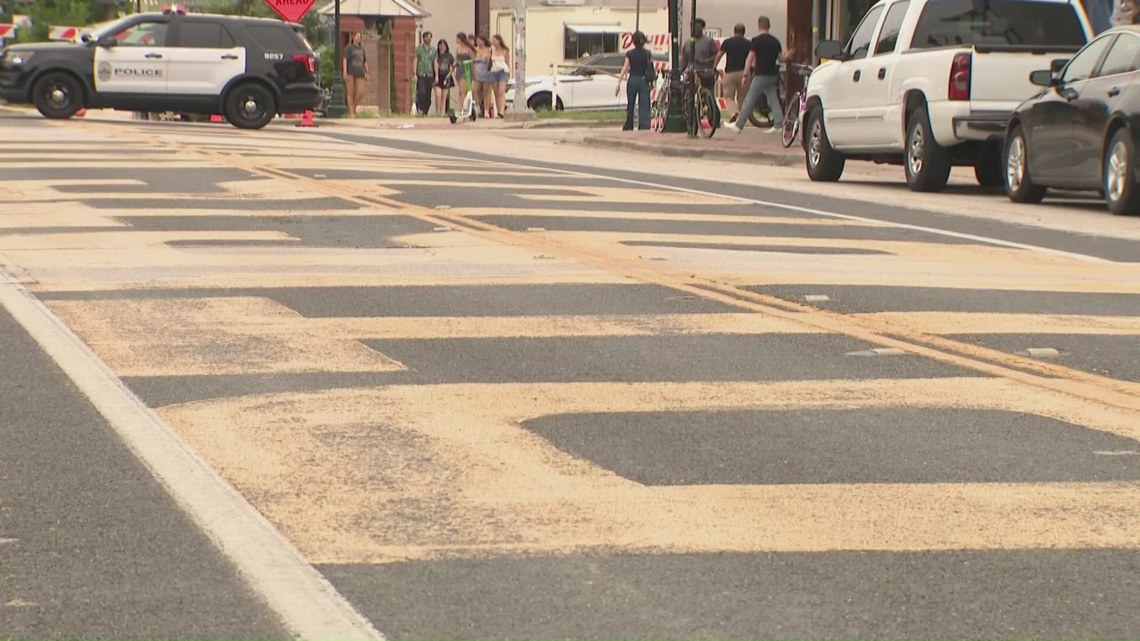
Under a state directive, the city has to get rid of the road display or risk losing state funding.
AUSTIN, Texas — City leaders and advocates gathered Friday to celebrate a display honoring the work of artists of color in Austin before it disappears.
The mural on East 11th Street is among six works of street art the Texas Department of Transportation (TxDOT) has ordered the city remove. The other works include the Pride crosswalks downtown and the burnt orange “TEXAS” on Guadalupe Street in front of the University of Texas at Austin campus.

This story continues below.
More in Politics
Austin celebrates display that honors the work of artists of color ahead of removal
The gathering to celebrate what this mural stands for took place as Americans celebrate Juneteenth. It marks the day in 1865 when Union troops announced freedom for enslaved people in Galveston.
“That’s a day that all Americans ought to celebrate and ought to use as an opportunity to remind ourselves that we’re all in this together,” Austin Mayor Kirk Watson said. “We need to recognize that our country still has a sustained history when it comes to the way African Americans have been and are treated, even today.”
Back in October, TxDOT told cities and counties to remove decorative crosswalks, murals, or messages that don’t serve a traffic or safety purpose. TxDOT said several of the city’s painted crosswalks and street murals are “not acceptable” under state and federal rules on road markings.
It’s a special day for us because we can use it as an opportunity to remind ourselves that actions that are used to celebrate our diversity and to lift up the creative talents of the African American community some people would put under attack,” Watson said. “The edict to take up markings on the street was done, I think, to create sadness and some division.”
Local artists painted a “Black Artists Matter” mural in large, yellow letters down East 11th Street between Waller and Lydia streets in 2020, amid a nationwide movement for social justice.
“It’s unfortunate that here we are in 2026, and we’re still being reminded about the kind of sadness that some people want to bring to people,” Watson said. “We’re still reminded of our stained history in this country that you pray, and you wish we were past, but actions like requiring this to be pulled up showed that we’re not past it.”
The message was painted on the road to support and acknowledge local artists of color and their contributions to Austin’s character.
“The African-American community has contributed so much to our city and to then come in and say you got to take that up when it’s really only a positive, there’s nothing negative about this,” Watson said. “I think it was done to try to demean people and to cater to people that discriminate.”
Capitol View Arts and the Austin Justice Coalition (AJC) chose the East 11th Street location because of its history as the heart of the African American community in East Austin.
“This is the heart and soul of what has been traditionally the African-American business district,” Watson said. “That’s why this spot was chosen, as it calls attention to our history, and it celebrates what our future ought to be.”
The district where the mural is located is the only African-American cultural district in the State of Texas.
“It’s important because when they see it, they recognize that they’re in the cultural heritage district. For so many years and even now, we don’t have any real wayfinding, wayfinding signage,” Six Square CEO Daphne McDole said. “So, if you moved here from California or some other state, you don’t even know that you’re in the district. So, this was a strong message about like placemaking, where you are, that helps people identify that this is what it was.”
TxDOT has framed the decision as a safety issue because of the need for “uniformity and predictability” in road markings. Gov. Greg Abbott issued an order in October 2025 instructing the removal of roadway displays that didn’t serve a safety function. He said taxpayer money should not be used to “advance political agendas on Texas roadways.”
TxDOT also cited a separate federal directive, “SAFE ROADS Initiative,” which was launched by U.S. Transportation Secretary Sean P. Duffy in July 2025 “to prioritize investments that improve mobility and safety on roadways,” according to the U.S. Department of Transportation’s Federal Highway Administration.
TxDOT denied the city’s request to allow the decorative crosswalks and street artwork to remain in place.
TxDOT said the city must provide a removal time frame and action plan by Monday, June 22, and Austin leaders said they plan to comply.
Mayor Watson said he isn’t happy about removing the murals, but the city did not have much of a choice.
Failure to do so could lead to the “withholding or denial” of state or federal transportation funds and threaten the suspension of agreements with Austin for things such as road maintenance, utility relocations for highway projects and a $25 million boardwalk on Lady Bird Lake.
While the city intends to comply with the directive to avoid jeopardizing millions in state and federal transportation grants, it will also explore alternative ways to celebrate Austin’s diversity.
“We’re coming up with different things to do that won’t be in any violation of any state or federal law but go ahead and celebrate our love for our diversity in Austin, Texas,” Watson said. “They may do these kinds of things, but we’re going to find ways to continue to celebrate our diversity. This, in my mind, a block party here in the heart of the traditional and historic African American cultural district is a great way to celebrate Juneteenth.”
In April, Watson formed a task force composed of members from various city commissions to identify creative solutions that align with state and federal guidelines.
“We didn’t want to look at this as a compliance issue from a city. We wanted to look at this as a cultural and art opportunity for us,” Steven Rivas, Chair of the Mayor’s Public Spaces Task Force, said. “These are public spaces. So if we’re going to remove a public space, or any public space, it would only make sense for 22 of us to come together to figure out what we can replace that with and make it better in the future.”
The city’s Public Spaces Task Force (PSTF) considered implementing similar designs on wall murals, sidewalks, and in economic districts.
Rivas said they evaluated many options for East 11th Street. However, many are long-term projects, such as creating a wrought iron entrance gate behind East to West, like the one on the West to East side, improvements to the cultural district, and new ways to feature African American Austinites and historical community members prominently.
“They are possibilities with public-private partnerships,” Rivas said.
They recently took down the 150th anniversary banners celebrating Huston-Tillotson University and Ebenezer Third Baptist Church, two of East Austin’s oldest and most revered foundational Black institutions.
“You’re going to see the whole big rollout. There’s going to be new banners on 11th Street now that all the lights are on,” McDole said. “We’ve already hired Rex Hamilton. He’s a new artist that will do the new iteration of banners that will speak to the black artist on the lamppost.”
Friday’s celebration marked the end of the road marking on East 11th Street, but the removal is the start of new ways to honor what it stands for.
“It is a celebration because it will be reimagined and it will be replaced, and we aren’t going anywhere,” McDole said. “We intend to remain in the cultural heritage district that we created, and we were relegated to live here in 1928. So why would we leave?”
This weekend, the city is also celebrating the rainbow crosswalks at Fourth and Colorado streets, which will also soon be removed.
A new mural is being installed between Colorado and Lavaca streets.
The city is inviting Austinites to come out and help finish painting that piece on Saturday starting at 4 p.m.
TxDOT allowed Austin to address three locations by “installing curbing and other improvements,” and will let three artworks, including “Fairy Alley” between Treadwell and Dexter Streets and two crosswalks decorated by children, fade away.