
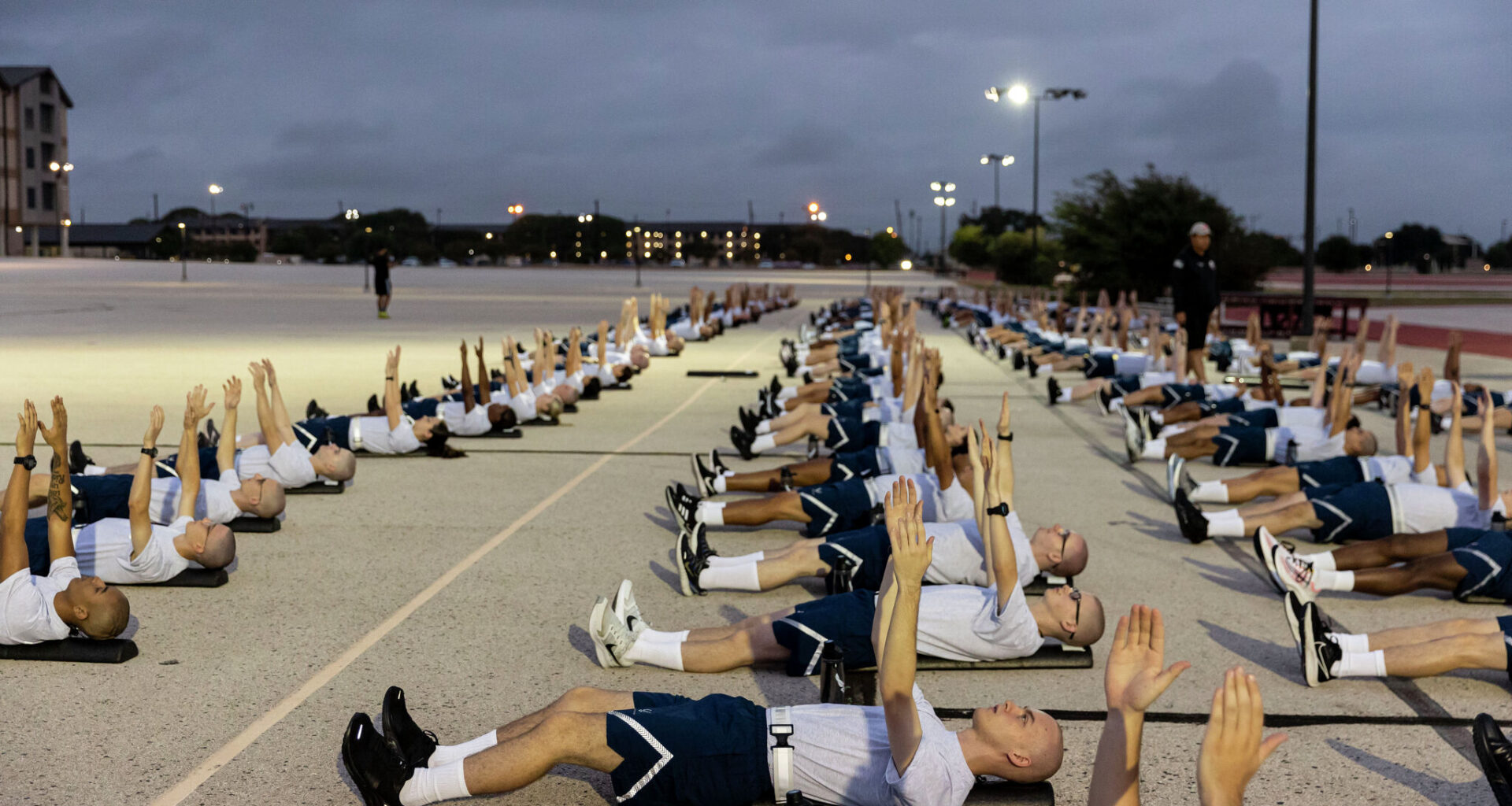
Recruits in basic training perform exercises at Lackland Air Force Base in San Antonio. Lackland, the hub of Air Force basic training, is experiencing a flu outbreak.
File/San Antonio Express-News
A flu outbreak at Joint Base San Antonio is sickening more recruits, with the number topping 200 according to U.S. Rep. Joaquin Castro.

The Air Force has yet to release any numbers but Castro said 222 recruits in basic training had fallen ill as of Thursday. Initial reports had said that up to 160 recruits were sickened in a flu outbreak that began three weeks ago.
Article continues below this ad
The outbreak comes two months after Defense Secretary Pete Hegseth made flu vaccines optional for troops in the armed services, including those entering basic training.
One recruit died Tuesday, days after being admitted to Brooke Army Medical Center, but the Pentagon has not said if he presented symptoms for the flu.
“The Air Force told my office there are now 222 flu cases as of yesterday,” Castro, D-San Antonio, said Friday on Twitter in response to the San Antonio Express-News. “We need answers.”
The Air Force, however, has been tight-lipped about the outbreak, saying nothing about it for weeks until the New York Times broke a story reporting that 160 recruits had fallen ill since Hegseth made flu vaccines optional.
Article continues below this ad
Recruits at Lackland, home of Air Force basic training, are typically required to receive vaccinations for a variety of viruses in their first week of boot camp. But in an April 20 memo, Hegseth said annual influenza vaccines no longer would be mandatory for military personnel.
In a video released April 21, he declared, “The War Department is once again restoring freedom to our Joint Force.”
RELATED: Flu outbreak strikes recruits in basic training at Lackland Air Force Base
“Under the disastrous Biden administration, this Pentagon waged an unrelenting war on our warriors on many fronts,” Hegseth said in the video, using a phrase that was part of the title of a book he authored prior to becoming defense secretary, “including when it came to denying them simple medical autonomy and the freedom to express their religious convictions.
Article continues below this ad
“In other words, our men and women in uniform were forced to choose between their conscience and their country.”
A Lackland spokeswoman, Angelina Casarez, confirmed the outbreak Thursday but did not say how many recruits had fallen ill. The New York Times reported that 160 were sick, and ABC News said the number was 159.
A source familiar with the Air Force’s response to the outbreak confirmed Castro’s account, saying 222 was accurate as of last week.
The outbreak started roughly six weeks after Hegseth issued the policy.
Article continues below this ad
Asked who had contracted the flu, Casarez said, “Right now, they’re looking at trainees in basic military training.”
A recruit in his sixth week of basic training at Lackland died Tuesday after experiencing “a medical emergency” four days earlier, but the Air Force has yet to say if it was related to the flu. The cause is under investigation.
The trainee, identified as Keon McDaniel, was taken to Brooke Army Medical Center, where he died days later.
“A comprehensive medical review is being conducted to determine the facts,” the Air Force said.
Article continues below this ad
The United States military has required its troops to receive mandatory inoculations since the Revolutionary War, when smallpox threatened to decimate the Continental Army. In more recent times, the Pentagon made vaccinations mandatory during the COVID-19 pandemic, which led to 7.1 million deaths worldwide, according to the World Health Organization, and 1.1 million deaths in the United States. It stands as the worst American pandemic in a century.
Defense Secretary Lloyd Austin sparked controversy when he mandated COVID-19 vaccinations for all troops, prompting some to say they would quit before complying, but most troops submitted to the order even as some expressed qualms over how quickly the vaccine had been produced.
“Most vaccines are tested for a few years or just a little bit longer than this one was, and how fast they pushed it out initially made me nervous because we hadn’t seen the long-term effects of the vaccine yet,” Illinois National Guard Pvt. Ethan Mudd told the Express-News in 2021, adding he was worried about the long-range effects.
RELATED: Masked and made over: Amid COVID’s fog of war, Air Force basic training never stopped
Article continues below this ad
Service members who refused to be vaccinated were forced to leave the military. Hegseth led the charge to allow them to return to service after Donald Trump became president.
Lackland’s response during COVID-19 was credited by the Centers for Disease Control with preventing a shutdown in basic military training, where recruits sleep in close quarters, march a foot or so apart from each other and do physical training inches from others. They eat four to a table in dining halls that dot the base.
In the 13 months after March 17, 2020, when a dramatically new way of basic training dubbed “masks and makeover” took effect, about 2,100 recruits tested positive for the virus. It delayed but didn’t stop them from being among the 35,382 who graduated, a number roughly comparable to the 37,000 who were trained in the 2019 pre-pandemic fiscal year.
The Air Force’s current surgeon general, Lt. Gen. John DeGoes, developed the program with the commander of the Air Education and Training Command, Lt. Gen. Marshall “Brad” Webb.
Article continues below this ad
Years before, around 2007, basic training endured a breakout of adenovirus 14, a malady called “boot camp flu” because it struck recruits who were living and working in close quarters — often those in initial military indoctrination. The Express-News reported in February 2012 that months earlier the Air Force gave trainees two vaccines that had fallen into disuse but were revived.
They had been given to troops in basic training from 1971 until 1999, and during that time four trainees died of adeno-related causes, military scientists reported. Eight died from 1999 to 2010.
RELATED: Vaccines countering viral illnesses at Lackland
The vaccines cut upper respiratory illnesses with fever by 87 percent. Such illnesses typically cause cold symptoms but can also trigger pneumonia.
Article continues below this ad
The vaccines for adenovirus 4 and 7 were reported working nationwide. Found safe in tests at JBSA-Fort Sam Houston, they had been given to more than 48,000 Army, Navy, Air Force, Marine Corps and Coast Guard recruits.
Adenovirus has long been a scourge of basic training at Lackland and other bases. As of 2012, at least 52 adenoviruses had sickened 15,000 trainees throughout the military per year over the past decade. One virus, serotype 14, was linked to the deaths of two airmen in San Antonio in 2007 and 2009.
Since the Army began giving the vaccines at nine training camps in October, all services reported a 75 percent reduction in upper respiratory illnesses.
In a turning point, the number of airmen sick with adeno 4 plummeted since the base began giving the vaccines Nov. 9, 2012. The number testing positive for adeno 4 fell from 88 that month to zero in January.
Article continues below this ad
A rash of illnesses came to light in 2007, when Lackland trainee Paige Renee Villers died at Wilford Hall Medical Center. She was among the airmen hit by adeno 14, which puts tired and stressed victims at risk of pneumonia.
More than half of 1,147 respiratory infections with fever that year were positive for adeno 14, causing 66 airmen to come down with pneumonia.
“It’s a very big success looking at the numbers now,” Air Force Maj. Kevin Fajardo said of the vaccines for adenovirus 4 and 7.
Article continues below this ad