
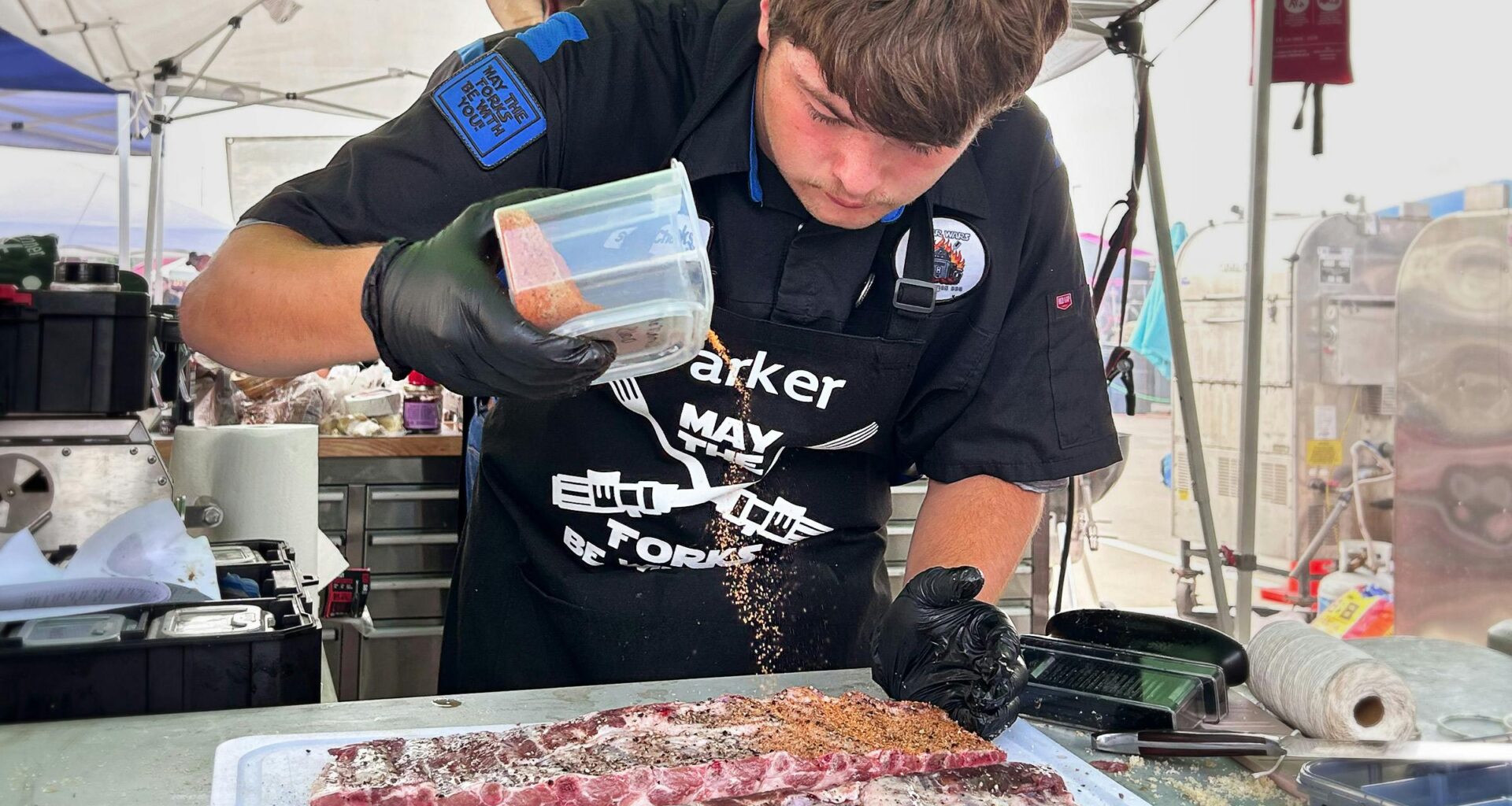
Last Tuesday, smoke rose over a sea of pop-up tents in the parking lot of the Scheels sporting goods store in the Colony. By midday in the north Dallas suburb, the temperature was nearing 100 degrees, and the teenagers in the tents were sweating over grills and smokers. They represented some 110 teams vying for glory at the finals of the National High School BBQ Association.
“This is sort of an odd thing to do, but I really like it,” said Bri, one of four girls on the Ember Valkyries barbecue team, from Bryan High School. The Valkyries finished thirteenth at the state championship, and their small patch of concrete, cordoned off with caution tape, was the model of efficiency. On one side was a trailer for storage, prep work, and constructing the turn-in boxes, and on the other side was a drum smoker, a charcoal grill, a propane griddle, and a direct-heat grill with a hot Dutch oven resting on top. High schools and middle schools from seven states competed that day, and as you might guess, Texas was well represented.
Denton High’s Bronco BBQ Gold team was set up next to its Bronco BBQ Purple team. Schools with robust programs often have multiple teams competing in the finals. Shawn Eagle, a former barbecue-joint owner and a culinary-arts teacher, leads Denton High’s barbecue teams and a more informal barbecue club for students looking to learn about barbecue regions, woods, smokers, and cooking times and temperatures. Eagle said he recruits from the club to “beef up the barbecue team.”
Eagle introduced me to Hayden, a rising senior and leader on the barbecue team. Last month, at the state championship, Hayden’s ribeye steak took third place. At the national competition, ribeye was one of six required entries for every team, and alongside pork ribs, it’s been a staple at every contest. This year, students also submitted grilled cheese sandwiches, chicken legs, desserts made in a cast-iron skillet, and pork shoulders. Hayden spent plenty of time perfecting his method. “If I went through my camera roll, I’d probably have two pictures every week just of steaks,” Hayden said. His family still enjoys eating them despite the repetition. I asked if he planned to stick with the barbecue team for his final year in high school. “This is like my therapy,” he said. “I’ve gotta stay with it.”
The day began at five thirty in the morning, when students started their prep work. At seven came the mad dash for raw meat, which was supplied by the competition as part of the $400 entry fee. Ribs, steaks, pork butts, and packages of chicken legs were all laid out on a series of tables pushed together, resembling a floating barge of meat. Then the teams were allowed to light their grills and smokers (no gas or electric allowed). They had three hours to complete their first category, which was grilled cheese.
Kevin Gros coaches the Char Wars team from James Madison High School, in San Antonio. He calls team member Sebastian, who recently graduated, “the Grilled Cheese King of South Texas.” He made several of his grilled Brie sandwiches on marble rye before choosing two to place inside the foil-lined Styrofoam box for the judges. The walk from the parking lot to the second floor inside Scheels, where the turn-in table was located, could be treacherous, so another member of the team acted as a spotter. I got a bite of the third-best grilled cheese from Sebastian, and it was indeed worthy of royalty.
Gros has entered multiple barbecue competitions himself, including American Royal last year. He isn’t employed by the school, and he coaches the team on his own time. His son, Parker, is also on the team, and they are joined by Karter, whose specialty is chicken legs, and dessert whiz Gianna, who baked more than thirty versions of her bananas Foster upside-down cake this season. Teams can be as large as five members and as small as two. Char Wars worked with the minimum during one competition earlier this year, but that was unusual, Gros said. “The four of them have really come together and put a neat chemistry together,” he explained.
Madison High School is a bit of a powerhouse, with four separate teams at nationals this year. In 2024, its all-girls MEAT Militia took home the championship in Branson, Missouri, while two other teams from the school finished third and sixth overall. A Madison team won third place at nationals in Kansas last year. Gros and his fellow coaches were hoping to repeat the school’s triumphs while back on home turf in Texas and were all hoping to best the other teams in their own school. “This is for super bragging rights,” Gros said.
There are two high school barbecue leagues in Texas: TX High School BBQ, which formed in 2018 and only includes Texas schools; and the national High School BBQ league, which debuted in 2019. Teams are invited to nationals based on their performance in their respective state championships. Not all qualifiers can afford to make the trip to nationals, so the league opens it up to wild card teams. None of the teams I interviewed said they received any financial support, besides the entry fee, from their school districts. “Everything in these contests is pretty much on your own,” Gros said.
Across from his team sat the Texas state champions, Lanier FFA, from Navarro Early College High School, in Austin. Chorizo was the star of their grilled cheese, which also contained toasted corn-tortilla dust, cilantro, and onions, along with Oaxaca, Muenster, and smoked-cheddar cheeses on sourdough bread. The team recently cooked for three hundred guests to raise funds to travel to the event.
The expenses can really add up. Gros and his team began setting up on Monday, competed all day Tuesday, and had to wait until Wednesday morning for the results to be announced. That meant two nights minimum in a nearby hotel and travel expenses during the five-hour drive from San Antonio. That doesn’t include all the cooking equipment he has accumulated, nor the seasoning, sauces, wood, and charcoal. It’s no wonder I saw so many sponsor banners hanging up around the competition with logos from local companies, barbecue joints, and seasoning brands.
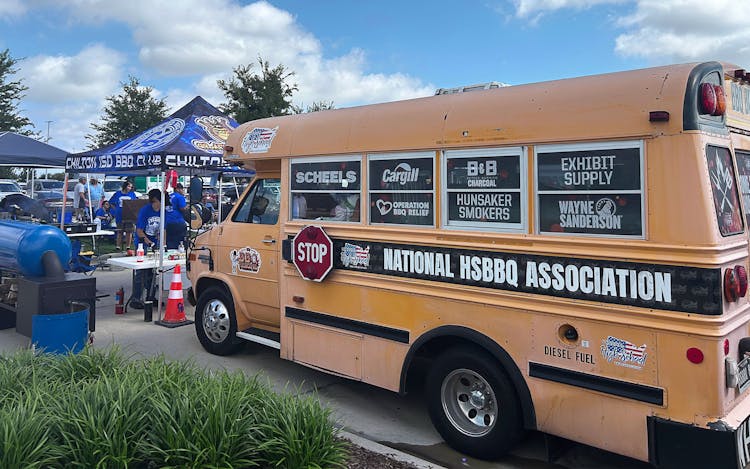 The National High School BBQ Championship, in the Colony. Photograph by Daniel Vaughn
 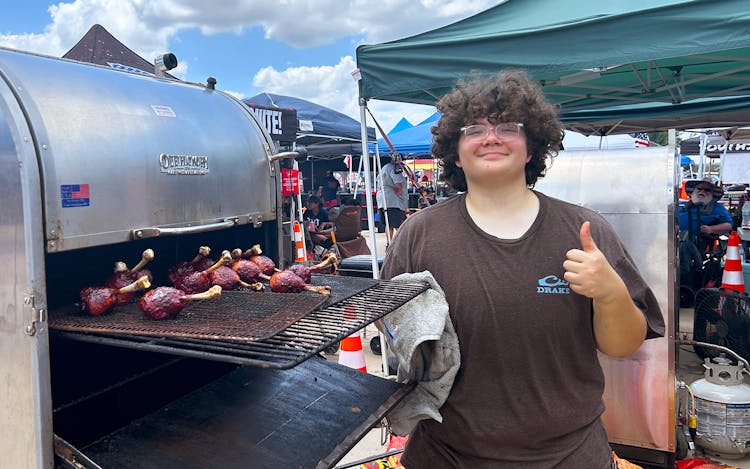 Karter from James Madison High School posing with his chicken legs. Photograph by Daniel Vaughn
Parents and coaches are heavily involved in preparing for these competitions, both financially and educationally. What I was most pleased to see during the competition was student leadership. Yellow tape surrounds every team’s designated space, and coaches are forbidden from entering. Gros carries a laser pointer because he’s not supposed to even reach over the tape to point his finger. I could sense Gros’s frustration a few times when the students would do something different than he wished, but he had to let it go. The students fail and triumph on their own during the competitions.
By one thirty in the afternoon, teams had turned in their grilled cheese, ribeye, and dessert, so the smoke was really rolling as they opened their cookers to check on the chicken legs, due next. I was amazed at just how appetizing every single entry looked. A student from Matthey Middle School called me over by name, which surprised me. Davian, who’s going into eighth grade, is the oldest of his Iron Flame BBQ team. I didn’t recognize him right away, but I had met him and some parents from the team by chance a few weeks earlier at Burnt Bean Co., in Seguin. Co-owner Ernest Servantes hosted the team for a meal, and I noticed them because the numbers on their jerseys were made of sausage links. We took a photo together, and I wished them luck, not knowing they would be competing at this event.
Iron Flame team member Isaiah was wearing an apron instead of a jersey on this day, and he held up a pair of chicken legs proudly before they went into the box for turn-in. It had been more than eight hours since the contest began, and another teammate looked like he was about to fall asleep in his folding chair. The middle schools are only scored against other middle schools, and of the 35 middle school teams at nationals, five of them are from Matthey, including last year’s national championship team, Cardinal Q. “I wish our school would recognize it a little bit better than they do,” team parent James Dacy said. “They don’t recognize that this is a sport.”
Sure, this isn’t football, but these students could go pro sooner than most high school athletes. I watched in awe as Karter from Char Wars put the finishing touches on his chicken legs. He had trimmed the meat from the bone to create a chicken lollipop. I tried the sauce that he blended before he brushed it on the skin, and it was a perfect balance of sweet, acidic, savory, and spicy. Once the legs were finished in the smoker, Karter removed every blemish from the skin with tweezers, covered his tracks with a fine-tipped brush dipped in sauce, and trimmed away any rough edges of skin with small scissors like a surgeon. He carried the box into Scheels as the punishing afternoon heat showed no signs of letting up.
“If you know how to cook, you will never, ever be hungry,” Gros told me. He had intended to teach them independence but had brought up some fine young pitmasters in the process. I had to call it a day before they turned in plates for the final two categories, but I did wait around until Karter returned to the tent, eyeing the chicken lollipops that didn’t make the final cut. He charitably handed me one. I took a bite, and it was some excellent chicken. I cleaned the meat off the bone and silently hoped he would give me another. According to the results, the judges thought sixteen other teenagers made better chicken that day.
The highest score Char Wars received was fourth in the grilled cheese category. They finished twenty-third overall. The highest finish from a Madison team this year was eighth. This year’s grand champion was Grill Central Boys, from San Antonio’s Central Catholic High School, which only started competing last year. Watching all of these students working with meat and fire, the future of barbecue seemed brighter and more secure than ever.
Read Next