
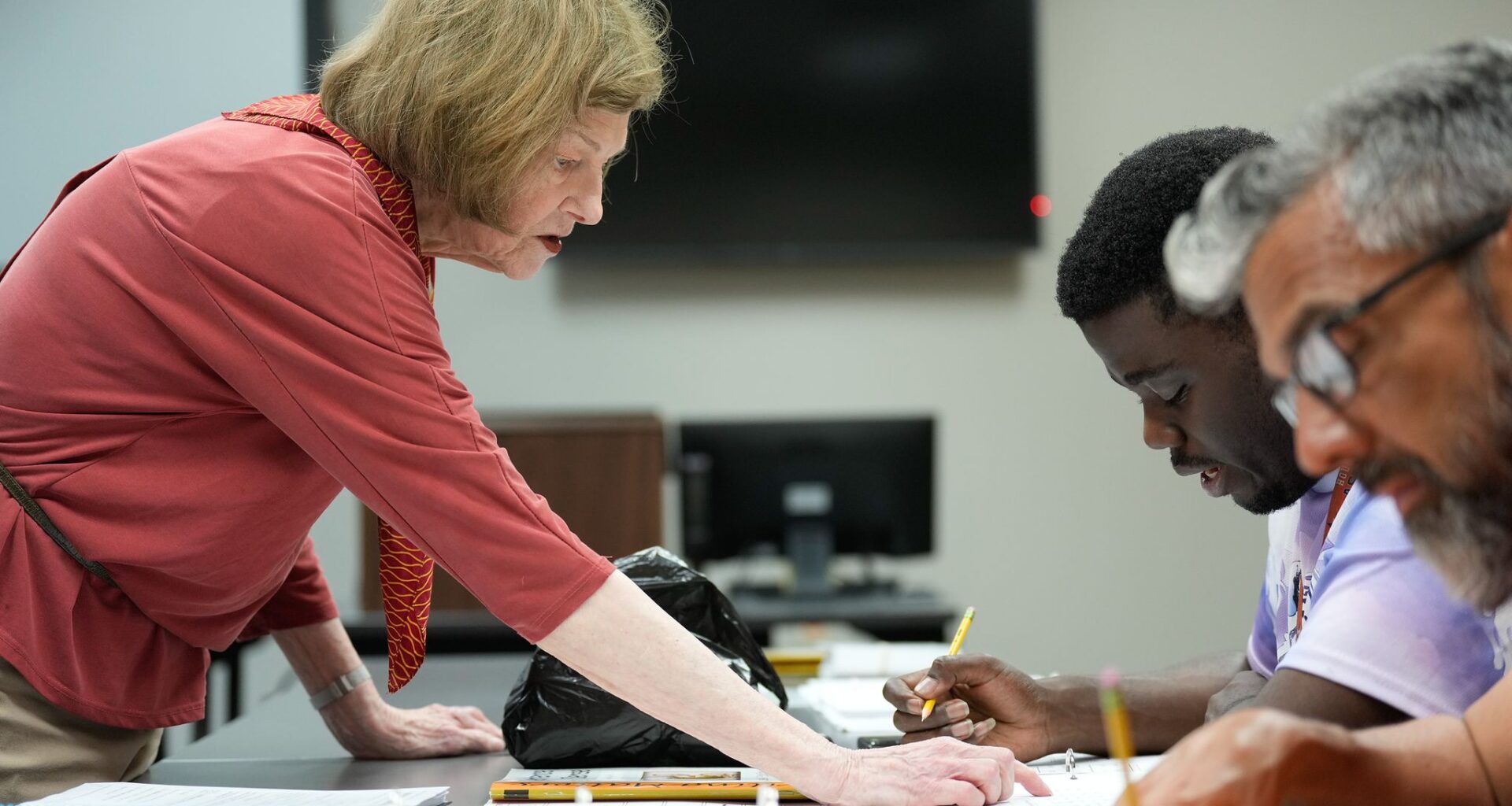
Kay Allen teaches adults how to read at Neuhaus Education Center in Bellaire on Tuesday, June 2, 2026.
Elizabeth Conley/Houston Chronicle
Nick Johns works to break down words in a sentence as he reads out loud to the class during an adult literacy class at the Neuhaus Education Center, Tuesday, Feb. 4, 2025, in Bellaire. The center teaches people ages 16 to 90 how to read and manage their dyslexia.
Jason Fochtman/Staff photographer
Reading instruction Kay Allen works on spelling strategies during an adult literacy classes at the Neuhaus Education Center, Tuesday, Feb. 4, 2025, in Bellaire. The center teaches people ages 16 to 90 how to read and manage their dyslexia.
Jason Fochtman/Staff photographer
Reading instruction Kay Allen discusses spelling strategies for two-syllable words during an adult literacy classes at the Neuhaus Education Center, Tuesday, Feb. 4, 2025, in Bellaire. The center teaches people ages 16 to 90 how to read and manage their dyslexia.
Jason Fochtman/Staff photographer
Kay Allen uses cue cards as she teaches adults how to read at Neuhaus Education Center in Bellaire on Tuesday, June 2, 2026.
Elizabeth Conley/Houston Chronicle
Kay Allen uses cue cards as she teaches adults how to read at Neuhaus Education Center in Bellaire on Tuesday, June 2, 2026.
Elizabeth Conley/Houston Chronicle
A student works on a worksheet during an adult reading class at Neuhaus Education Center in Bellaire on Tuesday, June 2, 2026.
Elizabeth Conley/Houston Chronicle
Kay Allen uses a white board as she teaches adults how to read at Neuhaus Education Center in Bellaire on Tuesday, June 2, 2026.
Elizabeth Conley/Houston Chronicle
Cue cards at Neuhaus Education Center in Bellaire on Tuesday, June 2, 2026.
Elizabeth Conley/Houston Chronicle
John Lozano spent his life learning how to get by without reading.
He developed a series of workarounds in his career as a master carpenter and NASA foreman. Most often, Lozano would snap photos of printed pages and convert the images to sound which he listened to in his earbuds.
Still, he couldn’t do that when filling out job applications in-person, so Lozano figured out that if he skipped questions he couldn’t read, interviewers would ask them again in conversation. He would confidently respond, noting that he had simply forgotten to answer.
Article continues below this ad
“I knew the answers. I just couldn’t read,” he said.
All that has changed in the past four years as Lozano, 61, has taken in-person and virtual reading classes at the Neuhaus Education Center.
DIVE DEEPER: Follow our reporting on the dyslexia crisis in Texas schools
The center has long been known for educating teachers on how to teach children to read. It also offers reading classes for around 90 students, ages 18 and up, including a small group of 16- to 23-year-olds. Most of them have dyslexia. The center also teaches students in other states through its virtual program.
Article continues below this ad
Some adult students attend class so they can read books to their grandchildren. Others want to strengthen their faith by reading the Bible. Some are retired, like Lozano, while others are still working. They all want to finally clear a hurdle they’ve faced most of their lives.
“It’s a real privilege to see people change their lives right before your eyes,” said Kay Allen, a reading instructor at the center.
Allen began teaching at the center when it started in the 1980s. She initially retired in 2000, but returned five years ago to help build the new adult literacy curriculum. The 79-year-old said she enjoys witnessing her students’ progress, partly because she is on the dyslexia continuum herself.
Kay Allen reacts to one of her students reading during an adult reading class at Neuhaus Education Center in Bellaire on Tuesday, June 2, 2026.
Elizabeth Conley/Houston Chronicle
GUIDE: Do you think your child might have dyslexia? Here’s what to know, from signs to resources.
Article continues below this ad
A growing problem
While the school serves dozens of students every year, it chips away at only a small part of Harris County’s growing literacy crisis.
Recent data on adult literacy is limited, but a 2017 national study found that 32% of Harris County adults are functionally illiterate, meaning that at best, adults in the survey could read short texts or complete simple forms, according to Houston’s adult literacy blueprint from 2021.
While there is not more recent data by county, a 2023 national survey found the crisis is worsening. In 2017, 18% of U.S. adults ages 16 to 65 were functionally illiterate. In 2023, that jumped to 28% of U.S. adults surveyed, although the study notes that the test went fully digital, which could have affected scores.
NEWS: Texas has shortchanged students with dyslexia for decades. Will a new law fix the broken system?
Article continues below this ad
Dyslexia undetected
When Lozano was tested and diagnosed with dyslexia at the Neuhaus Education Center, he said it was like the teachers “dropped a bomb” on him.
“I thought I was all right. I could do math and everything and do my job and everything. I thought I was normal, but I just couldn’t read. That was my problem,” he said.
Lozano graduated from high school in Houston, but he said he struggled. Some teachers let him give oral answers on tests instead of writing them down. Still, no one mentioned dyslexia to him, and he never knew much about it. He thought it was more like autism than how the brain decodes words and processes written language.
Reading instructor Kay Allen, right, helps Martha Schang decode a series of words during an adult literacy class at the Neuhaus Education Center, Tuesday, Feb. 4, 2025, in Bellaire. The center teaches people ages 16 to 90 to read and overcome their dyslexia as adults.
Jason Fochtman/Staff photographer
RELATED: More Texas children are being identified with dyslexia than ever before — and so are their parents
Article continues below this ad
Another student, Sharon House, started classes at Neuhaus in the early 2000s, when students had to pay. It became too expensive and she stopped.
When House retired as a public works engineer for the city and as a certified caregiver, she returned to Neuhaus.
House said that growing up, she didn’t know she was dyslexic, because she got good grades in school, and no one ever noticed her struggles with reading. She could always get by well enough, but eventually she left high school before graduating, and instead she got married and started her family soon after.
As an adult, she found it difficult to pronounce unfamiliar words on medication bottles, long “politics words,” or phrases in the Bible.
Thomas Harrison, 66, officially learned he had dyslexia after being tested at the center, but it had already held him back from graduating high school and going to college.
“I didn’t learn how to read while I was in school,” he said. “I went through school kind of pushed aside.”
Even though he couldn’t read, he stayed in school because his parents wanted him to get an education. Harrison said he wasn’t sure if the teachers knew he had dyslexia, or if they just didn’t know how to help him.
“I went all the way through 12th grade until I gave up,” he said.
As a teenager, he became a rodeo athlete to earn a living. Along the way, he relied on family and friends to read things for him, which he resented at times. He now operates heavy machinery for Harris County, which means long, grueling days clearing the roads of debris, especially after heavy rains.
Overcoming obstacles
Older adult students attend night classes twice a week, which can be a challenge with transportation and long workdays.
Harrison said he gets up every morning at daybreak to go to work in Tomball and Spring. After work, he drives to the center, which can take 45 minutes or longer each way. He feels bad when he’s late to class, but Allen is always understanding, he said. Still, sometimes he gets groggy and has to splash water on his face in the bathroom to keep going.
“When you got the desire to learn, you don’t give up, you don’t throw in a towel,” he said. “I don’t care if it takes to be 70 years old before I get good. I’m not going to stop till I get to the level I want to be on.”
ALSO READ: Dual language programs may help Texas’ growing dyslexic population
Some students have taken METROLift, the region’s free transit service for people with disabilities, and several say they wouldn’t be able to attend if the classes weren’t free.
But even with free tuition, transportation and a strong cup of coffee, it can be hard for students to walk through the center’s doors. Many of the adult students at Neuhaus struggled in school growing up, which can make it emotionally challenging to return to classes years later.
“I think the commonality of just having felt so bad about themselves in school, it just breaks all barriers,” Allen said. “They’re all very different, different in ages and backgrounds and ethnicity, but that common bond just makes all the difference.”
Kay Allen goes over a worksheet as she teaches adults how to read at Neuhaus Education Center in Bellaire on Tuesday, June 2, 2026.
Elizabeth Conley/Houston Chronicle
For some students, it means grieving the life they could have had, if they had received intervention and support to manage their dyslexia.
Lozano said one of his goals in life was to serve in the U.S. military. Illiteracy is the reason he never did.
“That was one of the deterrents that I didn’t go join,” Lozano said. “I felt in my heart that they would see me as stupid. And I couldn’t face that.”
But he said the warm atmosphere of the Neuhaus classes helped him open up to learning.
“Starting school that first semester, we were all new, and we were learning … You would kind of be a little bit timid, and try to see how it’s going to work, how people are going to react,” Lozano said. “After a few classes, everybody loosened up. And actually, it became a family.”
ALSO READ: Texas school districts see uneven dyslexia growth under new law. Why?
Seeing results
House, who enrolled to read the Bible better, said she’s figuring out more words. Family, friends and her church group are noticing.
Harrison, the former rodeo athlete, got a promotion after three years of classes at Neuhaus.
“It helped me to be able to overcome a lot of those things (and) accomplish more now,” he said. “I got a better position at my job. I’m able to go to a restaurant and read menus, newspapers, different things.”
He said that it makes him feel like a “better human being” not having to rely on other people.
Kay Allen listens to one of her students during an adult reading class at Neuhaus Education Center in Bellaire on Tuesday, June 2, 2026.
Elizabeth Conley/Houston Chronicle
Lozano called the classes a “miracle.”
Now when he and his wife go to his medical appointments, she doesn’t fill out the forms. He does. (She still checks, just in case.) Lozano said he has made a lot of progress, but he won’t be satisfied until he gets to 100%.
“I’m closer. But I’m not there yet,” Lozano said. “And you have to admit that to yourself.”