
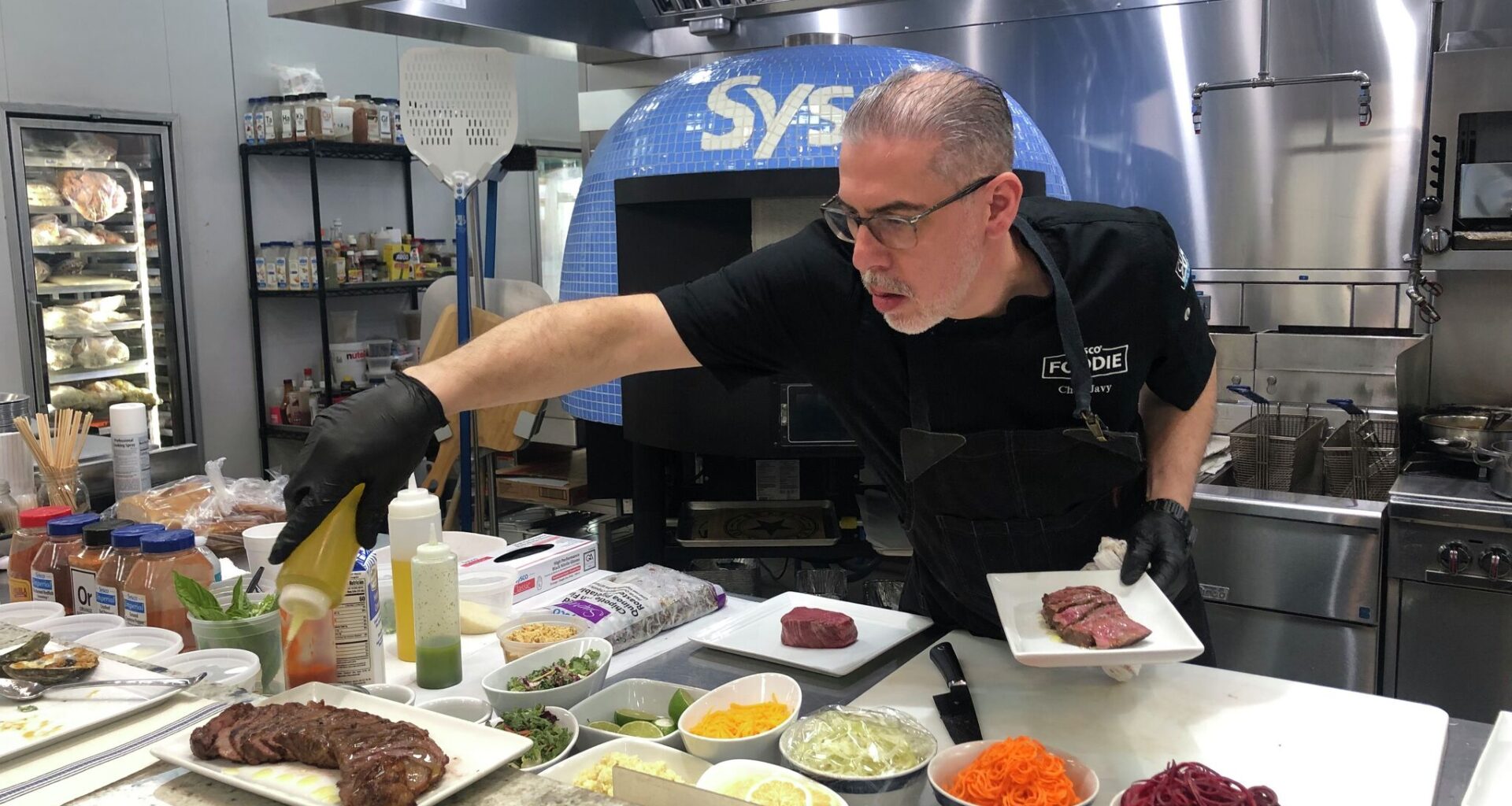
Sysco culinary specialist Javier Lopez prepares a plate of sliced beef tenderloin for a demo session on May 7, 2026, in Houston, Texas.
John-Henry Perera/Chron
On a recent Monday morning, Javier Lopez stood behind the counter in a test kitchen off I-45 in North Houston with chef Ryan Hallsted of Katy restaurant Pearl & Vine. Hallsted had requested a demo session with Lopez, a culinary specialist, to help devise new dishes for his restaurant, plus for an upcoming lunch event. During their 30-minute session, Hallstead and Lopez discussed and sampled plates of glistening tenderloin, ribeye, carpaccio and prawns.

It’s not uncommon for a restaurant chef to seek a culinary specialist for menu ideas, but the difference here is where it was taking place: the nearly 740,000-square-foot campus for Sysco, the multinational corporation based in Houston that dominates food-and-beverage industry distribution worldwide. And Sysco’s test kitchen is an almost Iron Chef-Kitchen Stadium-like spectacle.
Article continues below this ad
A prepared osso bucco on the countertop at Sysco’s culinary test kitchen on May 7, 2026 in Houston, Texas.
John-Henry Perera/Chron
This is a side of Sysco that most people never get to see outside the fleets of trucks dropping off products at restaurants. Founded in 1969 by Waco native John Baugh, Sysco is a major lifeline to the businesses it serves, supplying ingredients and material goods and providing consultation to food service operators. Today Sysco has a market cap of about $38 billion and is fresh off the $29.1 billion acquisition of small-business-focused Restaurant Depot. In other words, it’s the behemoth in an industry that prides itself on small, local and connected. To its critics, which are many in food and beverage, Sysco has become too large and too influential to operate unchecked.
But Sysco’s local executives say its size is actually the point.
The Elephant in the Room
The employee entrance at Sysco’s distribution facility on May 7, 2026, in Houston, Texas.
John-Henry Perera/Chron
The general public got a full taste of Sysco resentment in October 2025 when progressive nonprofit More Perfect Union published The Hidden Reason Why Restaurants Are Getting Worse by Brock Hrehor. In the report, Hrehor noted Sysco had become too central to independent restaurant operations, supplying pre-prepared and pre-made ingredients and meals en masse in a way that’s driving the company’s business model. This has had the effect, according, per the report, of contributing to a kind of sameness across different restaurants and killing unique and creative cooking under the threat of consolidation.
Article continues below this ad
Restaurant owners have been grumbling about Sysco for significantly longer. Rebecca Masson, the owner of Houston’s Fluff Bake Bar said she had been a Sysco customer between 2015 and ’20. The relationship wasn’t immediately cordial, but Mason appreciated the convenience that came with her goods being delivered. But the COVID-19 pandemic shifted everything, she claimed.
A FIFA globe on display in the main lobby of Sysco’s distribution center on May 7, 2026, in Houston, Texas.
John-Henry Perera/Chron
“They did me dirty: Nine days in a row, I was waiting on my truck. My sales rep wouldn’t do s–t,” Masson said. “Long story short, after three weeks of not getting responded to by my sales rep, her boss came. I said, ‘It’s not you, it’s me. I’m done.'”
Article continues below this ad
The experience left Masson with such a sour impression of Sysco that she cut ties with another distributor, European Imports, when the former purchased the latter. “I had to stop using them because I wasn’t going to give Sysco money,” she said.
Masson also happens to be a member of the Independent Restaurant Coalition, a nationwide trade group formed by individual restaurateurs and businesses during the pandemic. Co-founder Erika Polmar counts many among their member rolls, like Masson, who felt “burned” by Sysco’s actions during that period.
“Sysco had decided [independent restaurants] were too small—it wasn’t worth their time to deliver to them,” Polmar said.
A wall of accolades in Sysco’s distribution center lobby on May 7, 2026, in Houston, Texas.
John-Henry Perera/Chron
These days, the IRC’s attention has been directed toward Sysco’s acquisition of Restaurant Depot. Launched by Jerry Cohen in a Queens, N.Y., warehouse in 1990, Restaurant Depot today is a thriving chain of grab-and-go stores tailored toward independent restaurant owners. It sells everything from parchment paper to flatware, from Sternos to high-top tables. The merger awaits regulatory review, and the possibility of it going through, to paraphrase Polmar’ and the IRC, would be a nightmare.
Article continues below this ad
“When one business controls 25 percent of the food supply chain, you’re going to see prices go up because they’ve eaten their competition,” Polmar said. “That affects everybody, whether you’re a Sysco customer or not.”
The View from Inside
The exterior of Sysco’s distribution facility on May 7, 2026, in Houston, Texas.
John-Henry Perera/Chron
I visited Sysco’s Houston distribution campus, and what struck me most during my conversation with Greg Keller, Sysco’s EVP of national sales; Ryan Forth, region president of South Texas; and Ramit Plushnick-Masti, director of external comms, was that they really didn’t deny anything.
Article continues below this ad
Sysco does provide pre-prepared and pre-made ingredients and meals to its customers. Sysco did miss deliveries and cut routes during the pandemic. Sysco is an enormous company.
The trio added, however, that much of what has been said about Sysco is actually a misinterpretation. And they wanted to clarify that Sysco isn’t just in food distribution: they’re in the help-restaurants-succeed business.
A fleet of trucks parked at the Sysco distribution facility on May 7, 2026, in Houston, Texas.
John-Henry Perera/Chron
The beating heart of the company is Sysco’s 5,000-something-strong sales force, which acts as the intermediary between customers and the company’s various products and services. Most of these workers, according to Forth, are former restaurant industry professionals, whether they operated behind or in front of the house. It’s why, internally, Sysco refers to them less as sales reps and more as consultants.
Article continues below this ad
“We call them sales consultants for a reason: We want them to be consultative to help our customers succeed,” Keller said. “Sit down with our customers and understand what is it that they are trying to accomplish in terms of driving guests into their front door, and then how do we tap into the power of Sysco to enable that.”
Inside Sysco’s distribution facility on May 7, 2026, in Houston, Texas.
John-Henry Perera/Chron
Inside Sysco’s culinary test kitchen, I saw that play out in real time. On any given day, Keller said, the test kitchen will accommodate two to four customers, maybe to evolve their menu, or figure out the next culinary trend, or crack the code on how to make their restaurant more profitable. Also, Forth noted, they just want to get out of their restaurants and try something else.
Lopez, the culinary specialist, had previously worked in the kitchens of some noteworthy restaurants, including Brennan’s and Pesce of Houston, and Commander’s Palace of New Orleans. That experience now informs his consultancy in Sysco’s kitchen, wherein he helps brainstorm solutions for visiting clientele. For example: in one restaurant’s case, its next-door neighbor left. Now, the owner wants to build a bar and a grab-and-go area. How do they make that happen?
Article continues below this ad
“You come here and you have your ideas, and I have to make sure that I order properly and show you things properly,” Lopez said. “There’s people that come three times a month because they are waiting for my input.”
The Problem Solver
Ryan Hallstead of Pearl and Vine in Katy, Texas confers with Sysco staff members in the culinary test kitchen on May 7, 2026, in Houston, Texas.
John-Henry Perera/Chron
This is the Sysco the company wants to project outward to the industry, that it’s less “food goes over there” and more of a restaurant and food service problem solver.
Article continues below this ad
Consider that staffing costs have risen since the start of the pandemic. The menus that worked for restaurants before may be too expensive to pull off today. Thus, Sysco would put its business consultancy hat on, offering to help restaurants find room for labor costs by looking at their menus to figure out what to prioritize. And sometimes, per the Sysco team and to call back More Perfect Union’s report, that means frozen foods can be beneficial. Their stance is that Sysco is a helper; to Plushnick-Masti, the criticisms leveled by More Perfect Union are unfair.
Raw and grilled oysters in Sysco’s Culinary Test Kitchen on May 7, 2026, in Houston, Texas.
John-Henry Perera/Chron
“Take, for example, a pizza place. They deliver you the best pizza. They are not going to focus on making the best wings. That’s not where my labor and my resources are going to go. They’re going to go into the pizza,” Plushnick-Masti said.
“Buy something that’s either frozen or half cooked, or you know something that’s going to cut down on the labor, so that they can deliver the thing that’s expected by the consumer, still be flavorful, still be good, but they don’t have to invest their time and resources, and they can focus on that pizza, right?”
Article continues below this ad
According to senior leadership, Sysco’s size is mischaracterized as the elephant in the room. They pointed to areas where they feel Sysco’s size has been a benefit, including in the healthcare industry, and particularly long-term care, where Sysco commands about a 50 percent market share, Keller said. In those kinds of facilities, food is less about trends and what gets customers through the door, and more about nutrition.
“We have a team that literally develops the menus for long-term care facilities,” Keller said. “They’re registered dietitians, they understand the needs of the industry, right? They know the FDA requirements, they know the requirements of the individual operators.”
That scale has also helped cement Sysco’s self-perception as a kind of bridge between local and national. Through its fleet of trucks and 339 distribution centers in 10 countries, a smaller farmer who partners with them can have their products sold in markets they couldn’t have accessed on their own. In El Campo, Greener Pastures Chicken partnered with Sysco to distribute its broiler chicken to other parts of the U.S., the company said.
“You need the middle man,” Plushnick-Masti said. “Can you imagine if every farmer had to have a warehouse and new trucks? How much would your tomatoes cost?”
Article continues below this ad
It Comes Down to Trust
Produce awaiting pickup in Sysco’s massive refrigeration and warehouse facility on May 7, 2026, in Houston, Texas.
John-Henry Perera/Chron
Sysco’s apparent transparency appears to be cold comfort for its critics. They already know that Sysco is a useful and, ultimately, instrumental part of the food service industry. The problem for them comes down to the same thing: Sysco is simply too big, too powerful and too influential to be ignored.
“When there’s this consolidation, you’re taking out the competition. You’re making it harder to innovate,” Polmar said.
Article continues below this ad
The future of Restaurant Depot continues to be a sore point. Sysco’s leadership argues that the perception of the two companies and the deal is wrong. Keller said both companies inhabit two very different markets: Sysco is tailored specifically for 1:1 deliveries and consultation services, while Restaurant Depot is entirely dependent on cash-and-carry. Both segments, according to Keller, carry different customers that don’t typically crossover, though maybe in time successful operators who use Restaurant Depot might be incentivized to “graduate” to Sysco’s model.
A Sysco staff member takes video of the culinary test kitchen on May 7, 2026, in Houston, Texas.
John-Henry Perera/Chron
“Think of food trucks, think of smaller independent restaurants, think of independent restaurants that can’t afford the services of Sysco, and actually make money, so they’re willing to do the work themselves,” Keller said. “We have no intention, zero intention of changing that model, because it’s incredibly successful.”
Polmar isn’t convinced. In fact, she’s seen the opposite.
Article continues below this ad
“We don’t think those are two distinct universes,” Polmar said. “We see people who are Sysco customers, begrudgingly or not, and they still go to Restaurant Depot when a Sysco order is incomplete … they go to RD to get what they need.”
Polmar said some of Sysco’s initial language about the deal has also set off alarm bells about the company’s future plans, in particular the idea that it could become an “omnichannel partner for the foodservices industry.”
“I don’t think it’s good for one company to own s–t ton of other companies. That’s the great thing about America. We have choice,” added Masson.
A red snapper with tags on display at Sysco’s culinary test kitchen on May 7, 2026, in Houston, Texas.
John-Henry Perera/Chron
A giant red snapper, posed on a bed of cubed ice, whole limes and lemons, watched with a blank and lifeless stare the convivial scene around it. Members of the Sysco leadership team were snacking on strips of carpaccio and tenderloin in the back of the Houston facility. Hallsted and Lopez continued to have frank discussions about protein sourcing and spice blends. The chef is getting useful information he can take back to Katy, information that he hopes will boost his business.
Article continues below this ad
That’s the Sysco most people, including many in the food service industry, don’t see. Sysco is a maze of interconnected systems, from sales to distribution to refrigeration and storage to support services. These systems often operate well apart from one another, but they still exist in a kind of codependent tandem, and from an outside perspective held by many, that’s the colossal behemoth threatening to control the means of production so much that there’s no way to escape.
An array of products in Sysco’s culinary test kitchen on May 7, 2026 in Houston, Texas.
John-Henry Perera/Chron
But to Sysco’s loyalists inside the Greens Crossing distribution facility, theirs is a business that helps keep millions of Americans like Hallsted and the potentially thousands he serves weekly surviving and thriving. It’s a schism that, at present, is perhaps impossible to bridge.
By the end of Hallstead and Lopez’s session, plates and platters of their experimentation and discussion were strewn about the kitchen. Hallstead shook Lopez’s hands and walked out the door with his sales consultant. On the way out, Hallstead left Lopez with a final piece of feedback.
Article continues below this ad
“I’ll be back for that osso bucco.”