
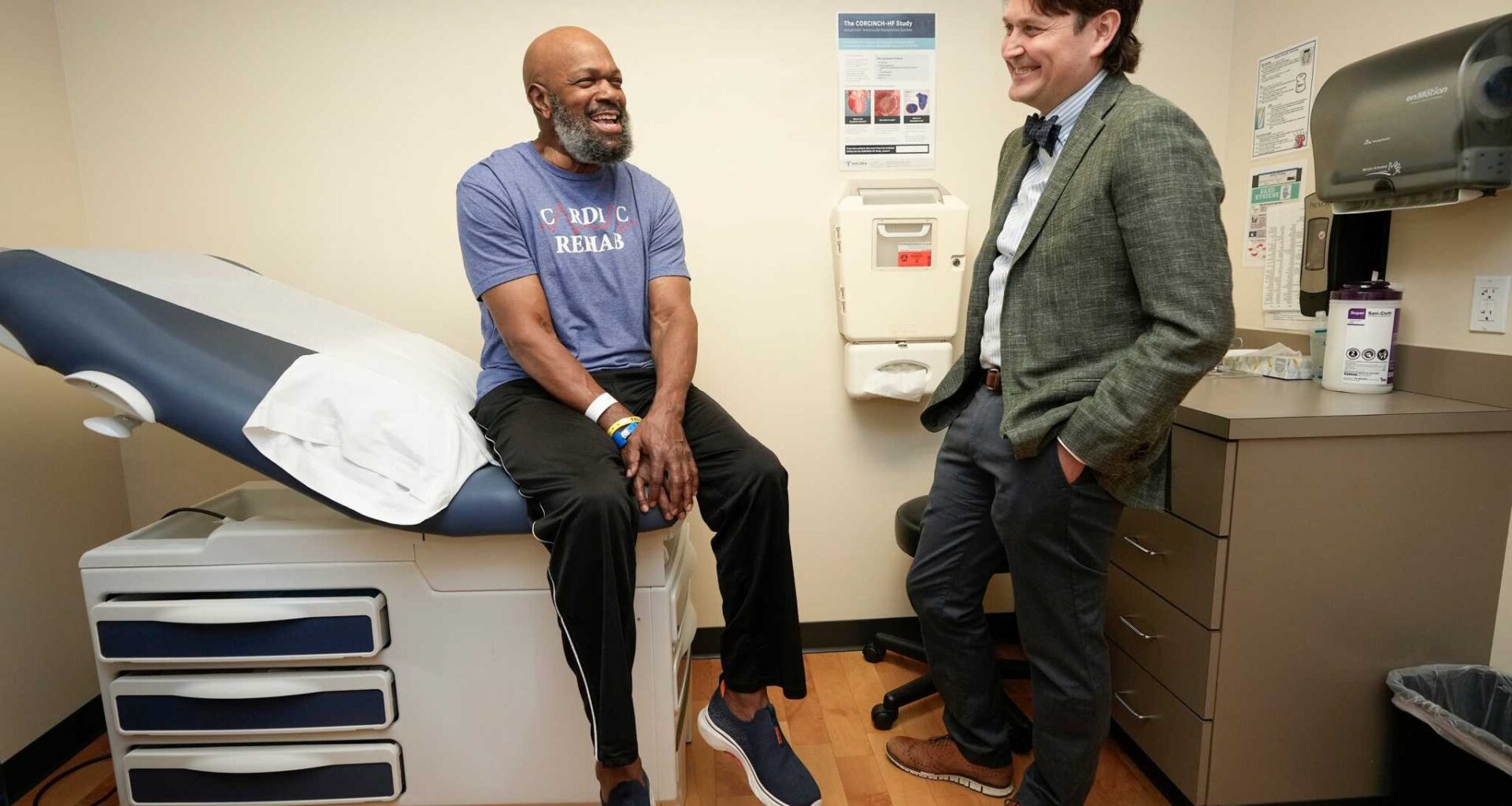
Heart transplant recipient Lenn Catley, left, talks to Dr. Raymond Bietry after Bietry did a checkup on Catley’s new heart at Ascension Seton Medical Center. Catley had a heart transplant in June 2024, that was the first of five heart transplants in Austin during five days last summer. Ascension Seton now has hit 500 heart transplants and 40 years of the heart transplant program.
Jay Janner/American-Statesman
Waiting for a heart is “like walking down a dark road and not knowing what’s coming down the path,” said Lenn Catley, who received a heart transplant at Ascension Seton Medical Center almost two years ago. He was No. 485 for heart transplants at the hospital, which is the only adult heart transplant program in Central Texas.

In 1999, Lemuel Bradshaw got his first heart transplant at age 30 after developing complications from a virus. “I ended up in the ICU scared, angry,” but Dr. David Morris, a cardiologist, was “so patient and calm.” Bradshaw and his newly married-into family had a path forward.
Article continues below this ad
That heart transplant gave Bradshaw the opportunity to see his three daughters grow up and give him 10 grandchildren. “I would not have had the opportunity had it not been for the expertise of this facility,” he said. A second transplant 20 years later continues to allow him to enjoy watching his grandchildren graduate and to talk to people around Central Texas about the importance of both organ and tissue donation.
Last August, on his 38th birthday, Jermaine Fox rang the bell at the transplant center to go home. He described his birthday and receiving his new heart as “everything is like a rush, but it’s like a good rush.”
This year, Ascension Seton Medical Center celebrated 40 years of its heart transplant program in May and its 500th heart transplant in February. Its pediatric partner program celebrated its 50th transplant since its first in 2020.
“We continue to fight to continue to take care of and provide that service here in Austin,” said Dr. Raymond Bietry, medical director of cardiac transplantation at Ascension Texas. “We want to have another 40 years of success here in Austin.”
Article continues below this ad
Before these transplant programs opened, people in Austin who needed a new heart would have to move to Houston or Dallas while they waited for a heart. Now even the most complicated cases can stay in Austin.
In May, the original cardiac surgeons and cardiologists gathered with recipients and their families to celebrate the 40 years of the program, and to begin the next chapter.
Austin resident Twain Schieffer, left, has a good time visiting with cardiologist Dr. David Morris, center, and surgeon Dr. John Oswalt, right, the two who performed his heart transplant surgery in 1988. They had a reunion in 2013, 25 years after his surgery. The program at Ascension Seton Medical Center has now hit 40 years and 500 transplants.
Austin American-Statesman
Starting the program
Forty years ago, “the concept of a heart transplant was daunting,” said Shay Rogillio, a social worker with the program, but the people who built the program have given Austin “40 years of second chances.”
Article continues below this ad
“It is built on the legacy of people who infuse it with life every single day,” she said. “You have pushed the boundaries of medicine, turned the impossible into the routine and given families the greatest gift imaginable more time.”
The original cooler for the first donor heart at Seton Hospital is now in the Daughters of Charity archives in St. Louis.
Provided by Daughters of Charity archives
Before the first transplant on Feb. 2, 1986, Chip Oswalt, John Calhoon, David Morris and Emery Dilling went to the Daughters of Charity, the nuns who ran Seton Medical Center, to ask for permission and funding to start a heart transplant center, so patients would no longer have to be sent to Dallas or Houston.
“It was part of what needed to go on,” Oswalt said. “You put your head down and get to it.”
Article continues below this ad
With permission in hand, the team went to UT Health San Antonio to practice on a dog heart.
At the time, the United Network of Organ Sharing was just getting started and not all transplant centers were connected. Donor hearts often came from patients in the same hospital or the hospital across town, and were transported in a cooler with ice. Oswalt remembers Dilling running up the stairs at the hospital with the first heart in a red and white Igloo cooler.
Emery Dilling carries the first donor heart up the stairs at Seton Hospital on Feb. 2, 1986.
Provided by Daughters of Charity archives
The actual heart transplant isn’t complicated once the patient makes it onto the heart-lung bypass machine. “It’s four sutures,” Oswalt said. “It’s always exciting when you take a cold heart in the operating room and watch it change color and come to life.”
Article continues below this ad
Seeing 40 years and 500 heart transplants “makes my heart swell,” Oswalt said.
Current heart transplant surgeon Dr. William Kessler said, “We are definitely standing on the shoulders of giants.”
How the program has evolved
Today, the hearts still arrive in a cooler with ice, but they are also in specialized fluid that preserves the heart. Donated hearts also can be transported anywhere within a four-hour flight.
Article continues below this ad
The organ-sharing network also provides a sophisticated network to match donor organs to patients. The network that has been criticized for how it ranks patients by race, age and social determinates of health such as accessibility to care, but has provided more opportunities than just waiting for an organ to become available nearby.
The anti-rejection medications and protocols also have become more sophisticated, including using genetic markers to predict rejection earlier, and to tailor the medications.
“We always continue to evolve and change,” said Morris, who was the original cardiologist on the team and now works part time. The program has more staff, including social services to help patients and their families navigate the process.
“Transplant wouldn’t exist without the incredible staff and team that exists throughout … social workers, nurses, front desk, many, many people,” Bietry said. “That’s how this gets done. It does not get done with a couple of physicians putting on their boots and getting it done that day. It takes an incredible team.”
Article continues below this ad
Dr. William Kessler of Ascension Seton Medical Center performs heart transplants at the hospital.
Matt Hooker/Dell Medical School
That team now includes Dell Medical School at the University of Texas. That partnership began in 2016 with the opening of the school and the start in 2022 of the Institute for Cardiovascular Health, which brings together Ascension Texas’ adult and pediatric transplant programs.
When the Seton program began, Kessler said, “we didn’t really have the resources.”
Now with the medical school, the program has “stepped it up a notch,” Kessler said. Now even the most difficult cases are not being sent to Houston or Dallas to wait for a heart. “They are staying put.”
Article continues below this ad
Jermaine Fox rang the heart transplant bell on his birthday on Aug. 7, 2025. The bell signifies he will soon go home.
Nicole Villalpando/American-Statesman
What’s next for the program?
The Austin program is striving to become a Center of Excellence for heart transplants, which means it would be one of the top 10 to 15 centers based on outcomes and the number of transplants it does. The program would need to more than double its transplant numbers from about 10 a year to 20 or 40 a year.
The goal is within reach, Kessler said.
Article continues below this ad
Part of accomplishing that goal is educating more people about the gift of transplant, something heart-recipient Bradshaw tries to do every day. “It is now more than ever increasingly difficult to get people to understand why donation is so important,” Bradshaw said. “Most people don’t get to see crowds like this” — the crowds of recipients and their family members grateful for the gift they were given. “None of us would be alive would if it were not for people who say yes to donation,” Bradshaw said.
Shelley Summers, left, who’s son, Shane Miller, was honored as an organ donor, hugs Lemuel Bradshaw, right, a heart transplant recipient, during the Texas Organ Sharing Alliance’s dedication of Austin’s first “Tree of Life” mural in 2013. Bradshaw has had two heart transplants, 20 years apart, and now goes around Texas talking about the importance of organ and tissue donation.
Rodolfo Gonzalez/Austin American-Statesman
Of his first donor, whom Bradshaw got to know about through the donor’s wife, “what he did let me see things like one of my grandchildren just came home from college.”
Bietry said stories like Bradshaw’s are “key for us in the future to continue to grow. … Without those stories, transplant turns into something our culture doesn’t fully embrace.”
Article continues below this ad
Everyone who has been part of this program, Rogillio said, is here because “ultimate selflessness made all of these miracles possible.”
“Because of everyone in this room, thousands of birthdays have been celebrated, graduations attended and quiet morning coffees enjoyed that might not have been otherwise,” she said.
Ascension Seton Medical Center has expanded since 1986 when it was Seton Hospital.
Sara Diggins/Austin American-Statesman