

The El Paso-Teller County 911 Authority will soon be without its largest entity as Colorado Springs officials opt to depart the agency after 36 years, Mayor Yemi Mobolade announced at a news conference Monday.
Mobolade hopes the departure and establishment of a new city authority will keep an estimated $3.8 million of the $13.1 million that officials believe city residents contribute in phone fees for dispatch services within Colorado Springs, rather than going to services outside of it.
“The money that’s being paid by our residents will stay in Colorado Springs,” Mobolade told reporters at the CSPD Police Operations Center about the gap between what residents pay and the roughly $9 million needed to run the city’s dispatch center.
The mayor’s office informed the Authority of its decision hours before the conference and did not consult with the Authority or its 38-member organizations as of Thursday, a city spokesperson told The Gazette.
Teller County Sheriff Jason Mikesell told The Gazette he learned of the announcement when a Gazette reporter reached out to him after the news conference and described the events unfolding as “sad to watch.”
“None of this has been a discussion with any of the shareholders as part of the El Paso-Teller County 911 Authority,” Mikesell said.
The El Paso-Teller County 911 Authority was not notified of the departure until “shortly before” the news conference on Monday and it would not comment on the change, according to a statement by the agency. A “more comprehensive response” will be sent out after the Authority board discusses the action’s implications during its regularly scheduled meeting on Wednesday.
The Authority was not immediately available to provide comment or verify the estimated allocations to The Gazette. It is unclear how losing an estimated $13.1 million would affect the authority or the two counties, 10 cities, 23 fire protection districts and three military installations that remain in the organization.
Mikesell told The Gazette that 911 dispatch resources around the region will degrade outside of Colorado Springs because of the departure, and he was confused why the city would take this action. He also disputed the city’s claims about the funding they receive, saying they “just want to have all of the funding” and already receive most of it.
A spokesperson with the El Paso County Sheriff’s Office said it had no comment Monday.
 Deputy Police Chief John Koch and Mayor Yemi Mobolade spoke during a press conference that Colorado Springs is proposing to leave the El Paso-Teller County 911 Authority and start a new city authority, as a way of saving money. The press conference was held at the Police Operations Center on Monday, June 22, 2026. (The Gazette, Jerilee Bennett)
Colorado Springs Deputy Fire Chief Tim De Leon and Deputy Police Chief John Koch, in addition to Mobolade, emphasized to The Gazette that the city’s residents should not notice any changes with the departure. Fire departments and protection districts in the county, including those within and around Colorado Springs, would not be affected “at all,” De Leon said.
The El Paso-Teller County 911 Authority, which is based in Colorado Springs, currently collects a $1.35 fee that provides around $20 million toward annual expenditures, including dispatch centers, training and the emergency alert system Peak Alerts.
The savings city officials claim will come from the departure is the difference between the phone fees Colorado Springs residents pay to the Authority and the cost of running CSPD’s dispatch center.
While state law requires all collected funds to be used for dispatch-related items, De Leon said the city could replace the general fund revenue supporting the 911 communications center with the revenue collected by the new authority.
“We’re going to save some money, and we can use that money to reinvest in our public safety services,” Mobolade said. “One of the three things we are potentially pursuing with the cost savings is apparatus.”
Mobolade would not raise the current fee Colorado Springs residents pay toward the 911 authority in a new city-run authority, he told reporters. Authorities across the state charge phone users between $0.70 and $4 monthly, according to the utilities commission.
The Authority currently funds dispatch centers for the CSPD, Cripple Creek Police Department, El Paso County Sheriff’s Office, Fort Carson, Teller County Sheriff’s Office and Woodland Park Police Department. They also ensure those centers operate with the same standards, which can help dispatchers in events like wildfires.
“I have been a member for 10 years as a sheriff and 30 years as a law enforcement officer in the region, and I believe the Authority is the best thing to ever happen to our region,” Mikesell said of the Authority being one of the best in Colorado.
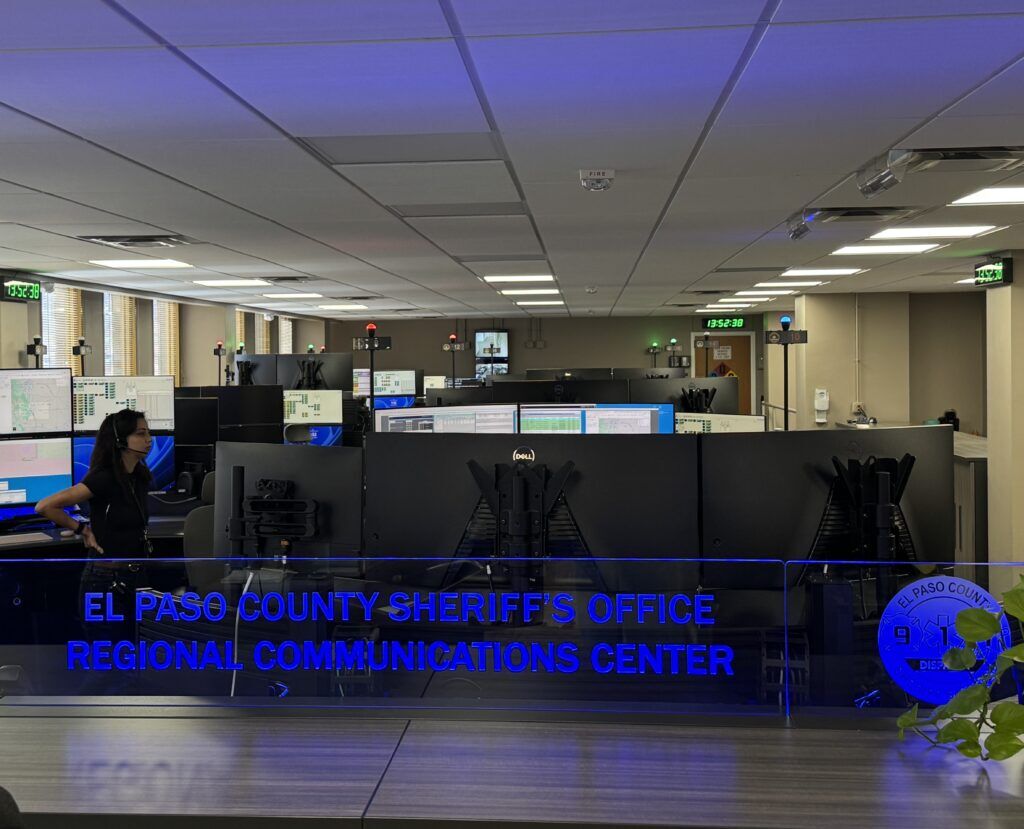 Dispatchers work inside the El Paso County Sheriff’s Office Regional Communications Center after it reopened following renovations to meet a growing demand on Wednesday, Oct. 8, 2025. The center serves eight law enforcement agencies and 20 fire departments in El Paso County, in addition to the Air Force Academy. (Cleo Westin, The Gazette)
The bylaws of the 911 authority grant Mobolade unilateral control over leaving the agency, provided there is 180 days of notice before Jan. 1 of any year, but Mobolade said Monday that a departure date in 2027 is still being determined.
To collect any of the $13.1 million the city believes its residents pay, the Colorado Springs City Council must approve a new 911 services phone fee. If implemented, city residents would only be charged one fee determined by the city council.
Koch, the CSPD deputy chief, told The Gazette their “reasonable estimate” of fees the city could collect came from analyzing the authority’s expenses in its annual budget; an exact number had not yet been determined.
There are no current plans for how to spend that money on additional dispatch expenditures once the city can collect the fees, according to the spokesperson, who described the move as fiscally responsible.
The departure may put the city of Colorado Springs in a transitional period without an authority until the end of 2027, the spokesperson said, leaving the city’s 911 emergency services fee up to the City Council in the interim.
This may force the city to enter temporary contracts for any necessary services provided before the departure, like Peak Alerts, according to Koch and the spokesperson. Although police officials insisted there would be no gaps in service during the transition.
It was not immediately clear whether the City Council would support a measure to establish an authority or if an attempt to rejoin the existing authority was possible, although it would likely require Mobolade’s signature. Councilmembers Nancy Henjum and Roland Rainey were informed about the proposal through their work on the Public Safety Working Committee.
“We will be examining the details, hearing from stakeholders, asking important questions and vetting this change on behalf of our city,” Henjum said at the news conference. “I look forward to that process.”
Colorado Springs could become the fifth city in the state to establish a 911 authority within an existing county authority and the first since 2020, joining Aurora, Federal Heights, Pueblo and Thornton.
Dispatchers with the city of Pueblo, Thornton, Federal Heights and Arapahoe County told The Gazette their working relationships with multiple authorities have been positive, smooth and collaborative, even with separate authorities.
Pueblo and Aurora have always had separate authorities, while Thornton and Federal Heights left Adams County’s authority ADCOM911, in 2004 and 2020, respectively, according to dispatchers.
The Centennial State’s newest authority is in Kiowa County, where it left a joint authority with Bent County and established its own in April 2025.
Colorado Springs has been part of the El Paso-Teller County 911 Authority since its founding agreement in 1989, according to City Council meeting minutes from that year.
The initial intergovernmental agreement at least included El Paso County, Teller County, Manitou Springs and Woodland Park.
The measure faced only one vote of opposition between the Colorado Springs City Council and El Paso County Board of Commissioners, as Commissioner Jim Campbell could not vote for what he described as another form of taxation, according to the board’s meeting minutes.
The initial proposal for the authority’s board was to seat seven board members, but it was increased to nine to give Colorado Springs three total seats on the board.
The city’s current representatives are Koch, De Leon and Deputy Police Chief Jeff Jensen.
For a couple of decades, the authority only collected fees, previously referred to as tariffs, on landline phones. The authority charged a monthly fee of $0.50 from 1992 to 2004, when officials increased it to $0.70, the maximum charge at the time.
The authority evolved in its dispatch communication services in the following decades as cellphones were invented and became widely used. A spokesperson with the authority told The Gazette in 2007 that cellphones were the “biggest nightmare in the 911 world.”
By 2008, the authority had established an automated warning system to ring relevant landlines during incidents like wildfire evacuation notices, according to previous Gazette reporting.
In 2016, the authority unanimously approved raising the fee from $0.70 to up to $1.90 pending approval from the Public Utilities Commission.
The same year, text-to-9-1-1 was launched within the region by the authority, previous reporting by The Gazette shows.
Gazette reporter Brennen Kauffman contributed to this story.
 New 911 dispatchers work at training computers in December 2011 during an emergency medical dispatch class at the El Paso County, Teller County 911 Authority. (The Gazette file)