
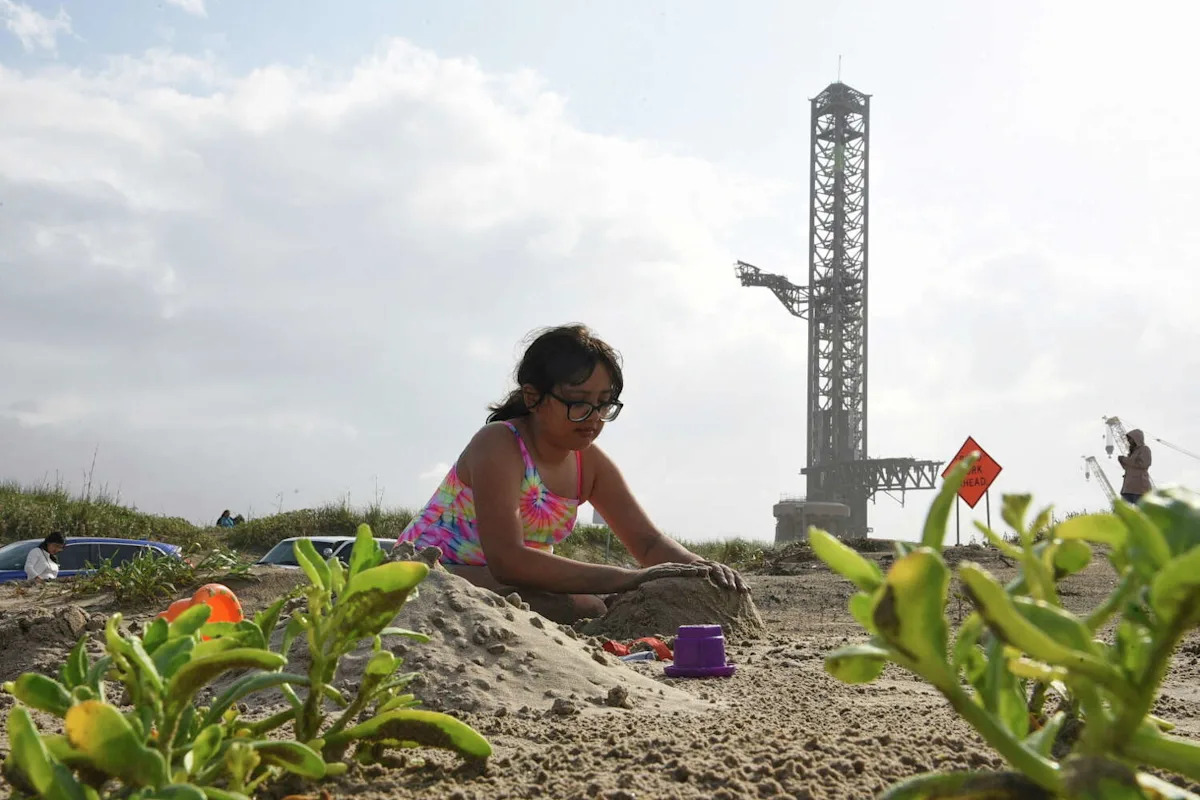
The Texas Supreme Court reinstated the dismissal of a lawsuit from environmental and community groups that sued the government for closing a South Texas beach during SpaceX rocket launches.
The groups argued that the closures conflict with the Texas Constitution, which says the public has an “unrestricted right” to access public beaches. But the Supreme Court supported a trial court’s decision to dismiss the lawsuit, saying a provision in the state constitution bars private parties from bringing lawsuits to enforce that beach-access right.
EXPANSION: SpaceX receives federal approval to develop acres of wetlands for launch pad expansion
Yet the Supreme Court did not answer a key question: Does closing a beach for public safety during rocket launches interfere with Texans’ constitutional rights?
“We express no view on whether the beach closures, or the statutes permitting them, violate the public’s ‘unrestricted’ right,” according to a footnote in the court’s opinion released Friday.
SpaceX is building and testing its Starship rocket outside of Brownsville in a company town called Starbase. Its launch pad sits along a state highway, which is the only way to access Boca Chica Beach.
The company closes this road – and thus the beach – for rocket launches and other activities. Its early flights caused the highway to close for extended periods of time, but documents from the Federal Aviation Administration, which oversees commercial rocket launches, show that SpaceX has learned to reduce how long it closes the road for each launch.
However, the company is hoping to launch Starship more frequently.
“The decision comes as Cameron County, and now the City of Starbase, repeatedly close Boca Chica Beach at SpaceX’s request, handing the public beach to the company to use as a blast zone during rocket launches and related activities,” Save RGV, an environmental advocacy nonprofit and one of the lawsuit’s plaintiffs, said in a news release.
Ultimately, Save RGV said the Supreme Court has left Texans unable to enforce their constitutional right to access public beaches.
“The court’s decision effectively says that only the government can enforce the Open Beaches Amendment – even when it is the government that is violating it,” Marisa Perales, the plaintiffs’ attorney, said in the news release. “The result is a constitutional right that becomes unenforceable whenever government officials choose to disregard it.”
Save RGV first sued the Texas General Land Office, its commissioner and Cameron County in 2021. They argued that a law from 2013, which permitted closing beaches for spaceflight activities, conflicted with a 2009 amendment to the state’s constitution that ensures Texans have an “unrestricted right” to use and access public beaches.
Texas Attorney General Ken Paxton intervened to defend the state law, according to the Supreme Court’s opinion, and the Sierra Club and Carrizo/Comecrudo Nation of Texas joined as plaintiffs.
The trial court in Cameron County dismissed the case because the Texas Constitution’s section on public beaches specifies that it “does not create a private right of enforcement.”
This phrase is unique and not used anywhere else in the Texas Constitution or statutes, according to the Supreme Court’s opinion. The trial court decided it meant that only governmental actors can enforce this section of the constitution – and the Supreme Court agreed, overturning an appeals court’s decision that had allowed the lawsuit to proceed.
Paxton celebrated Friday’s ruling on X, calling it “a major win for innovation and space exploration.”
“Texas law allows for portions of a beach to be secured for Texans’ safety, which is exactly what’s needed to ensure SpaceX has a safe and operational launch site,” Paxton said.
Save RGV, the Sierra Club, the Carrizo/Comecrudo Nation of Texas and their attorneys are “continuing to evaluate the court’s decision and are weighing all available next steps,” Save RGV said in its news release.
Subscribe
There’s more to Houston with the Chronicle. Subscribe today for just 25¢.
This article originally published at Texas Supreme Court dismisses lawsuit over SpaceX beach closures but avoids key question.