

Last week, the NBA’s Dallas Mavericks sued the NHL’s Dallas Stars, then the Stars sued them right back.
Now locked in a complex legal battle over the future of the American Airlines Center, the Victory Park arena both currently call home, the teams will duke it out in the Texas Business Court.
Related

If you’re wondering what that is, you aren’t alone. The Business Court is new, established during Texas’ 2023 legislative session, and its judges weren’t sworn in until Sept. 19, 2024.
Mavericks
Part of Gov. Greg Abbott’s agenda to make Texas the best state for business, the Business Court is specifically designed to handle complex corporate litigation and compete with Delaware’s ubiquitous Chancery Court.
“Just as the Delaware Chancery Court is designed to handle big cases and to move them along quickly, that’s exactly what the Texas Business Court is set up to do,” said Chris Kratovil, a Dykema law firm attorney with experience in the business court.
What is the Texas Business Court?
Delaware’s Chancery Court emerged as the U.S.’s preeminent business court in the early 20th century, and now two-thirds of the Fortune 500, and many other companies, are incorporated in Delaware ― in part to get access to the legal body. This includes both Dallas Sports Group, the Mavericks’ parent company, and DSE Hockey Club, the Stars’ parent company.
Texas is after more incorporations to go alongside the rising number of company headquarters and stock exchange listings, leading to the establishment of its own business court system.
The Texas Business Court is helmed by 10 governor-appointed judges across five divisions, each highly regarded jurists with experience handling major corporate litigation. It is available to companies that do business in Texas, and will only handle cases in which the amount of money in controversy exceeds $5 million.
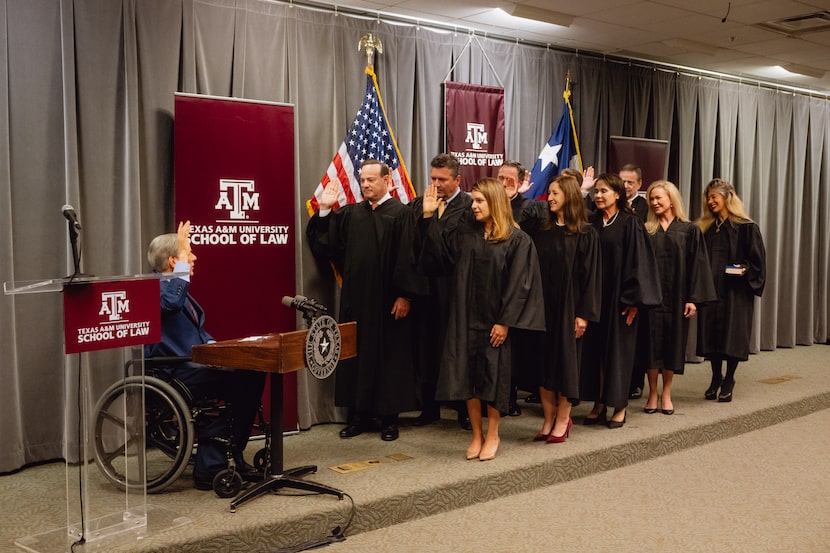
Gov. Greg Abbott swears in newly appointed judges to the Texas Business Court at an official ceremony at Texas A&M University School of Law in Fort Worth on Sept. 19, 2024. Abbott swore in a total of ten justices, two in each Business Court division in San Antonio, Dallas, Fort Worth, Austin and Houston.
Desiree Rios / Special Contributor
While Texas doesn’t have Delaware’s century-old body of case law to draw on, Texas tried to give its court a jumpstart in the most recent legislative session.
Senate Bill 29 codified the “business judgment” rule into law, providing corporations some guidance on how the Business Court will rule. It exists as a legal doctrine that presumes directors of a corporation make decisions in good faith and protects them from certain liabilities in corporate litigation.
Why Business Court and not other courts?
As companies domiciled in Delaware, the Mavericks and Stars technically may have had access to the Chancery Court. However, Kratovil explained there are a variety of likely reasons the Mavericks and Stars chose the Texas Business Court over other available options.
Taking someone to court does involve physical presence, and flying to Delaware would not be convenient for two Texas entities.
Federal court might have been an option, but those are threatened by the government shutdown.
Realistically, the more likely other option for Dallas’ sports teams would have been district court, but that comes with its own set of challenges.
“We have some excellent Dallas County judges, and we have some who aren’t quite as strong and you don’t know what you’re going to get,” Kratovil said. “There’s a much broader range of possible outcomes with who the judge is.”
In addition, those judges have dockets of 1,000 or more cases on average, with disputes ranging from minor fender benders to large wrongful death cases. Getting a case through those courts can take a long time, while Business Court judges have dockets of around 50 cases.
District court judges may or may not have the particular expertise for complex corporate litigation, but what they lack is an abundance of time to dedicate to one particular case. Because of its limited scope, the Business Court is better primed to give careful attention to complex cases, as Mavericks vs. Stars figures to be.
It also essentially has its own expert appellate court, with the establishment of the 15th Court of Appeals.
One quirk of the Business Court is that it has not been given a permanent home in any of its divisions. Therefore, according to Kratovil, judges have had to find creative solutions.
The Mavericks and Stars case has been assigned to Judge Bill Whitehill, who is working out of the mock trial courtroom at SMU’s Dedman School of Law.
Hypothetically, Whitehill would be able to secure other venues should this become a large jury trial, but that has yet to happen in the Business Court.
What this case means for the Business Court
While the Texas Business Court is largely set up for success, it is still very young. It has delivered few actual judgments and has not hosted a full-scale jury trial yet.
Mavericks vs. Stars is by far the highest-profile legal battle to take place in the Business Court. As two not just household names but hometown heroes, the Mavericks and Stars will bring extra attention to the nascent court.
Related

“People who normally have no interest in the court system and the outcome of litigation are going to be watching this case because it could affect their favorite hockey team, could affect their favorite basketball team,” Kratovil said.
As headquarters move to Texas, and companies now have the ability to list on the Texas Stock Exchange, reincorporating in the Lone Star State is the third pillar through which a company can plant Texas roots.
Handling this case well could help legitimize the Texas legal body as the premier venue for corporate litigation and incentivize companies to reincorporate here.
“I think the Business Courts are off to a tremendous start in Texas,” Kratovil said. “The idea is to have predictable, rules-based outcomes, and I think they’re going to be able to deliver that.”
 Betting is changing American sports
The industry is incentivized to foster addiction.
 The private equity rush that could ruin college sports
My firm offers a new way that’s better than the deal Texas A&M just signed.