
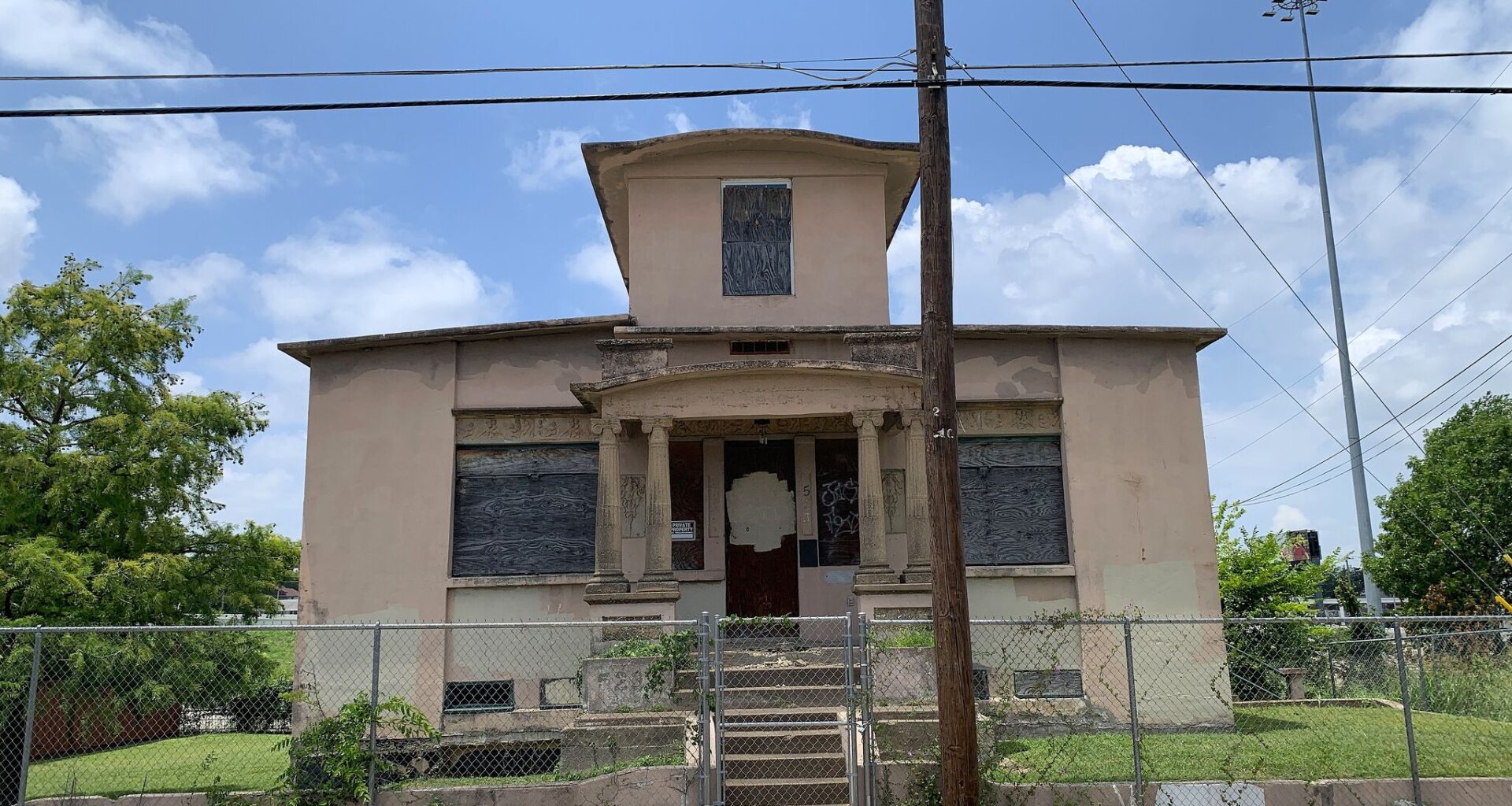
State Sen. Royce West was wondering who was taking pictures of the house next to his Oak Cliff law offices Saturday. And: Why? Uh, well, that was me, I told him Monday morning. Because it’s among the entries on Preservation Dallas’ latest Endangered Places List being released this week.
“List for what?” he asked.
I told him again, then ticked off some of the other places: the 10th Street Historic District, the perennial concern not far from the West & Associates digs on South R.L. Thornton Freeway; the 151-year-old Garvin Cemetery on Northwest Highway, a city landmark yet again being eyed by developers; the former Hotel St. Germain in Uptown, imperiled by a planned high-rise; the crime-ridden Cole Manor Motel on Harry Hines Boulevard, which is more than endangered, as it’s coming down as I type.
And, of course, Dallas City Hall, whose abandonment creeps ever closer with each vote of City Council members who forget they’re but transient occupants.
Article continues below this ad
“That house has been there since 1914,” said West, referring to the manse designed and built by Czechoslovakian immigrant Joseph Kovandovitch. It’s made almost entirely of concrete. One of the city’s first poured concrete houses, actually. Which is why city Landmark Commission designation documents refer to it as — wait for it — The Concrete House.
“It’s not going anywhere,” West said. Then he laughed.
This is the glimpse of the Kovandovitch House most people get as they drive north on Interstate 35E toward downtown Dallas — its backside, which has looked better but, more often, much worse.
Robert Wilonsky/Staff writer
I’ve seen the future of Dallas City Hall. It’s where Eads Street in Oak Cliff dead-ends into vacant land and a thicket of trees, also owned by West, adjacent to the burgeoning Bottom neighborhood. An architectural marvel made entirely of concrete. Indestructible. Meant to last for a few lifetimes. Which it has, despite numerous fires set by the unsheltered and, according to one history, a cult. And boarded up for as long as anyone can remember.
Article continues below this ad
Just one possible glimpse at 1500 Marilla. Depends on the timeline, I guess.
At this suggestion, too, West laughs. “Exactly,” said West, who uses The Concrete House for storage but is beginning to ponder its future. Like everyone who came before him for the last 112 years.
Sarah Crain, executive director of Preservation Dallas, is far less amused by my City Hall comparison. She told me Monday there were some 20 possible candidates for this year’s most-endangered list. It got so long that there was a second – a “watch list” – which includes the Majestic Theater, which the city is hoping to privatize, and the Belmont Hotel, now shuttered for as long as it was reopened.
“I’ll be candid with you: The work of preservation in Dallas is the hardest it’s been since its inception in the 1970s,” Crain said. “The problem is, Dallas is choosing not to have vision and choosing to prioritize developer interests over cultural needs.”
Which, come on, has been Dallas’ motto ever since John Neely Bryan first rolled into town.
Article continues below this ad
There’s a hole in the side of the chain-link fence surrounding the house, through which people have tried to gain entrance to the boarded-up Concrete House.
Robert Wilonsky/Staff writer
“The problem with The Concrete House and most of the buildings on this list is that their owners have had every opportunity to repair them over time,” Crain said, “and what’s most disappointing is that most of these buildings end up rotting away.”
This certainly isn’t the first time The Concrete House, which has enjoyed landmark status for 30 years, has landed on a most-imperiled list: In the summer of 1977, D included it among Dallas “Landmarks That Should Be Saved,” alongside the Cedars’ Sullivan House, now part of Old City Park, and the Shepherd King mansion that’s now The Mansion on Turtle Creek.
“The house stands vacant except for the derelicts who hang out their wash on its colonnade and scurry away when anyone approaches,” Joe Holley wrote back then. “The interior is light and airy and has a fine view of the Dallas skyline. It would be perfect as an artist’s studio.”
In 2014, shortly after West bought the house, the Old Oak Cliff Conservation League added it to its list of “architecture at risk.” At the time, West told my former colleague Roy Appleton that he bought the house – its highway-facing backside then slathered in graffiti – because it was “detracting from my business.” Said the state senator 12 years ago, “It’s blighted, and something has to be done. I have a sizable investment with my building.”
Article continues below this ad
West told the paper back then he had no idea what the future held for The Concrete House. He also knew little of its backstory, which began with Kovandovitch’s dream of building a temple that he hoped “would stand forever,” according to designation documents, “an idea reinforced by his belief in reincarnation.”
Well, that would explain the frieze of winged angels hovering over the front entrance.
Joseph Kovandovitch, a restaurant owner who may or may not have intended his concrete house to serve as a temple for his eventual resurrection, adorned his house with cherubs.
Robert Wilonsky/Staff writer
Kovandovitch, who emigrated to Dallas when he was 15 in 1887, owned the downtown Eagle Café until his retirement in 1920. Which is to say, he wasn’t an architect, though he might well have been “a mystic/philosopher,” according to one architect who tried rehabbing the house.
His inexperience didn’t stop the Czech from dipping his toes in the concrete: According to the late historian Frances James, he built the city’s first all-concrete house on Ross Avenue in 1907 — “a prototype,” per designation docs, that was essentially an add-on to his wood-frame house. It was razed in 1972.
Article continues below this ad
The restaurateur went all-in seven years later with his Italian villa-like temple, concrete walls and concrete columns and a concrete roof almost two inches thick, on what was then a cliff of northern Oak Cliff — so chosen, his family once said, because the Czech “wanted to watch Dallas grow.” But he didn’t last there long, choosing to move back to Ross to be near the restaurant.
According to Mary Beth Dunning, who prepared the designation documents for the Landmark Commission in 1987, the house’s next occupant was “a recluse named Eddie Osnient,” who for years lived “without electricity, water, plumbing and cooking facilities” until he landed in a nursing home.
Next came architect Jess Epps Jr., a native of Oak Cliff and a Navy sniper who bought the house in the mid-1980s. Right about the time the city tried to demolish the house. After it had caught fire. Again.
If and when Joseph Kovandovitch is resurrected, he’ll either be surprised to see his house boarded up or still standing at all. Maybe one day we will find out.
Robert Wilonsky/Staff writer
By the spring of 1987, preservationists were convinced the house was all but doomed. Ruthmary White, chair of the Landmark Commission, begged Epps to make “every effort … to preserve this most important and unique element of our city’s history.” Even the state’s senior architectural historian weighed in with a letter to city officials, calling it “a real rarity as a cast concrete residence” that had been neglected yet remained intact.
Article continues below this ad
Epps eventually fell ill, abandoned the rehab and moved to Houston, where he lived to be 94.
Robert Bazan also tried to make a go of it: He finally got the house made a Dallas landmark in 1996. But his ownership came to an end with his death in 2007 at the age of 41. Bazan’s brother Charles, who died at 58 in 2020, was the man who sold it to West.
West told me Monday his son Roddrick, an architect formerly at HKS (and the man best known for wanting to plant soccer fields under Interstate 345), will eventually oversee the redo of The Concrete House. “When, I can’t say,” West said. Because he doesn’t know.
Of this much he is sure: The land upon which the house sits only grows more valuable with each new house being built in the Bottom, with the burgeoning redevelopment of the old Oak Farms Dairy site, with the opening of Halperin Park less than a mile away.
“We’re beginning to see more and more urban renewal development in this area, so it’s just a matter of time before we do something with it,” West said. “Right now we’re just trying to maintain it. It’s not falling down. And it’s not going anywhere.” A pause. Then, sternly, with great emphasis: “It’s not endangered.”