
Texas community festivals often come with highly bedecked local royalty. This extravagant regalia belongs to the Texas Citrus Festival in Mission.
Bullock Texas State History Museum
This is the kind of assignment we like.

When Kathryn Siefker, senior curator at the Bullock Texas State History Museum, envisioned the current playful exhibit, “Texas Festivals,” she urged the museum’s employees to fan out across the state.
Article continues below this ad
“Find your favorite festivals,” Siefker told them. “Report back whatever you see.”
In Texas small towns and big cities, they noted a giant concrete pecan (Seguin), a trophy for spitting watermelon seeds (Luling), a neon strawberry festival sign (Poteet), a fat-headed onion mascot (Weslaco), as well as models for Priscilla the Pig from the Hogeye Festival (Elgin) and Big Jake from the Texas State Forest Festival (Lufkin).
Article continues below this ad
What might surprise some visitors to the show, which runs through Sept. 27, are the displays of sparkling regalia designed for festival royalty: crowns, scepters, sashes, robes, trains, costume jewelry and more. Locally chosen kings, queens and royal courts were — and in many cases, still are — key parts of community festivals. Traced to agricultural fairs and pageants that go back at least to the early 20th century in Texas, these temporary aristocrats promoted local products and heritage. They often traveled to other community festivals as ambassadors for their hometowns.
Perhaps the most amazing display of all is a Texas SandFest mermaid fashioned on site by a master sculptor from a pile of special granules imported from Port Aransas. A ton of the sticky stuff was shipped to Austin because experts insist that the Mustang Island beach materials make superior sculptural shapes.
Founded in 1997, Texas SandFest is the largest beach sand sculpture competition in the United States. Each April, some 500,000-square-foot stretch of beach beckons tens of thousands of visitors and more than 400 volunteers.
Article continues below this ad
Why this show? Why now?
The Hogeye Festival in Elgin includes mascot Priscilla the Pig.
Bullock Texas State History Museum
“For the Bullock Museum’s 25th anniversary, we wanted to create an exhibit that brought people together in a celebratory way,” Siefker said. “We developed several concepts and then asked museum staff to vote for their favorite. The idea of Texas festivals was the unanimous winner. As we dug into the research, we realized how fitting the exhibit truly is. Festivals celebrate the best parts of Texas — its people, economy, cultural heritage and pride.”
The exhibit organizers found some common themes in hundreds of disparate Texas fandangos that range from small-scale street parties put on by volunteers to vast festivals operated by corporations.
Article continues below this ad
In keeping with the celebratory tone, little mention is made of controversial aspects of Texas festivals, such as the Sweetwater Rattlesnake Roundup, profoundly loved by many locals but not popular among those who find some of the collecting methods and reptile treatment inhumane.
Here’s what the museum’s excellent, bilingual wall texts tell us about those common elements:
They celebrate something of value to the community. They typically include a parade, a royal court, competitions, food and live entertainment. Most importantly, they bring people together for a common purpose. Whether a person loves yams or mermaids or folk music, there is a Texas festival devoted to fostering community around that shared experience and identity.
Community celebrations reflect Texan identity. They celebrate regional agriculture (watermelons, pecans, strawberries, peaches, onions, citrus, roses and turkeys), nature and natural resources (sand, snakes, shrimp, forests and poppies), cultural heritage (Wendish, Czech, Black, German, Tejano, Cajun and Texan), and the arts (literature, music and sculpture).
What are the defining elements of a festival?
Pageant winners on a float in a parade for the Luling Watermelon Thump Festival.
Emily_M_Wilson/Getty Images
There is no one identifier that transforms an ordinary event into a festival, but the assemblies highlighted in this exhibit have these common elements. Back to the wall texts:
Article continues below this ad
Parade: A traditional procession of floats through the town that reflects community participation.
Royal Court: A group of people chosen to represent the festival as its ambassadors. The court is often presented and the king and queen crowned in a scripted coronation ceremony.
Competitions: Challenges that are relevant to the festival’s theme.
Food: Either edibles made as part of a competition that features a specific product, or food served to the public that also highlights the product or region.
Entertainment: Live entertainment featuring musicians, theatrical performances and maybe skill demonstrations.
Relevant to Place: The festival is grounded in a theme that is tied to its location.
Things I learned from this exhibit
The Harambee Festival in Dallas was created in 1974 for the African American community as an alternative to Halloween.
Bullock Texas State History Museum
As a lifelong lover of Texas history and culture, strolling through these displays with curator Siefker was like visiting old friends.
Article continues below this ad
Only two were completely new to me: Harambee Festival in Dallas, created in 1974 for the African American community as an alternative to Halloween; and the Children’s Art & Literacy Festival, a perfect match for Abilene.
Despite the overall familiarity, “Texas Festivals” revealed a lot of previously unknown details. This is but a slender sampling of information available on wall texts:
Watermelon Thump (Luling) Started in 1954 when a teacher proposed celebrating the town’s agricultural history. Attracts 30,000 visitors to a town of 5,000 people. Three types of contests: growing, eating and seed spitting. The record for spitting distance is 68 feet, 9⅛ inches, set in 1989. Champion melons weigh more than 100 pounds, with the heaviest champion melon weighing 141 pounds in 2019.
Texas Rose Festival (Tyler): Founded in 1933 to bring attention to the East Texas rose-growing industry. More than 100,000 attendees annually might witness the Rose Queen coronation, parade and garden tours. Designs are taken seriously. The festival’s current costume designer is Texas native Jacob Climer, who is based in New York City and designs costumes for theater productions across the country.
Strawberry Festival (Poteet) Started by the local Rotary Club in 1948, this South Texas fiesta attracts 100,000 attendees each April. More than 20 locals, members of the Poteet Strawberry Growers Association, sell fresh strawberries and participate in a strawberry growing contest and auction. The 2024 Grand Champion was Leticia Garcia of 4G Reyes Farms. A crate of two flats of her prize-winning Ruby June strawberries was auctioned for $13,000. As you can imagine, there’s plenty to eat at this fair.
Texas Citrus Fiesta (Mission) Founded in 1932 by the Young Men’s Business League, this fest celebrates the Rio Grande Valley’s winter citrus harvest. The first festival was held in a citrus orchard and included the crowning of a Queen Citrianna and King Citrus. A Parade of Oranges has been a tradition since nearly the beginning of the festival. The citrusy costumes are to die for.
Maifest (Brenham) In the old country, Germans celebrate the arrival of spring with Maifest. German Texans in the Brenham area started theirs in 1881 with German food, beer, and music. The fest includes a Maipole dance, downtown parade and carnival. As the oldest festival still held in Texas, Maifest celebrated its centennial during the 1980s.
Charro Days (Brownsville) Founded in 1938, this fiesta honors the Mexican cowboy, or charro. Meant to stimulate the economy during the Great Depression, it is a multi-day event that attracts 50,000 to 80,000 visitors from both sides of the international bridge. Heavy emphasis on Mexican and Mexican American apparel.
Wurstfest (New Braunfels) While Texas brims with celebrations of German food and culture, we had to mention one that reveres sausage, beer and polkas. Created in 1961, it moved in 1967 to its current location, a 4.5-acre site dedicated to Wurstfest for 10 days each fall. Branded beer pitchers and pails become collectible.
Peach Jamboree (Stonewall): First held in 1962, this Hill Country carnival is held in late June when the peach season hits its peak. Since its inception, the festival has also included a CPRA rodeo and the crowning of a Peach Queen and her royal court. Stonewall native Lyndon Johnson crowned the festival’s first Peach Queen in 1962. At the Peach Show, the competition is broken into five categories: heaviest peach, best individual peach, and best 1/8, 1/4, and 1/2 bushel of peaches. If peaches can be added to a dish, they will be at this event.
Shrimporee (Aransas Pass) No excuses, I love the name and the vibe of the largest shrimp festival in Texas at what became known as the Shrimp Capital of Texas during the 1920s and ‘30s. In the festival’s earliest days, shrimping boats would dock at Conn Brown Harbor to be blessed by a local priest. Miss Shrimporee was originally chosen as part of a bathing beauty pageant, and the shrimp captain with the most pounds of shrimp unloaded at Aransas Pass won the title of King Shrimporee.
Article continues below this ad
You can dive into the stories of 27 Texas festivals at the Bullock Texas State History Museum.
Bullock Texas State History Museum
Kolache Festival (Caldwell): Czech heritage has not been forgotten across the state. This Burleson County pastry jubilee has taken place every September since 1984. More than 8,000 people visit Caldwell’s town square to run the Kolache Krunch 5K, watch the costume parade, shop at the vendor’s market and view the quilt and car shows. The Kolache Festival was founded in large part by the Mayor of Caldwell, Bernard Rychlik. Descended from a family of Czech immigrants who came to Texas in the 1880s, the Rychliks have been instrumental in preserving Czech heritage in Caldwell and the surrounding Burleson County.
Texas Onion Fest (Weslaco) Started in 1989 to celebrate the 1015 Texas sweet onion. The events include crowning of Miss Texas Onion Fest and Jr. Miss Texas Onion Fest. Bags of onions are given out for free. These large onions are only grown in the Rio Grande Valley and are the official Texas State Vegetable. You’ve got to love that!
Pecan Fest (Seguin) In 1962, local dentist and pecan farmer Edmund “Doc” Darilek erected a five-foot long, 1,000-pound pecan sculpture in downtown Seguin to commemorate the importance of the nut to the area. This statue held the title of “world’s largest pecan” until 1982, when a pecan farm in Missouri constructed its own 12-foot long pecan. But Seguin wanted its title back, completing a 16-foot fiberglass pecan at the Texas Agricultural Education and Heritage Center in 2011. The Bullock displays a nearly to-scale replica of the original pecan made by Doc Darilek that was created by the City of Seguin to bring to events.
Cajun Heritage Festival (Port Arthur): Come hungry — crawfish, jambalaya and gumbo are all prominently featured. These foods reflect the cultural diversity and blending that is uniquely Cajun. Jambalaya and gumbo both center on the Creole “holy trinity” of celery, bell peppers and onions. Gumbo blends French, African and Choctaw ingredients and flavors, while jambalaya reflects Spanish, French and African roots. Port Arthur, the official Cajun Capital of Texas, held its first Cajun Heritage Festival in 2015.
Conjunto Festival (Los Fresnos) The first Conjunto Festival was held in San Benito on October 29, 1991, the 80th birthday of “father” of conjunto music Narciso Martínez. Conjunto was created by Tejano musicians in the Rio Grande Valley in the late 1890s. It blends Mexican and German musical traditions and instruments — particularly the German button accordion with the Mexican bajo sexto bass guitar — into something distinctly Tex-Mex. This two-day cultural event is centered on live conjunto music and dancing, attracting bands and visitors from across the Rio Grande Valley and the U.S.
Texas State Forest Festival (Lufkin) This Piney Woods fest was founded in 1938 as a county fair by the Angelina County Chamber of Commerce. Lufkin sits at the middle of three national forests and is home to many timber-related businesses. The timber industry has been a mainstay of Lufkin’s economy since the 1880s. In its early years, it featured a parade, rodeo, stock show, carnival, coronation and ball for royal court and forestry exhibits. Today the four-day festival celebrates the outdoors while honoring the timber industry.
Buccaneer Days (Corpus Christi) No, it’s not Talk Like a Pirate Day, but Corpus has been celebrating its pirate and privateer past since 1938. “Buc Days” began as a three-day event centered on a beauty pageant and a reenactment of Spanish explorers arriving in Corpus Christi in 1519. The festival has added parades, a royal court and coronation, a rodeo, carnival and live music to the now 10-day celebration. Each year’s festival kicks off with the town’s mayor walking the plank.
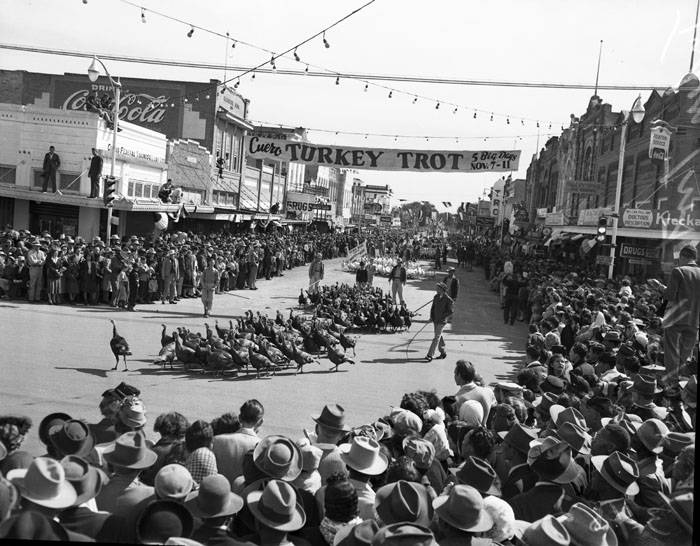
Turkey Trot Parade, Cuero, Texas, Nov.11, 1947. A modified version of the trot is still part of the annual Cuero Turkeyfest.
University of Texas at San Antonio
Turkeyfest (Cuero) On Nov. 25-27, 1912, Cuero hosted its first Turkey Trot. Estimates told of 30,000 people flocking to town to see over 18,000 turkeys herded down Main Street. In 1973, it became an annual event called Turkeyfest. By then, two U.S. towns, Cuero and Worthington, Minnesota, claimed the title of Turkey Capital of the World. The towns teamed up to plan two annual turkey races, one in each town. The winner determines the capital for the year. Cuero’s Turkeyfest, held in October, includes the final turkey race as well as a parade, pancake breakfast, cookoff, live music and a carnival.
Art Car Parade (Houston): Houston’s Art Car Parade started with a 1967 Ford station wagon donated to the Orange Show Center for Visionary Art in 1984. In 1988, the Orange Show held the first official Art Car Parade with 40 cars. Today, the Parade is one of the largest of its kind in the world, attracting over 250 vehicles and 300,000 people every year. Art Car Club students from Heights High School spent over 200 hours transforming this 1977 Chevy Caprice into an homage to legendary Texan singer-songwriter-guitarist Stevie Ray Vaughan.
Article continues below this ad