
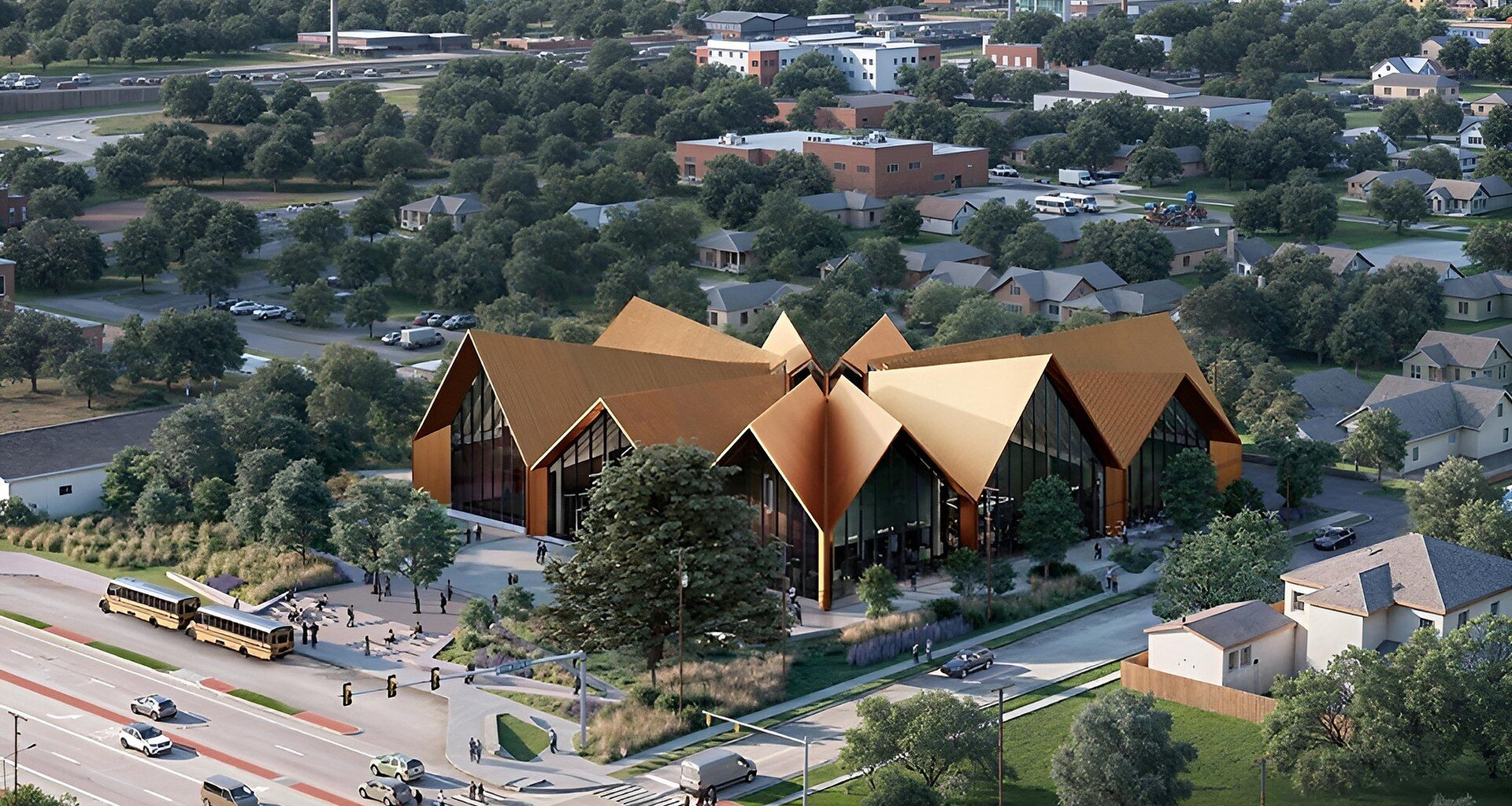
The National Juneteenth Museum, a 50,000-square-foot mass timber civic centre designed by Bjarke Ingels Group, will break ground in Fort Worth, Texas, in late 2026 or early 2027 at a cost of $70 million. That is according to the museum and its development team, which will first demolish the existing Southside Community Center on 7 October, the 100th birthday of Opal Lee, the activist known as the Grandmother of Juneteenth who first imagined the project.
Backed by $15 million from the City of Fort Worth and a matching $10 million from the Texas Legislature, the museum has secured public funding totalling $70 million. So far, leaders have raised $50 million, with chief executive Jarred Howard saying the build would wait for its money before any dirt was turned.
‘We won’t put a shovel in the ground until we have the money to pay for it,’ Howard said.
Led on-site by a construction manager-at-risk team from H.J. Russell & Company, Post L Group, and Source Building Group, the museum places four Black-led firms in leadership roles alongside KAI Enterprises as executive architect. Douglass Alligood, a BIG partner with more than four decades in practice, leads the design for the studio behind one of Europe’s largest mass timber buildings, with Local Projects, designer of New York’s National September 11 Memorial Museum, shaping the exhibitions.
Taking its cues from the gabled rooflines and porches of the Historic Southside, the design folds an undulating mass-timber roof into a twelve-point nova star, a motif borrowed from the Juneteenth flag. Beneath the peaks, a publicly accessible courtyard anchors galleries set on a circular plan, whilst extensive glazing carries daylight deep into the timber interior.
 Viewed from above, the roof points form a twelve-point nova star around a publicly accessible courtyard, the motif drawn from the Juneteenth flag. (Image Credit: Plomp / BIG)
For Alligood, whose career has centred on community-driven work, the building speaks to more than its civic role. ‘Juneteenth is not only American history—it is world history,’ Alligood said.
Built largely from exposed engineered timber, the building rises over two storeys, with the museum galleries set on the upper floor. Inside sit 10,000 square feet of exhibition space, a 250-seat theatre, a business incubator and a food hall for local vendors, reached through five street-level entrances and two covered portals onto the central court.
Inside, exposed timber rafters carry the gabled roofline into a 250-seat theatre for talks, performances and community events. (Image Credit: BIG / KAI Enterprises)
Having run a one-room Juneteenth museum on the same block for close to twenty years, Lee sees the new building as the next step from her walking campaign to Washington and the petition that made Juneteenth a federal holiday in 2021. ‘It’s mind-boggling, but I’m glad to see it all come to pass,’ Lee said.
Set on a Historic Southside block severed by Interstate 35 in the 1960s, the museum rises in a district once celebrated as a centre of Black commerce. The start of construction follows the June opening of another US mass timber museum and comes within months of the 100th birthday of Lee, a Presidential Medal of Freedom recipient who spent decades advocating for Juneteenth to become a federal holiday.

Jason Ross, publisher, is a 15-year professional in building and construction, connecting with more than 400 specifiers. A Gottstein Fellowship recipient, he is passionate about growing the market for wood-based information. Jason is Wood Central’s in-house emcee and is available for corporate host and MC services.