
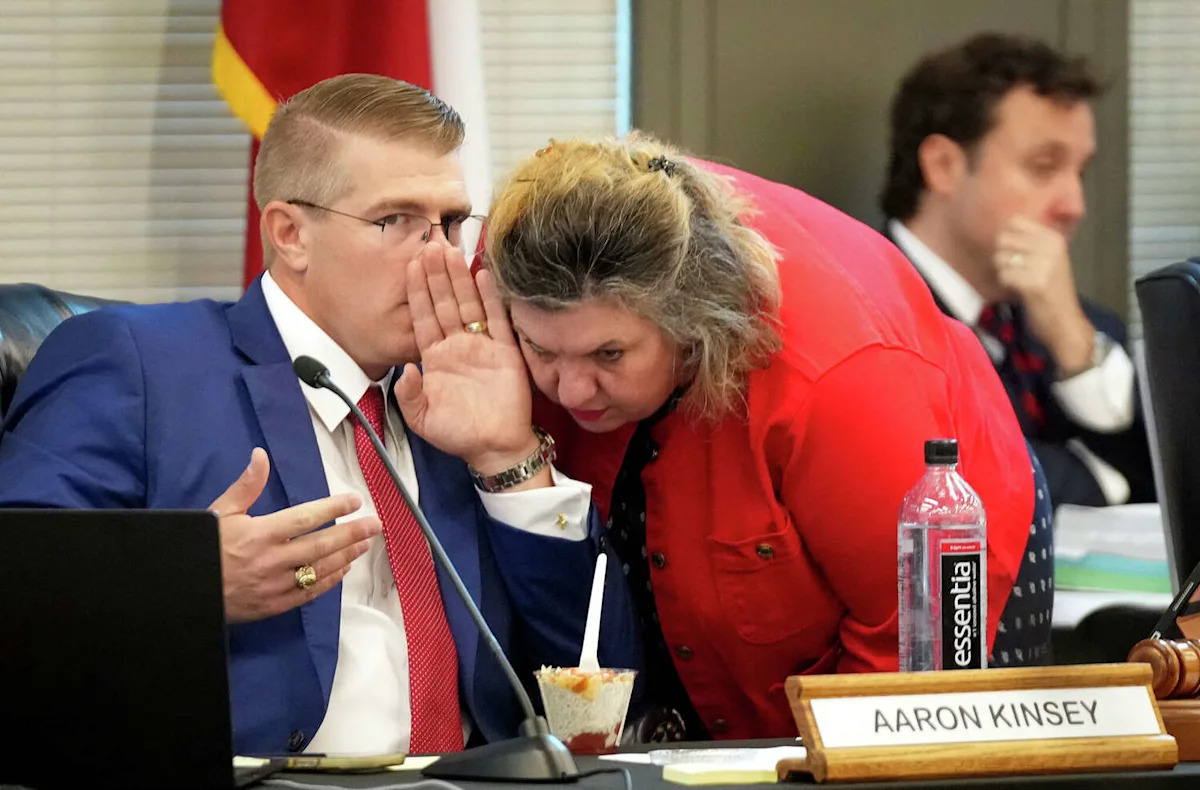
Dozens of speakers called on the Texas State Board of Education to move forward with a set of revised social studies standards during testimony that began Monday afternoon and stretched well into the night. Dozens more asked the board to amend the standards to give more attention to certain cultures or chapters in history.
Monday’s meeting represented the last opportunity for the public to weigh in on the standards before the board takes them up for a final vote. More than 250 people signed up to give public testimony on the issue. Board members are expected to discuss proposed amendments in the coming days before taking a final vote on Friday.
Related: Texas is considering a bigger role for Christianity in schools this month. Here’s how
The proposed standards would lay out what students are expected to learn in their social studies classes at each grade level. The standards have drawn controversy, with critics saying they place too much emphasis on Christianity while giving short shrift to other world religions. For example, biblical figures such as Abraham and Moses are included alongside figures from American and Texas history such as George Washington and Sam Houston.
The portrayal of Islam in the standards was a point of debate during the meeting. The mention of Islam in the proposed standards is limited, and mostly centers on conflicts like the Spanish Reconquista and acts of terrorism like those that occurred on Sept. 11. Earlier versions of the proposals included material dealing with the development of Algebra and astronomy in the Muslim world, but those were stripped out in the amendment process.
Yusuf Shaikh, a Plano ISD graduate, said accurate portrayal of Muslims in world history classes matters. When Muslim students see Islam portrayed in history textbooks only as a source of conflict and not its contributions to math, science and other disciplines, they can be left with the impression that they don’t belong. He also noted that the seventh grade standards include the 1948 creation of the modern state of Israel, but don’t mention the mass displacement of hundreds of thousands of Palestinians that followed.
Related: Are you smarter than a first grader? See if you could pass Texas’ controversial
Representation of Islam in social studies standards grows heated
Inshirah Daher, a 15-year social studies teacher and a Palestinian American, took issue not only with the standards’ portrayal of Islam, but also the grade levels at which that material is introduced. She noted that fourth graders would be asked to learn about al-Qaeda before they’re taught foundational skills like how to read a map or how to distinguish a fact from an opinion.
“This is not education,” she said. “This is a shortcut that skips the hard work of actually teaching children to be critical thinkers.
Many other speakers — and at least one board member — characterized Islam as an inherently violent ideology whose adherents plan to take over the United States. In response to Daher noting that Islam is the fastest-growing religion in the United States, board member Brandon Hall, R-Aledo, proclaimed that “Islam will not take over.”
“You may have the wind at your back, but we serve the one true God, and it runs into a brick wall right here in the United States of America,” he said.
Larry Holland, a member of the conservative grassroots group Citizens for Education Reform, said it’s wholly appropriate that Christian principles should be included in the state’s curriculum. But he argued that Islam is incompatible with Texas law and the U.S. Constitution because it lays out its own laws separate from those of the state or nation.
“If we do not teach Christian principles and values today, then we will be subjects of Islam tomorrow,” he said.
At times, the atmosphere in the room became heated. At one point during testimony, board Chairman Aaron Kinsey asked a state trooper to remove a few audience members who became disruptive. The audience members were ultimately allowed to stay, but Kinsey said he would have an entire section of the room cleared if the audience got out of hand again.
Proposed social studies standards called too long
A number of teachers and teachers’ advocates told the board the standards were too lengthy. James Hallemek, government relations specialist for the Texas State Teachers Association, asked the board to streamline the standards before approving them. Giving teachers mandatory standards that are too extensive will leave them without enough time to give students the kind of tailored instruction they need, he said.
Ann Heuberger, a retired school librarian and former school board trustee in Del Valle ISD, said the standards were convoluted and unworkable. Teachers shouldn’t have to rush through the standards to check them off a list, she said. The standards should give students enough time with each concept to go beyond rote memorization and into a deeper understanding of the material, she said.
The length of the proposed standards has been a point of contention, both in public testimony sessions and in the process for developing the proposal. Steven Pruitt, a middle school social studies teacher in Garland ISD, served on the first of two work groups that offered recommendations for the standards. When Pruitt and his group received the proposed standards that the board’s content advisors had drafted, it was immediately obvious that there was too much content, he told The Dallas Morning News.
Pruitt worked as a part of a team that offered recommendations for the world history course students take in high school. The proposed list of standards was so lengthy that teachers would have to make difficult decisions about which concepts to cover, which to emphasize and which to leave out, he said.
“It was obvious to us that there wasn’t enough input from people that had actual classroom teaching experience in creating those learning objectives,” he said.
Like other members of the working groups, Pruitt said his group received guidance saying they were allowed to add content or remove it, but they couldn’t do both. Because the group determined that the proposed standards were too extensive, that meant they couldn’t add other material they wanted to see included. Pruitt said there were other historical eras and events he would have liked to see in the standards, including expeditions by African explorers centuries before Christopher Columbus.
The documents working groups were presented with noted several times that the course was intended to focus primarily on Western history and how it led to how the United States came to be, Pruitt said. But if students don’t have a good understanding of events that shaped global history beyond Europe and the United States, they won’t be well-rounded citizens when they leave high school.
“They’re certainly American citizens,” he said. “They’re certainly Texan citizens, but a long way from being a more well-rounded citizen.
The board is expected to resume discussion of the proposed social studies standards at a meeting Tuesday in Austin.
The DMN Education Lab deepens the coverage and conversation about urgent education issues critical to the future of North Texas.
The DMN Education Lab is a community-funded journalism initiative, with support from Bobby and Lottye Lyle, Communities Foundation of Texas, The Dallas Foundation, Dallas Regional Chamber, Deedie Rose, Garrett and Cecilia Boone, Judy and Jim Gibbs, The Meadows Foundation, The Murrell Foundation, Ron Steinhart, Solutions Journalism Network, Southern Methodist University, Sydney Smith Hicks, and the University of Texas at Dallas. The Dallas Morning News retains full editorial control of the Education Lab’s journalism.
Subscribe