
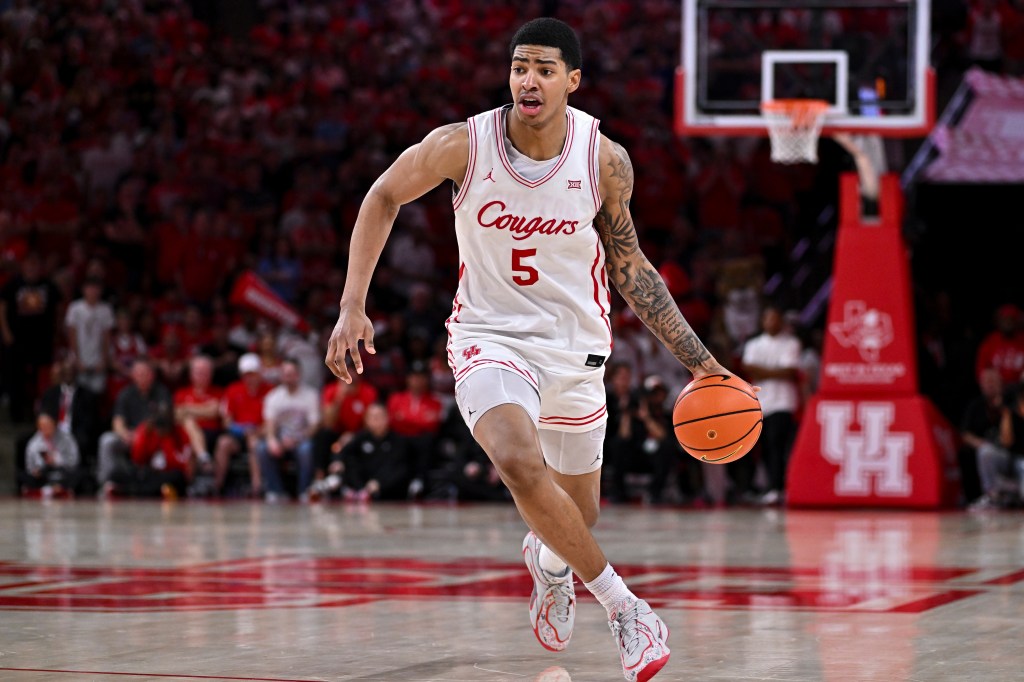
The Celtics used their first-round draft pick to address one of their biggest roster needs.
With the 27th overall selection in the 2026 NBA Draft, Boston selected Chris Cenac Jr., a 6-foot-11 big man out of Houston.
Known for his length, athleticism and rebounding ability, Cenac averaged 9.5 points and 7.8 boards per game during his lone season with the Cougars, shooting 48.5% from the field and 33.3% from 3-point range.
“He’s just a good young player,” Celtics president of basketball operations Brad Stevens said Tuesday night. “Energetic, plays hard, excellent athlete, long. Fits a position of need, some things that we were a little short on this year from an athletic perspective, I think with his size and his length. And when you play in the program he’s played for, he’s been taught well and been held to a high standard. I like that, and he will undoubtedly come here and be eager to jump into it.
“He’s a good worker, he’s a good person, and he’s got a lot to learn, but we’re excited about starting that process with him.”
As Stevens noted, the Celtics entered the offseason needing frontcourt reinforcements after Neemias Queta, Luka Garza and impending free agent Nikola Vucevic looked overmatched during the team’s first-round playoff loss to Philadelphia. Cenac is a high-upside addition to that position group, but probably not a short-term solution to the issues Boston dealt with this postseason.
Several prominent draft analysts viewed the 19-year-old freshman as a project who could have benefited from another season in college:
The Athletic’s John Hollinger: “Cenac requires a bit more projection than some other players in this class and is unlikely to be game-ready immediately, but he has some real upside as a floor-spacing glass-eater who moves pretty fluidly for his size.”
The Ringer’s J. Kyle Mann: “A bet on Cenac is a bet on upside at this point, but there are obvious physical tools to work with. His success will rely on his new team having a strong veteran presence, a simplified role for him (for now), and a proven player development infrastructure.”
The Athletic’s Sam Vecenie: He’s probably entering the draft at least one year — if not two years — before he’s ready, and my guess is Cenac will have a slow build over the next few years. Don’t expect anything in Year 1, as he should be considered a project. But if he gets to the right organization that can help him develop his perimeter skills and continue to work on his feel for the game, he could be a significant impact player.”
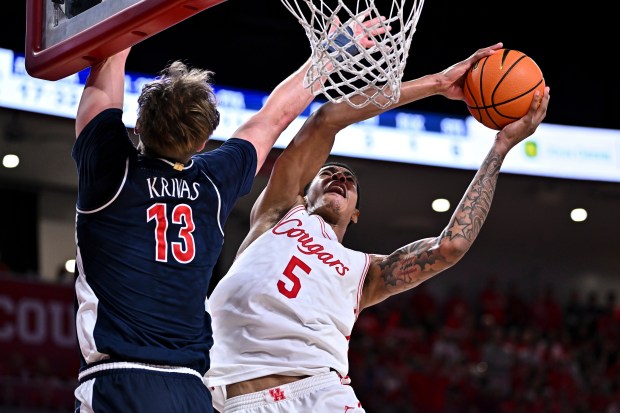 FILE – Houston forward Chris Cenac Jr. (5) shoots the ball as Arizona center Motiejus Krivas (13) defends in the second half of an NCAA college basketball game, Feb. 21, 2026, in Houston. (AP Photo/Maria Lysaker, File)
Cenac also wasn’t much of a shot-blocker at Houston, registering just 18 in 37 games (and only one game with more than one block). Still, he was widely pegged as a player likely to come off the board in the late teens or 20s. ESPN had him ranked as the 19th-best prospect in this year’s draft class.
Stevens said the Celtics aren’t expecting Cenac, who won’t turn 20 until February, to be an immediate NBA contributor. He noted, though, that the team felt the same way about last year’s first-round draftee, and Hugo Gonzalez went on to play rotation minutes for most of his rookie season.
“I hope we’re good enough that it’s hard for any 18-year-old or 19-year-old to come in here and be really good out of the gate,” Stevens said. “I think that usually is more about their own personal development and growth and learning how hard it is and learning how to be a part of a team and learning how we work and how we go about it every day. And then if they can add value, that’s great, but there won’t be any expectation of that from my standpoint. There certainly probably is a lot of excitement and expectation from him.
“But we were sitting here last year, and I didn’t think the guy that we drafted would play at all for us. You never know. Let’s see. We’ll see how they all come in and work, and he’ll certainly have the opportunity like everybody else. But you’re behind when you’re 19 and you’re dealing with now men.”
Cenac should get his first opportunity to match up against fellow professionals at the Las Vegas Summer League, which begins July 9.
The Celtics will finalize their 2026 draft class Wednesday night. They currently own the 10th pick of the second round (No. 40 overall).
“I think we’re going to continue to look at size,” Stevens said when asked about the team’s offseason priorities. “And then I do think we will look to add. We’ll see how (Wednesday) goes. We have a pick at No. 40. Whether that is somebody that we ultimately roster or (sign to a) two-way or whatever, we’ll figure that stuff out. But I do think size, and then I would like to add maybe one more person with speed on the perimeter.”
The draft began with Brockton native and BYU forward AJ Dybantsa becoming the second consecutive New England product to go No. 1 overall (joining 2025-26 Rookie of the Year Cooper Flagg, who hails from Maine) and the first Massachusetts-raised prospect to do so since Patrick Ewing in 1985.
The Washington Wizards, draft lottery winners after three consecutive sub-20-win seasons, took Dybantsa with the top pick. Kansas’ Darryn Peterson went second overall to the Utah Jazz, followed by Duke’s Cameron Boozer (Memphis Grizzlies) and North Carolina’s Caleb Wilson (Chicago Bulls) to round out a star-studded top four.
Stanford guard Ebuka Okorie, who grew up in Nashua, N.H., and spent part of his high school career at Cushing Academy in Ashburnham, came off the board at No. 17 overall. He’ll join the Detroit Pistons, who acquired the pick from Memphis, via Oklahoma City.
The San Antonio Spurs traded up late in the first round to leapfrog the Celtics and take UConn big man Tarris Reed Jr. at No. 26. The Cleveland Cavaliers made a similar leap to land Reed’s former college teammate, wing Alex Karaban, with the 29th pick, giving up a future second-rounder to move up from No. 34.