
Austin leaders could ask voters this fall for money to tackle several projects across the city.
Last month, a majority of the Austin City Council directed staff to create a bond package with a focus on parks, transportation and cultural arts. Staff responded with a plan that would spend about $400 million.
Council Member Ryan Alter helped lead the effort.
“We have a lot of deferred maintenance and just other capital needs,” Alter said. “That ranges from our parks to our sidewalks and roadways. There are just things that you have to invest in as a growing city.”
But some on the council, including Mayor Kirk Watson, are concerned this isn’t the right time to ask voters for money. A November bond election would come just one year after voters soundly rejected a property tax rate increase known Proposition Q, which would have raised more than $100 million in property tax revenue.
A final bond package has not been approved by the Austin City Council. So the exact cost to taxpayers is still unknown.
Council Member Paige Ellis said the council wants to be mindful of how a bond package would impact taxpayers. But is also trying to balance long-term investments.
“The voter-approved bond projects are sometimes the only chance that some neighborhoods are going to get the improvements that they desire,” Ellis said. “So I am focusing on parks, active trails and libraries.”
Addressing city needs with a bond
Voter-approved bonds can provide an injection of cash up front for large building and infrastructure projects, like libraries, roads and parks. The city then uses an increase in property taxes to repay the bond separate from the taxes that pay for the city’s basic needs, like public safety and homelessness.
Austin voters have passed three bonds in the last eight years. In 2018, voters approved $925 million that funded several areas including housing, parks, libraries, public safety and transportation. In 2020, Austinites approved a $460 million mobility bond. And then $350 million for affordable housing in 2022.
Millions of those bond dollars have yet to be spent, according to city data.
Still, some council members feel it’s time for another bond. And some people in the community think so too.
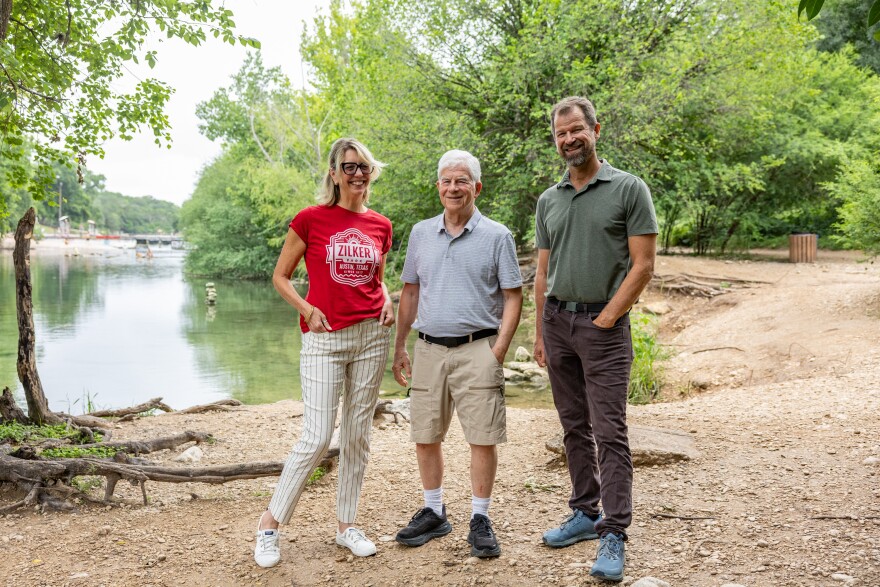
(From left to right) Fleetwood Jacobs, Executive Director of Zilker 351, Tedd Siff, Board Member of Austin Outside, and Jonathan Ogren, Principal and Environmental Planner for Silo Group at Barton Springs.
Members of the Zilker 351 group support a parks bond in November in hopes of restoring the shore at Barking Springs — the free side of Barton Springs Pool.
Fleetwood Jacobs, the nonprofit’s executive director, said the group is trying to protect one of the Austin’s most beloved green spaces.
“[The restoration project] will improve our water quality in one of the most heavily used swimming areas,” she said. “It will stabilize an eroding shoreline. It will increase access and safety. And importantly it will preserve the natural character of Barking Springs.”
The project would also add more appropriate places for people to relax like benches and picnic tables. Jacobs said it’s a project that has been needed for quite some time.
“It was approved by council in 2009 in the Barton Springs Pool master plan,” Jacobs said. “And it’s just been sitting here waiting for funding for that many years. And every year that we don’t do something about it this just gets worse and worse.”
She said the group is willing to help raise matching funds if the city adds the $3 million project as part of a new bond.
‘Not like last time’
The city’s bond advisory task force, which was formed in 2024, has identified $4 billion in needs across the city. For this bond, the group focused on parks, transportation and cultural arts projects that could be completed in six years, said Mary Hager, who chaired the task force.
“This is the future of the city,” Hager said. “Operating budgets come and go, sales tax goes up and down, these types of long-term improvements to our city are so important and we can’t be fickle about it.”
Council Member Mike Siegel agrees. He said asking residents for permission to increase taxes for a bond is not like the last property tax increase because the projects are more tangible.
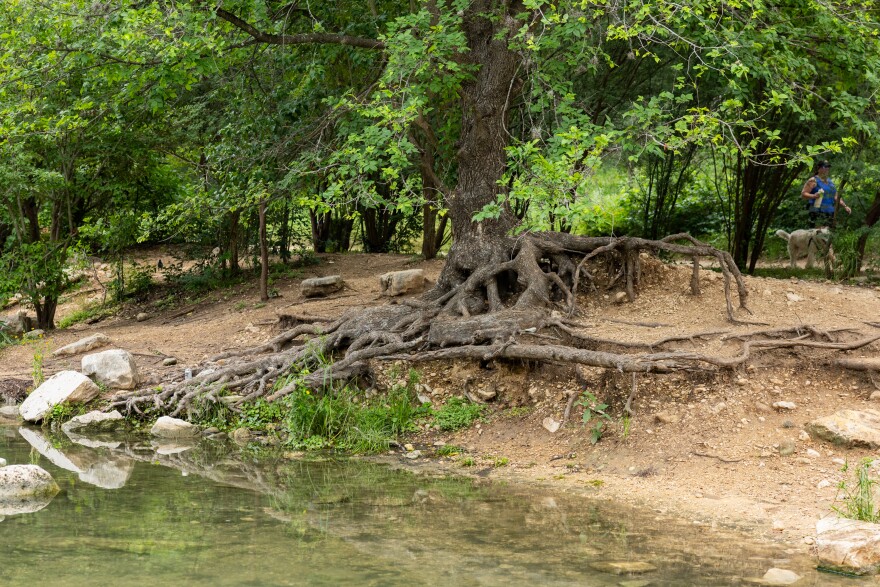
Tree erosion is shown on a tree at the free side of Barton Springs. Zilker 351, a non profit that works to honor, preserve and enhance the natural cultural, and recreational treasures of Zilker Park, is hoping to receive bond money to improve the ‘free side’ of Barton Springs.
“You’re going to see your park bathroom get repaired, you’re going to see your local pool get a new shade structure, you’re going to see the acquisition of land in a part of town that does not otherwise have a park,” Siegel said. “And I think that is a lot different than what voters were asked to approve with the tax rate election, which was more of a generalized investment in our general fund.”
Council members Chito Vela, Zo Qadri and José Velásquez also supported the call for a bond package in November.
The right time?
Not everyone on the city council agrees asking voters to support a bond in November is a good idea.
Mayor Kirk Watson is leading that charge against a bond this year, reiterating the city’s financial policies to ensure the city is being good stewards of taxpayer dollars and rebuilding trust.
Watson supports park improvements, libraries and bike lanes and understands the city has many needs. But he questions the timing, especially so soon after the failure of the tax rate election called Prop Q, which Watson refers to as a TRE.
“The city had needs last year,” Watson said. “It had needs when voters rejected the TRE. It will have needs in 2028. The existence of needs doesn’t eliminate our responsibility to govern responsibly.”
Additionally, he said that a bond and a property tax election are different revenue generators, but the money would still come from the same place.
“The money is coming out of the taxpayer’s pocket” Watson said. “And the TRE was a direct statement to us about responsibility with regard to spending…. And by the way there have been things that impact that pocket. People’s pockets are shallower.”
Council Member Marc Duchen is siding with Watson.
“Voters are wary of making a choice that will increase the cost of living and don’t feel like City Hall has their back when it comes to affordability,” Duchen said.
If the city council decides to move forward with a bond, city staff suggested council consider a bond of no more than $400 million. And staff recommend waiting until 2028 to allow for continued progress on existing bond programs and potentially increase bond capacity.
City staff will come back in July with a potential package. The city council has until August to decide whether to take that to the voters in November.