
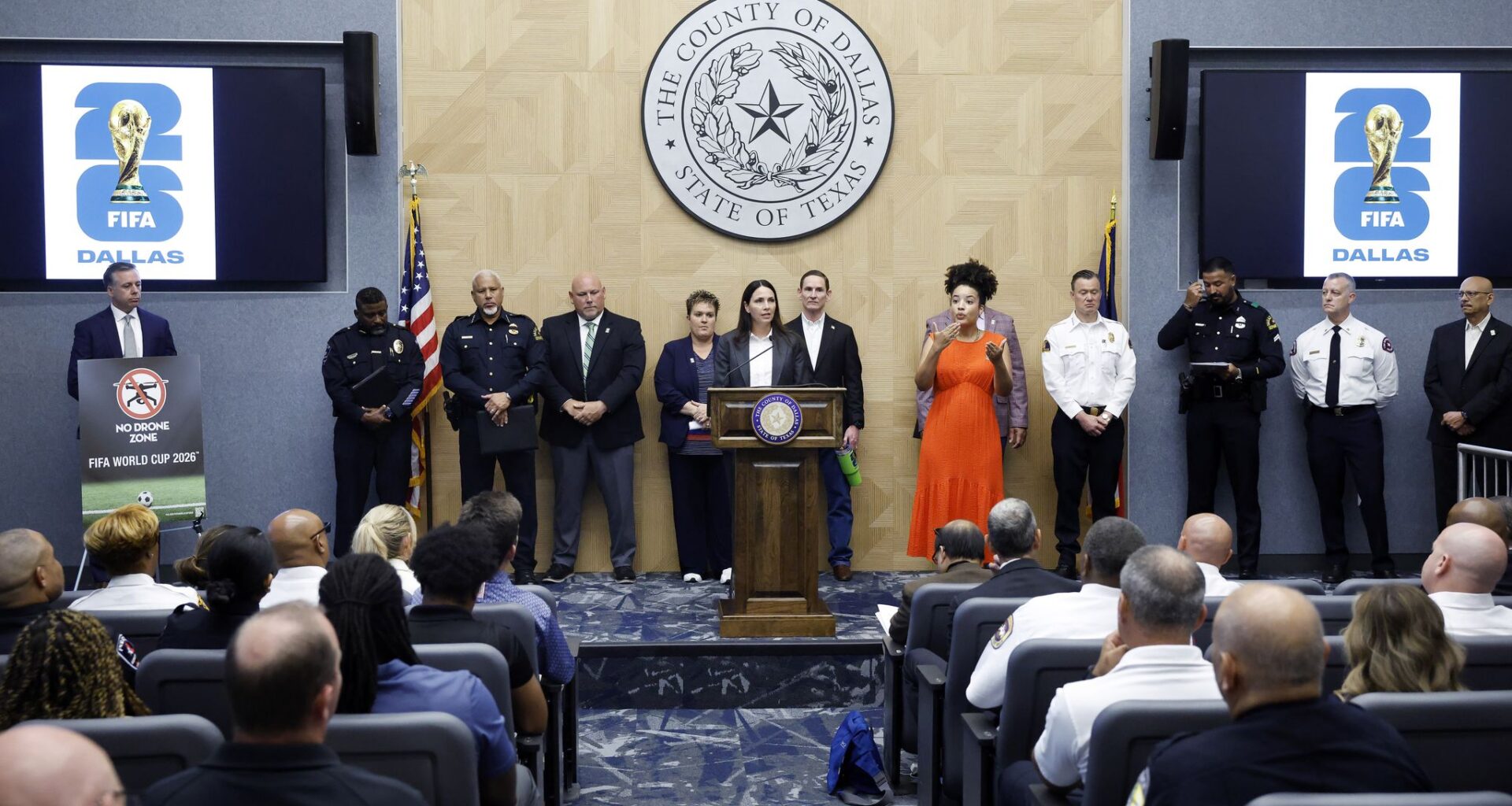
Christina Foley, U.S. Secret Service Special Agent in Charge, Dallas District and Federal Coordinator of FIFA World Cup Dallas, delivers remarks from the podium during a North Texas FIFA World Cup Safety and Security press conference on June 1. Contributing columnist Matthew J. DeSarno writes that making the World Cup safe requires thousands of people across dozens of agencies.
Tom Fox/The Dallas Morning News
As thousands of soccer fans descend on North Texas this summer, most people will notice the visible signs of preparation: increased police presence, security checkpoints and crowds from around the world. What they won’t see is the extraordinary coordination effort that has been underway for more than a year.
Having spent much of my career leading crisis response, counterterrorism and major-event security operations, I can say with confidence that the 2026 FIFA World Cup may be one of the most complex security undertakings ever attempted in the United States.
A Super Bowl focuses national resources on a single city for a single weekend. Even the Olympics largely operate within one metropolitan area. The World Cup stretches across 11 host cities and 39 days. Teams, officials, media organizations, dignitaries and hundreds of thousands of fans move continuously across the country. The challenge is not protecting one venue. It is maintaining a coordinated security posture across thousands of miles while the event itself is constantly moving.
Article continues below this ad
The complexity extends well beyond geography. The World Cup creates a rare environment where enormous crowds, global media attention, foreign dignitaries and travelers from nearly every corner of the world converge simultaneously. That reality requires federal, state and local agencies to remain vigilant against a wide range of threats, from terrorism and transnational crime to cyberattacks, drone activity and other forms of disruption.
The FBI plays a central role in that effort, serving as the lead federal agency for threat detection, intelligence integration and crisis response. But no federal agency can accomplish something of this scale alone. The FBI is coordinating through Joint Operations Centers and intelligence-sharing mechanisms that connect local, state and federal partners across the country throughout the tournament.
One of the reasons North Texas is exceptionally well-positioned for this moment is the strength of its law enforcement partnerships. During my years leading the FBI’s Dallas Field Office, I worked with agencies across the region every day. The relationships among police chiefs, sheriffs, fire chiefs, emergency managers and federal leaders in North Texas are the strongest I have seen anywhere in the country.
That didn’t happen overnight. For years, agencies across Dallas-Fort Worth have built a culture of collaboration that places mission above jurisdiction and partnership above ego. Leaders know one another. They trust one another. They train together. And when challenges emerge, they solve problems together.
Article continues below this ad
That culture matters because an event like the World Cup is ultimately a leadership challenge disguised as a security challenge.
Thousands of people from dozens of agencies have spent months preparing for scenarios most fans will never think about. They have coordinated transportation plans, emergency response procedures, intelligence-sharing protocols, communications systems, medical contingencies, credentialing requirements and countless logistical details. Success will depend not on any single agency, but on hundreds of professionals quietly doing their jobs before anyone ever notices.
Adding to the complexity is the global nature of the event itself. International federations, national teams, broadcasters, sponsors, dignitaries and VIPs all arrive with unique expectations and requirements. World soccer operates on a scale unlike almost any other sporting enterprise, and many participants are accustomed to extraordinary levels of access, accommodation and security. Managing those expectations while maintaining a safe and secure environment requires not only security expertise, but diplomacy, patience and constant coordination among organizations that often operate under very different cultures and authorities.
None of that work is particularly visible. Behind every match are intelligence analysts, investigators, emergency managers, transportation officials, firefighters, paramedics, police officers and federal agents working quietly to identify risks, solve problems and prevent incidents before the public ever becomes aware of them.
If the tournament unfolds safely, fans will remember the matches, the atmosphere and the experience. They will never know of the countless meetings, planning sessions, exercises and coordination efforts that made that success possible.
Article continues below this ad
And that is exactly the point. Most people judge security by what happens. Professionals judge it by what never happens.
Over the next several weeks, the world will be watching North Texas. What most people will see is soccer. What I see is the culmination of years of partnership, months of preparation and thousands of public servants working quietly behind the scenes to ensure that one of the world’s largest sporting events is remembered for what happens on the field, not for what happens off it.
Have thoughts about this? Send a letter to the editor using our letters form or email letters@dallasnews.com. Letters should be no more than 200 words and include the first and last name of the writer and city of residence.