
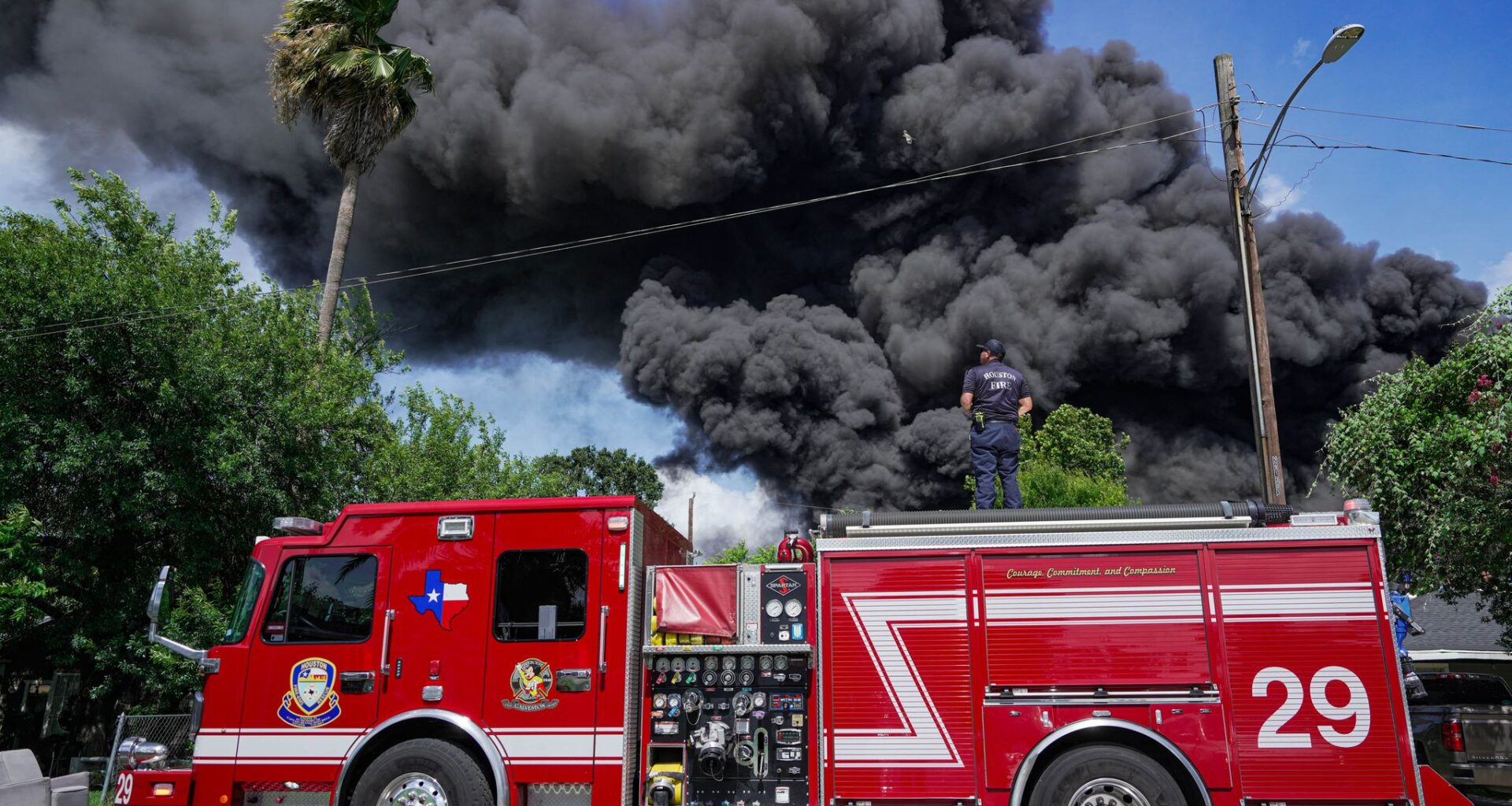
Houston firefighters respond near a residential neighborhood as thick black smoke rises from a large tire fire near the intersection of Kellogg and Manchester streets in Houston on Monday, June 22, 2026.
Raquel Natalicchio/Houston Chronicle
The thick black plume of smoke from Monday’s fire at a metal recycling warehouse near Second Ward could be seen for miles. Fighting this massive blaze tied up multiple units and about one hundred firefighters from multiple stations, keeping crews on scene well into the next day. It was a vivid example of how quickly a major emergency can consume Houston Fire Department resources even while routine 911 calls continue across the city. But here’s what’s especially alarming: Our emergency responders are stretched to the limit even on days without a major emergency.
Houston is not the same city it was a decade ago. More people are living, working and driving in a larger and more complex region.
With that growth has come an alarming increase in 911 calls for fires, car crashes, heart attacks, shootings and hazardous materials incidents. Those calls are pushing Houston’s fire and emergency medical services system beyond its capacity. Seconds matter in an emergency, and the longer someone waits for help, the lower their chances of survival.
Article continues below this ad
The problem is not new. Even a decade ago, city leaders were warned that the Houston Fire Department needed to add resources as Houston continued to grow.
A recent analysis of the Houston Fire Department’s workload and response capacity by the International Association of Fire Fighters gives Houston even more reason for concern. From 2018 to 2024, the number of fire and other non-EMS calls Houston firefighters respond to each day increased by 34% — growing from 122 to 162. EMS calls increased by 21% during that same timeframe — growing from 810 to 979.
The analysis also found that HFD does not meet national response-time standards. In 2023 and 2024, engines met the four-minute response standard only 29% of the time. Ambulances met the standard in their own response areas only 23% of the time. When ambulances had to respond outside their normal areas because no closer unit was available, they met the standard only 3% of the time.
A third area of concern is EMS availability. During the final 200 days of the study, HFD had repeated incidents when critical EMS transport resources were already tied up on other calls.
Article continues below this ad
This analysis is the third warning Houston has received about fire and EMS capacity. A city-commissioned report in 2016 recommended adding EMS transport resources and building and staffing new fire stations as Houston continued to grow. Then a 2019 analysis found that ambulance response delays were tied to a gap between demand and capacity and that targeted ambulance additions could improve response times.
Three reports, by different authors in different years, have pointed to the same basic problem.
The strain is visible throughout the system. Units stay tied up longer. Crews travel farther because the closest available unit is often already committed to another call. Any skepticism about this ignores what the men and women of HFD experience every day.
So, what is the solution?
The International Association of Fire Fighters report recommends building 10 fire stations with new fire engines, adding two ladder trucks and 65 new ambulances, and hiring more firefighters and paramedics to staff them. It also recommends operational improvements, including changes to dispatch protocols, better data collection and a closer look at the ETHAN program, HFD’s telehealth option for some medical calls that may not require ambulance transport.
Article continues below this ad
Those previous reports also included good ideas that should not be left on the shelf. But good ideas alone will not solve a capacity problem if the city does not also invest in the resources needed to meet the demand.
A growing region cannot keep adding calls and expect the same fire and EMS footprint to deliver the same level of service. Renovating existing stations is important, but repairs do not add coverage in growing areas. Better technology is useful, but it does not put another ambulance on the street when every available unit is already busy. Overtime is helping keep units staffed today, but it is not a long-term substitute for having enough firefighters and paramedics to meet Houston’s needs.
No one is saying change can occur overnight or without a cost.
We need a phased fire and EMS growth plan with clear priorities, timelines, cost estimates, staffing needs, station locations, ambulance availability, dispatch improvements and measurable response-time goals. Houstonians deserve to know where the gaps are, what it will take to close them and how the city intends to protect residents as demand continues to rise.
Firefighters are not asking Houston to ignore fiscal reality. We are asking Houston to recognize operational reality.
Article continues below this ad
The Houston Professional Fire Fighters Association commissioned the International Association of Fire Fighters analysis to start the conversation.
Will the conversation continue, or will Houston wait another decade for another report that says the same thing?
Lancton is president of the Houston Professional Fire Fighters Association, Local 341.