
There is an element to the sports landscape in this town that I’m not sure I fully recognized until the last year or so. For the last three decades or so, the “operating systems” of our major sports franchises have been remarkably stable. New York, Chicago, Detroit, Pittsburgh, and a handful of others might be able to challenge Dallas in stability of ownership, but I do not believe there is another market that could match us in stability of operating systems. While Jerry Jones is the obvious ace in this rotation, Mark Cuban was top executive of the Mavericks for 23 years, and the Nelsons were as intertwined into the fabric of the Mavericks organization as any non-player could be. Jon Daniels had a 17-year run as general manager of the Rangers, and while his imprints may be tougher to see as time passes, he hired his predecessor, Chris Young, thereby continuing the regime to some extent. Jim Nill was hired in 2013, making him the third-longest-tenured GM in the NHL.
It’s a fuzzy term I’m using here, “operating systems,” but I think it gets the point across. We know how these guys do business. We know how they want to play. We get a sense for the types of players they prefer. Heck, we even learn which reporters they tell things to first. We learn their bad jokes, almost like a boss’s, and much like bosses, if they do it right, they can create a bit of an identity around the team.
No such framework exists for the current regime of the Mavs. We’ve barely even hung out with the new guys; we have no idea what they order at the bar. This week, new team president Masai Ujiri and general manager Mike Schmitz made their first major public decisions. First, they hired the University of Michigan’s Dusty May as the team’s new head coach. May spent the last 21 years in the college ranks and has no NBA experience. It was a stunner. Two weeks ago, ESPN reported that while there had been “rumblings” linking the Mavericks to May as well as Duke’s Jon Scheyer, but that “since Masai Ujiri was hired to run basketball operations last month, the belief around the league is that the most likely outcome for Dallas is elevating one of the NBA’s rising assistants.”
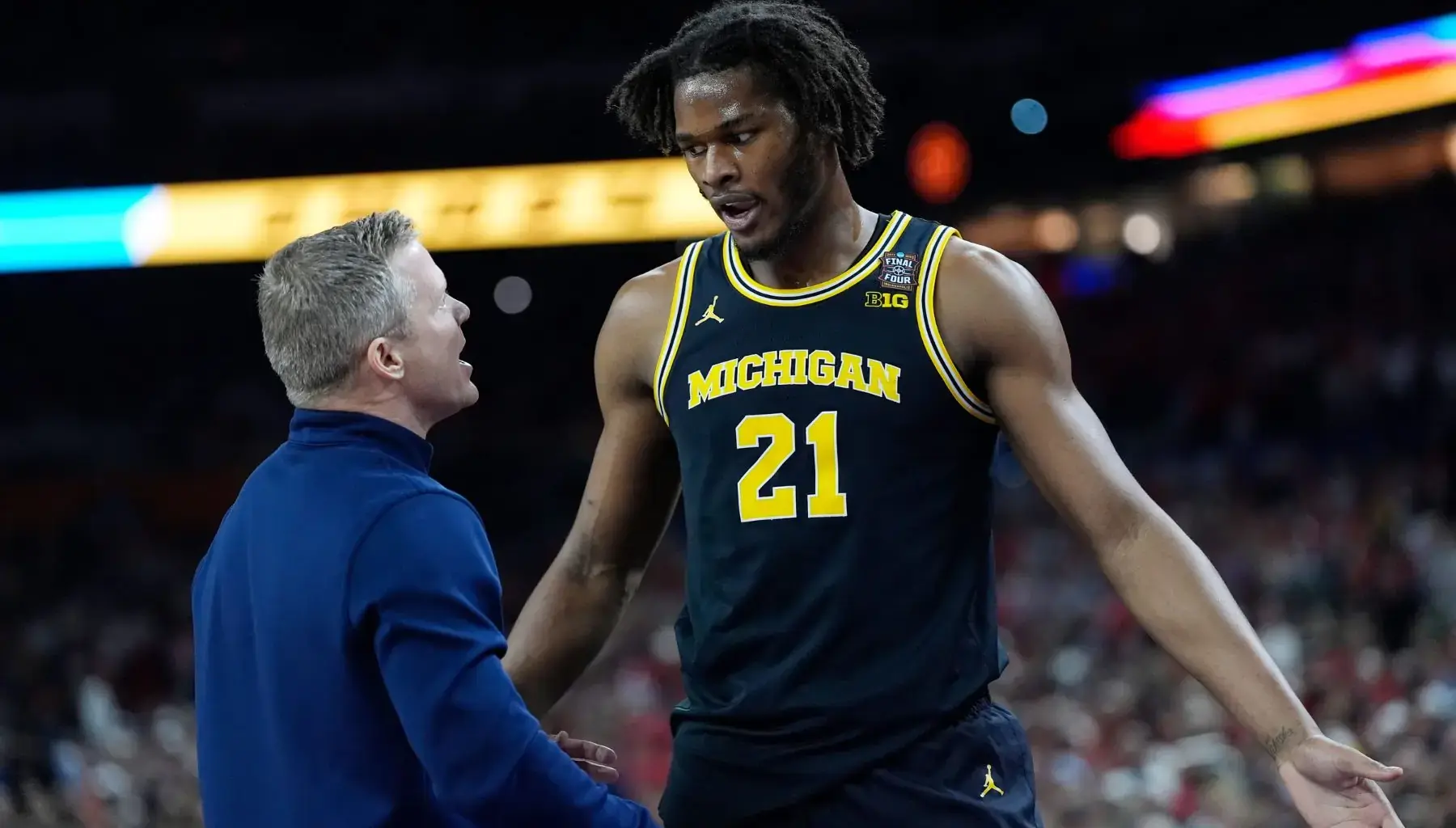
Any notion that we had a handle on what this new group would do in their first draft should have left the building the moment May was hired. This is considered a guard-heavy draft, and the Mavericks have pressing backcourt needs. But with the ninth overall pick, Dallas selected Michigan forward/big Morez Johnson, a player most mocks and consensus boards had slotted in the 12-to-16 range. Johnson was regarded as the third-most desirable pro prospect among the three national-championship-winning teammates from Ann Arbor expected to be drafted; instead, he went first. Dallas used its other pick, number 30, along with a couple of future second round picks, to acquire 20-year-old EuroLeague sharpshooter Segia De Larrea.
It’s impossible to know the degree to which May being hired two days ago influenced the Johnson pick. On one hand, if May had turned down the job, you’d hate to think that would change Dallas’ draft plans much. On the other, if you’re betting on a player that outsiders might not appreciate to the degree you do, if you think a player has an impact on winning that is a little tougher to extract and imagine, there really is no better situation than hiring his college coach. It isn’t like May and the Mavs just chose Johnson over other players. They chose him over other players May coached.
That makes a little bit easier to sell yourself on Johnson given his perceived limited upside. He took 35 threes all of last season (and made 12), but his mark at the free-throw line (78.2 percent, 122-of-156) provides some level of optimism that a reliable jumper could be somewhere in his future. Even if it isn’t, May has already demonstrated that he can make use of him as an offensive piece without it. When May spoke to Kevin O’Connor last month about his three lottery prospects, he referred to Johnson, who is a bit positionless even in today’s game, as their “connector.” That sort of player doesn’t usually go ninth overall because if they don’t become that bridging offensive force, they can be a drag on your roster. But if you could’ve guaranteed Bam Adebayo, a player Johnson draws comparisons to, would be Bam Adebayo, he wouldn’t have lasted until 14th in 2017. May coaching Johnson guarantees nothing, but it certainly makes the fit more likely if for no other reason than these two people already know how to solve problems together. They already know how to communicate.
Being a connector on offense is nice, but that’s not why the Mavs drafted Johnson. Later in that conversion with O’Connor, May had this to say about Johnson (I’ve bolded the part that stands out to me most):
“We had a saying before the game. If we didn’t feel like we had great preparation, or we didn’t feel like we were in a great spot, it became a saying among our staff, ‘Well, we have ‘Rez, and they don’t. We’re not getting punked tonight, we will be the more physical team.”
About halfway through this video of Ujiri calling Johnson to congratulate him, Johnson’s new boss tells him “you’re all mine…” in a cadence that makes me worried for Johnson and opposing offenses at the same time. They could be very wrong about this, but I think they believe they just drafted a future Defensive Player of the Year candidate.
Time and time again during his tenure in Toronto, Ujiri hunted players with unusual physical tools for their position; bigger, longer, defense-first players whom he bet that would develop their offense down the line. He has been very successful with this approach, but the downside can be that you end up with positional redundancy and many good-but-not-great players.
The Mavericks have a singular, generational talent in Cooper Flagg, and they know it. The type of help they think he needs, though, does give us some info. I’ve often chafed at designations of “this guy is the third-best player on a good team, not the second,” because that equation is entirely dependent on the quality and type of player above or below them on the pecking order. When your “one” is Cooper F’ing Flagg, having a bunch of threes and fours is a lot more doable.
Ujiri has been great at finding those guys, and if nothing else, that is the sort of guy we can safely expect Morez Johnson to be. There is way more unknown than known with this Mavericks roster, so the only player I am considering Johnson’s fit with is Flagg’s.
(Dereck Lively II’s health concerns make it almost impossible to consider him too much when drafting in the top 10, although I don’t think this pick is an indictment of Lively in any way. I have similar thoughts about the presence of Kyrie Irving.)
It will take more dates for us to get a feel for our new partner here. We just don’t know all that much about them, what makes them tick. But in the last few days, the Mavericks hired a head coach almost no one thought they would hire and drafted a player at nine almost no one thought they would draft. And in both cases, it is nearly impossible to imagine Cuban making those calls. The operating system has indeed changed.
Author 
Jake Kemp covers the Cowboys and Mavericks for StrongSide. He is a lifelong Dallas sports fan who previously worked for Sports Radio 96.7/1310 The Ticket and currently co-hosts the podcast “The Dumb Zone.” He has cried at least once during every movie about football he’s ever seen and enjoys celebrating life through sports.