
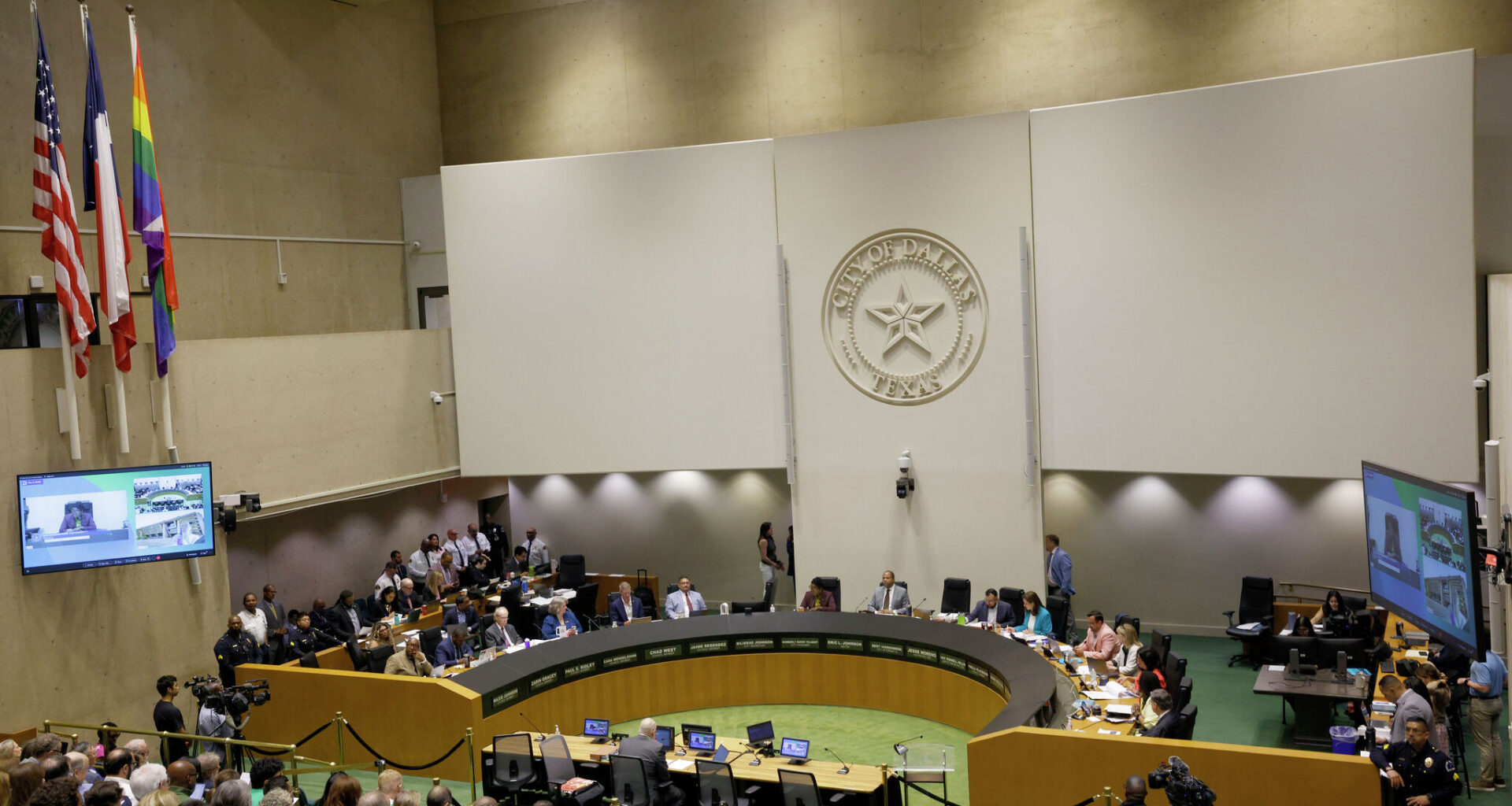
Earlier this month, the City Council rejected repair plans for City Hall. Council member Chad West agrees it will cost more to stay and renovate it than to move into a new building. But the higher cost of staying should not be a deal-breaker for remaining at 1500 Marilla St.
Chitose Suzuki/The Dallas Morning News
Dallas City Hall couldn’t be more divided, and it seems we are turning our fractured working relationships into a sea of trouble all around our city.
I appreciate the patience afforded to me by my Oak Cliff constituents who have attended meetings, emailed, called and texted me about the possibility of moving out of City Hall. Their feedback has solidified my thinking that this matter is part financial, part cultural and part planning.
From day one, I have steadfastly supported gathering all the necessary financial data needed for council to make an informed financial decision on whether to move to another location in the central business district or to stay put in City Hall and finally invest in its restoration. I will continue to take votes that lead us to the apples-to-apples cost comparison we must have to make a sound decision.
Article continues below this ad
I accept the assessments of AECOM and other experts that have provided the City Council with four phased repair plans, including cost estimates, for City Hall repairs.
My conclusion is that it will cost more to stay in City Hall and renovate it than to move into a new building. But the inevitable higher cost of staying is not a deal-breaker for remaining at 1500 Marilla St.
I voted in favor of moving forward with gathering a cost analysis because our residents deserve to be fully informed of what’s at stake. That can only happen if we let CBRE finish its work of gathering lease-to-own costs. I believe it was my fiduciary duty to vote in favor of letting the city manager see this analysis completed.
I’m dismayed that some of my council colleagues have consistently voted against fact-finding. Further, some outside of City Hall have appointed themselves experts who have deluged us with flimsy financial numbers that are closer to fantasy than reality. The city’s part of the process hasn’t been perfect, but I don’t fault the experts we have hired for their work thus far gathering phased repair estimates. In this case, I score the point in favor of moving.
Article continues below this ad
Culturally, there isn’t much I can write that adds to what has already been said. The value of I.M. Pei’s City Hall as a cultural asset deserves consideration in any stay-or-go analysis. For me, on the cultural question, the point goes to staying in City Hall.
And what about planning for the future of downtown?
I got into politics because of my desire to see thoughtful planning in my district to better balance preservation with growth, and I worked alongside neighbors for five years to pass the West Oak Cliff Area Plan (WOCAP) and associated zoning. This planning effort was hard, but I believe today what I believed when we kicked it off — great neighborhoods deserve great plans. Downtown deserves no less. It deserves more than promises from staff that a developer will come along with a vision if the City Hall site is scraped. It deserves a thoughtful approach that balances preservation and development where the council isn’t pushed by staff into rushed decisions.
My primary criticism is based on city staff’s lack of a transparent plan for what will happen to the City Hall footprint if we move our seat of government and leave the current building vacant, or worse, if we demolish it and leave a scraped, vacant site.
Despite putting out requests for ideas to which hundreds of people and firms replied, I have seen no plans from city staff for a catalytic project that could give downtown the jump start it needs to keep up with the growth of the rest of the region.
Article continues below this ad
I remain unconvinced that moving out of City Hall is the only solution to revive downtown. When a quarter of downtown is surface parking lots, and it is choked by highways like Interstate 345, it is hard to argue that a poorly maintained government building on 12 acres is the paramount problem holding back downtown.
Ultimately, I will reject any further attempts by staff to rush our decision on this generational decision without a serious plan to revitalize downtown with robust housing, business and amenities. Here, the point goes to stay.
Unfortunately, this lack of planning and transparency is not limited to the City Hall decision.
Recently, I have seen the lack of proper planning for downtown’s future hurt my own district. A plan from staff on the table now would sever a major connection between north Oak Cliff and downtown.
Through no fault of the new convention center’s construction team, staff’s current recommended alignment would force traffic from the Jefferson Boulevard Viaduct onto a street behind the convention center and then route cars all the way around Reunion Tower. This maze of twists and turns would make it harder for Oak Cliff residents to get downtown and harder for tourists and lunchtime diners to visit Oak Cliff’s thriving local businesses. This is the definition of poor planning and short-sighted design.
Article continues below this ad
I understand that some folks believe there is nothing that would make it worthwhile for Dallas to move its City Hall to another site. They don’t want to see redevelopment where the current City Hall stands because they are so totally invested in the building itself.
I must disappoint them and say I don’t subscribe to that worldview. However, I do agree that we have reached a point in which the cons outweigh the pros, so I will not vote to abandon something that has legitimate historical value for the vague promise of something better.
If I believed that promise, you would be right to tell me you have two Oak Cliff-to-downtown bridges to sell me.
Chad West represents District 1 on the Dallas City Council, which includes north Oak Cliff.
Article continues below this ad
Have thoughts about this? Send a letter to the editor using our letters form or email letters@dallasnews.com. Letters should be no more than 200 words and include the first and last name of the writer and city of residence.