
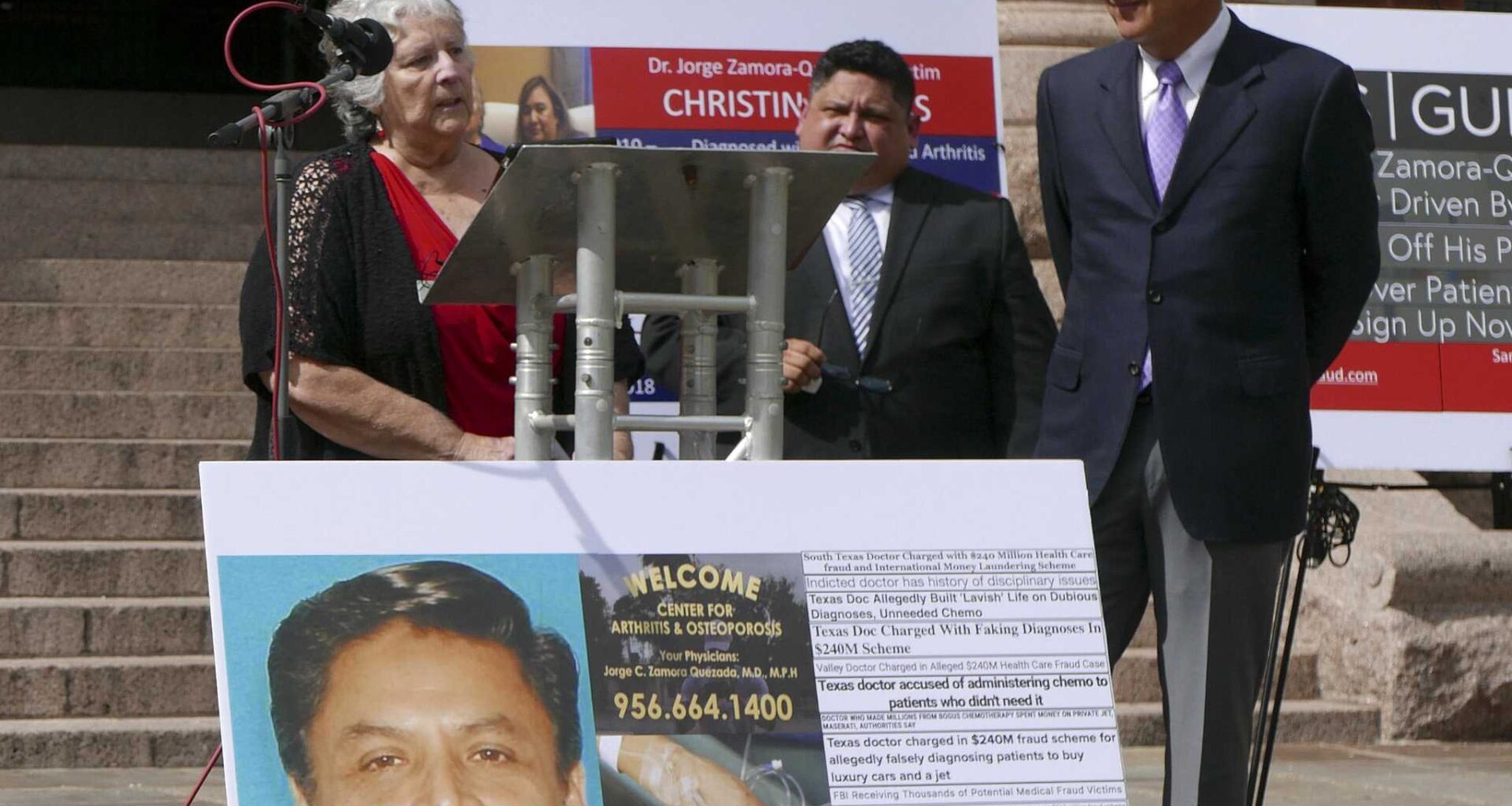
The South Texas doctor who poisoned dozens of patients with unnecessary chemotherapy amid a $325 million healthcare fraud scheme has been freed from federal prison only a year after being sentenced for his crimes.
Dr. Jorge Zamora-Quezada, 69, the disgraced rheumatologist who once operated medical practices in the Rio Grande Valley and San Antonio, was released from prison on Monday, June 22, according to the U.S. Bureau of Prisons.
Zamora-Quezada had initially been sentenced on May 21, 2025, to 10 years in federal prison after being convicted for a healthcare fraud scheme that left dozens of patients with lifelong disabilities and medical problems. However, he received credit for the seven years he spent in custody at a Valley detention center between the time of his 2018 arrest and his sentencing.
For nearly 20 years, Zamora-Quezada intentionally misdiagnosed patients with rheumatoid arthritis in order to fraudulently bill government and private insurers for pricey, but unnecessary treatments, including chemotherapy. Though a jury convicted Zamora-Quezada of seven counts of healthcare fraud and one count of conspiracy to obstruct justice, federal prosecutors said the true scale of harm he caused stretched into the thousands. Dozens of his victims packed a courtroom at the McAllen federal courthouse last May to tell him firsthand how he had “destroyed” their lives with his greed.
“I hope that you rot in hell!” one victim told him.
Throughout the hours-long sentencing hearing, Zamora-Quezada sat stonefaced, making eye contact as each victim rose to excoriate him, but never flinching. However, his wife, Meisy Angelica Zamora, could often be seen smirking, scoffing and rolling her eyes from where she sat at the front of the gallery. Meisy Zamora and two clinic workers — Estella Santos Natera and Felix Ramos — who were also charged with participating in the scheme, were acquitted.
Neither the husband nor the wife has ever shown remorse or offered an apology for what Dr. Zamora-Quezada’s patients endured. Instead, both have often worked to thwart criminal investigations and medical licensing regulators in multiple states.
As part of his sentence, Zamora-Quezada was ordered to pay more than $28.2 million in restitution and was required to forfeit the proceeds from his illicitly funded lavish lifestyle. That included multiple luxury properties in Colorado, California and Mexico, as well as several commercial properties — including the site of his former medical practice — a $1 million jet, a Maserati and a Porsche. In exchange for his cooperation, Zamora-Quezada and his wife would be allowed to keep their primary residence.
With the doctor behind bars, prosecutors had been relying on his wife to facilitate the forfeitures. But she has repeatedly refused to cooperate. In one instance, Meisy Zamora declined to provide the most basic information about two luxury condos and a timeshare in Puerto Vallarta so that court officers could sell them as part of the restitution. Instead, Meisy Zamora “secretly entered into a 12-month rental of one of the condominiums… through December 2, 2026,” prosecutors said in a March 20 court filing.
“The Government and Receiver have found the Defendant and his wife difficult to deal with from the very beginning,” the filing further reads.
It’s part of a pattern of noncooperation from the couple stretching back years, long before either of them ever faced criminal charges. In the early 2000s, Zamora-Quezada was found liable for sexual harassment as part of a civil lawsuit. And one year before Zamora-Quezada’s arrest, a McAllen bankruptcy judge lambasted the doctor and his wife for trying to “abuse the legal system” and “thwart” the bankruptcy process by shedding assets, not accurately reporting his finances, and selling off high-dollar personal property — including a second jet — before his creditors could collect.
“The Court finds Dr. Zamora-Quezada’s testimony to be — to put it mildly — wholly lacking in credibility,” U.S. Bankruptcy Judge Eduardo V. Rodriguez said in an August 2017 court filing.
Editor’s Note: This story has been updated with Zamora-Quezada’s date of release after clarification from the U.S. Bureau of Prisons Office of Public Affairs after the story was published.