
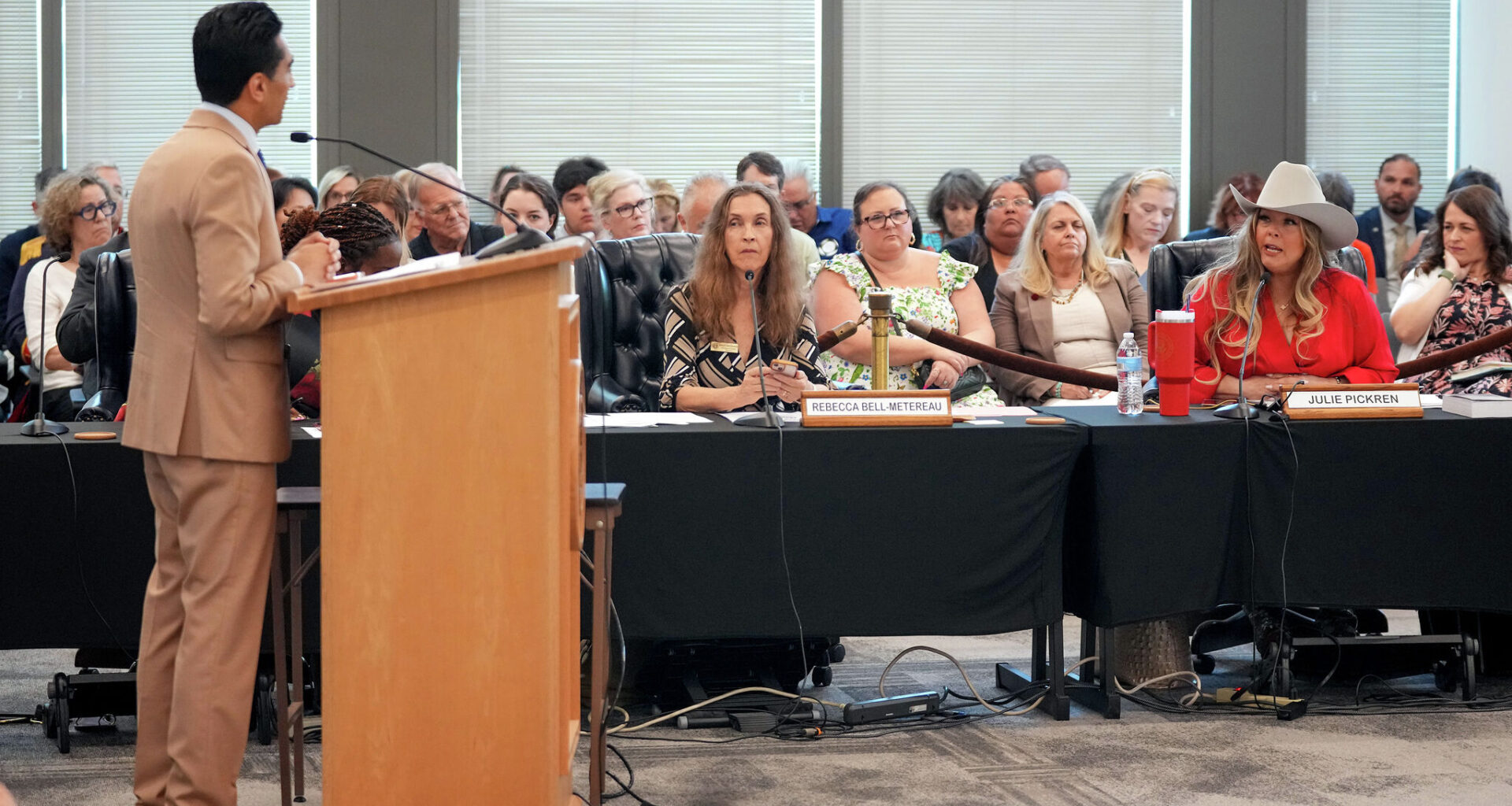
State Board of Education member Julie Pickren (right) questions state Rep. Salman Bhojani, D-Euless, during a meeting at the Barbara Jordan Building in Austin on Monday, June 22, 2026. The board is considering revisions that would place greater emphasis on Christian history and biblical content in public school classrooms.
Jay Janner/Austin American-Statesman
Republicans on the State Board of Education advanced a proposed social studies rewrite after significantly scaling back what Texas public school students learn about slavery and civil rights.
On Tuesday night, the board voted to cut previously proposed lessons that explained racial segregation and slave revolts. Also gone are provisions that had specifically acknowledged that African Americans were enslaved in the United States “because of the color of their skin,” and that southern states seceded from the Union in part to preserve the practice of slavery.
LIVE UPDATES: Follow along as the State Board of Education overhauls the state’s social studies standards
Article continues below this ad
Members did not explain the reasoning behind many of the changes.
But many of the concepts were dropped at the recommendation of the board’s panel of appointed advisors, a mix of historians and conservative activists. The advisors have taken on an expanded role in helping draft the standards, while work groups of classroom teachers have largely been sidelined.
The board will take a final vote Friday on the standards that determine what Texas students must learn in social studies classes from kindergarten to 12th grade. The controversial rewrite would emphasize U.S. history and Christian concepts, while dialing back lessons on world cultures and other religions. If approved, the new lessons would begin rolling out to public schools in 2030 and become part of standardized tests.
Republicans on the board described the goal of the overhaul as boosting public school students’ knowledge of American exceptionalism and Judeo-Christian values.
Article continues below this ad
“We just want our students to love our country,” Julie Pickren, a Pearland Republican, said during a GOP prayer session outside the Monday hearing.
On the whole, the new standards would dramatically boost the number of historical figures and events that public school students must learn about in each grade.
But historians told Hearst Newspapers that, taken together, the changes would flatten nuance and encourage students to memorize rote facts and figures, rather than wrestle with important debates. They said it’s especially true in the standards’ proposed telling of abolition and civil rights.
READ MORE: Texas to pay $8.4 million to fix errors in Christianity-infused Bluebonnet curriculum
Members of the board’s Republican majority expressed a desire throughout the week to elevate “heroes” of American history, like Harriet Tubman and Abraham Lincoln. The standards will require students to learn about more historical figures, including civil rights activist Claudette Colvin and Opal Lee, the Texan whose activism led to the recognition of Juneteenth as a federal holiday.
Article continues below this ad
But the proposal drops or trims back lessons on figures who fought desegregation or abolition, including Alabama Gov. George Wallace, the Ku Klux Klan and Confederate leaders.
The board also cut a detailed explanation of how Jim Crow laws perpetuated segregation, and renamed the Tulsa Race Massacre, believed to be the worst case of racial violence in American history, to the “Tulsa Race Riots.”
Those changes lead to a “whitewashed,” smoothed-out view of the country’s struggle against racial injustice, said Steven Mintz, a history professor at the University of Texas-Austin.
READ MORE: Texas’ curriculum overhaul would add Christian history lessons and Bible readings across all grades
“In most issues in history, there are legitimate debates among historians on the facts, the motivations,” said. “Instead, the standards treat this country as a completely unified people, and that therefore we should not focus on our differences.”
Article continues below this ad
The drafts also significantly recast slavery as a global, widespread phenomenon, rather than the current standards’ focus on the Atlantic slave trade to European colonies in the Americas.
Students would learn about examples of slavery among early indigenous civilizations in Texas, the Roman Empire, African kingdoms, the Vikings and medieval Muslims.
One of the content advisors, Donald Frazier, a history professor who runs the Texas Center at Schreiner University, said those lessons would provide the context that slavery is not unique to the United States.
“A lot of people would like us to think it’s the original sin in American history,” Frazier said. “This is a liberating opportunity for our Texas school kids to understand that this is a bad deal, and this was a bad deal all over the place.”
Slavery has indeed existed in many contexts, said Mintz. But the approach effectively “minimizes” the importance of the practice in the Americas, he said, especially because it was wholly race-based and set up decades of discrimination and continued prejudice into the modern day.
Article continues below this ad
SEE THE PROPOSALS: Here’s how Texas plans to boost religious content in public schools, grade by grade
“I am particularly concerned by efforts to minimize the role of race in discussions of slavery and segregation,” Tiffany Perkinz, a Houston-area educator, told the board. “Race was not incidental to American slavery, it was fundamental to it.”
Race was a point of tension throughout the public testimony on the proposed standards.
Advocates representing minority groups said the standards would trim lessons about Japanese internment and gloss over the history of Chicano communities. The board also voted to remove previously proposed lessons that explained the forced removal of American Indians and the rise of fascism in the 20th century.
Though Republicans generally voted together to advance the standards, several joined with Democrats to beat back repeated attempts to remove provisions that would require students to learn the central role slavery played in the Civil War, as well as a reference to the Chinese Exclusion Act, which restricted immigration based on race and nationality.
Other attempts by Democrats to re-insert certain provisions or add more about the history of minority communities failed.
“Our voices are being left out constantly,” said board member Tiffany Clark of Dallas.