
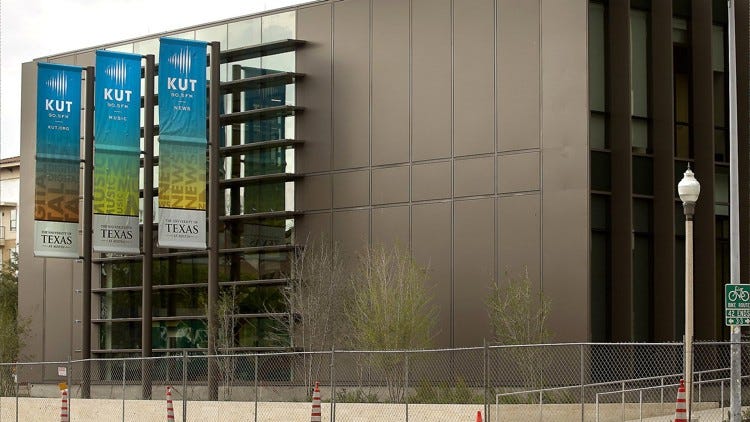
Major donors of KUT have begun to question whether the radio station should find a new license holder outside of the University of Texas.
Austin American-Statesman
Over the past five years, Lynne Dobson and her husband Greg Wooldridge have donated $2.5 million to KUT to bolster local journalism at Austin’s public radio station and help fund its inaugural community festival.

A public dispute between the University of Texas, which has licensed the station for its entire 68-year existence, and KUT’s management led to the last-minute displacement of the May festival off campus and the firing of General Manager Debbie Hiott. Since then, the funders have begun questioning whether the station and UT should sever ties.
Article continues below this ad
“We are just concerned that the ability to do journalism the way it is intended to do, if that becomes compromised, there have to be other alternatives,” Wooldridge said.
The couple said that in recent days, they have had a series of ongoing conversations with other KUT donors about what shape a separation would take and where the station would go.
RELATED: Emails reveal UT leaders’ role in KUT festival dispute before Debbie Hiott firing
“We are in a fact-gathering time right now,” Dobson said. “We aren’t rushing into anything and are continuing our support for the station right now.”
Article continues below this ad
A key question donors have discussed is whether the station should be housed at another institution such as Austin Community College, which has housed the city’s PBS station since 2022, or whether community members should establish KUT as a standalone nonprofit news organization. The radio station almost entirely supports itself through community funding.
Critical to any change, however, is UT’s willingness to relinquish the station’s license that it has held for nearly seven decades.
UT spokesman Mike Rosen declined to respond to questions about whether the university is committed to operating KUT and whether UT would be willing or interested in transferring its license to another owner.
UT also did not grant an interview request for interim KUT General Manager Gerald Johnson, nor did it reply to questions sent to the Moody College of Communication about the station’s relationship with the college.
Article continues below this ad
Austin resident Eugene Sepulveda, who served as president and CEO of Marfa Public Radio from 2012 to 2014, said the recent firing of Hiott and the removal of the festival from campus “has emerged as a friction point” in the station’s future. UT should safeguard the station from political influence “or spin it off,” he said.
Travis County Commissioner Brigid Shea, who worked as a public radio reporter early in her career before building her political resume in Austin, also has been involved in the discussions.
“I am extremely concerned, and I want to do everything I can to protect and keep it a strong community-oriented station that it clearly is,” she said. “It is a remarkable institution in our community, and I would hate to see it harmed.”
The University of Texas fired KUT General Manager Debbie Hiott after a dispute related to the radio station’s inaugural community festival last May.
Courtesy of KUT/ Gabriel C. Pérez
What happened at KUT?
The abrupt changes to the KUT festival in early May came after top UT officials claimed Hiott and other organizers had failed to sufficiently plan for security at the event. The festival ultimately drew about 2,000 people, including politicians from both sides of the political aisle.
Article continues below this ad
Anita Vangelisti, interim dean of the Moody College of Communication, which houses KUT, ordered Hiott to cancel the outdoor portions of the festival just a week before the event was set to begin, and several days after UT’s head of legal affairs, Amanda Cochran-McCall, asked for clarity on KUT’s permit for alcohol sales and inclement weather plan.
After a back-and-forth with top UT leaders, including the provost and a senior adviser to the president, KUT announced the forced cancellation of some programming and its plans to move all Saturday events off-campus. But Hiott, a veteran journalist who was previously the Statesman’s top editor for seven years, pushed back on UT’s allegations of security failures, saying that the station had addressed all concerns as the university raised them and had not received a list of deficiencies.
Democratic U.S. Sen. Cory Booker was the keynote speaker of the festival. UT officials did not discuss his appearance in documents reviewed by the Statesman, and his talk took place in UT’s LBJ auditorium as planned.
But the dispute gave rise to speculation that UT no longer wanted the festival on campus for political reasons amid conservative attacks against public broadcasting stations nationally. At UT, newly installed university leaders had previously promised to rid the campus of bias amid political pressure on universities to restore public trust.
Article continues below this ad
“I think (the festival) smelled ‘progressive’ and they tried to sabotage it with fabricated reasons,” Woolridge said. Sepulveda shared similar concerns.
In a letter written after the festival changes, Cochran-McCall accused Hiott of false statements and poor planning, stating, “The safety and security of our campus community is, and always will be, a top priority.”
Rosen declined to respond when asked if anything other than security concerns motivated the cancellation of the festival.
Hiott, who was fired June 15, told KUT in an interview immediately after her termination that “a community asset as important as KUT should not be in the hands of an institution that doesn’t have any sense of accountability or concern for the community. My hope would be that the university would relinquish the licenses to the community.”
Article continues below this ad
Dobson and Woolridge, who worked in journalism and established the Tejemos Foundation, a San Antonio-based nonprofit that funds community projects, said they started contributing to KUT because of Hiott’s leadership and commitment to independent local reporting.
“If they (UT officials) are going to try to suppress and oppress the news and cross the line of independence, we are in talks with a lot of people around town who want to keep an NPR station and want to keep a presence,” Dobson said.
University of Texas students walk through campus on the first day of classes Monday, Aug. 25, 2025.
Jay Janner/Austin American-Statesman
Could KUT be moved?
Moving KUT from under the university-held license would likely be impossible without UT participation.
Article continues below this ad
The Federal Communications Commission licenses radio frequencies set aside by the federal government for the public good to noncommercial entities such as nonprofits and universities, which hold legal authority over the assigned station. The FCC licenses the 90.5 station to UT for KUT. UT’s license doesn’t expire until 2029.
Jessica Nyman, an Austin attorney who specializes in FCC regulatory law, said UT and a proposed new license holder would have to submit documents about their proposed transaction and a license change application to federal officials, triggering a 30-day period for public comment.
Once that period is over, the transfer could be approved within a couple of weeks if there are no objections and the deal falls within FCC rules, she said.
Nearly half of all NPR affiliates have been housed at universities for decades. It started that way because universities could provide robust resources that other nonprofits lacked and act on the unique charge to invest in community and educational goods because of their own mission, said Christopher Terry, a professor at the University of Minnesota who has studied media ownership.
Article continues below this ad
For decades, the relationship between public radio and universities was a win-win. Universities managing and funding the stations demonstrated their public impact, while also raising their visibility in the community.
But a year after President Donald Trump accused NPR of liberal bias and Congress cut funding for public broadcasting — putting more pressure on universities to support their stations — some institutions have come to reckon with that historic relationship.
How structurally independent a radio station is from a university varies depending on its license requirements and available community support, as well as the university itself, Terry said.
Though community funds make up the bulk of KUT’s funding, station staff are UT employees, and its payroll, employees and systems are tied into university operations, making it a difficult and potentially costly relationship to untangle.
Article continues below this ad
But KUT pays administrative fees to both UT and Moody College for those services, including for portions of salaries that do not report to KUT, Hiott confirmed in an email to the Statesman. Hiott also said the station raised the money itself for its share of a new campus building in 2012.
Though independent stations exist — like Texas Public Radio in San Antonio and KERA in Dallas — they are rare because of the cost to run a station and operate a radio signal, Terry said. There are limits on how radio stations can make money because of their non-commercial status, making a university backer more important.
When the University of Bridgeport declared bankruptcy in 1991, its station, WPKN, became its own nonprofit and asked the FCC to approve the transfer of its license. The FCC did so in 1992, and the Connecticut broadcaster has remained independent since then.
Article continues below this ad