
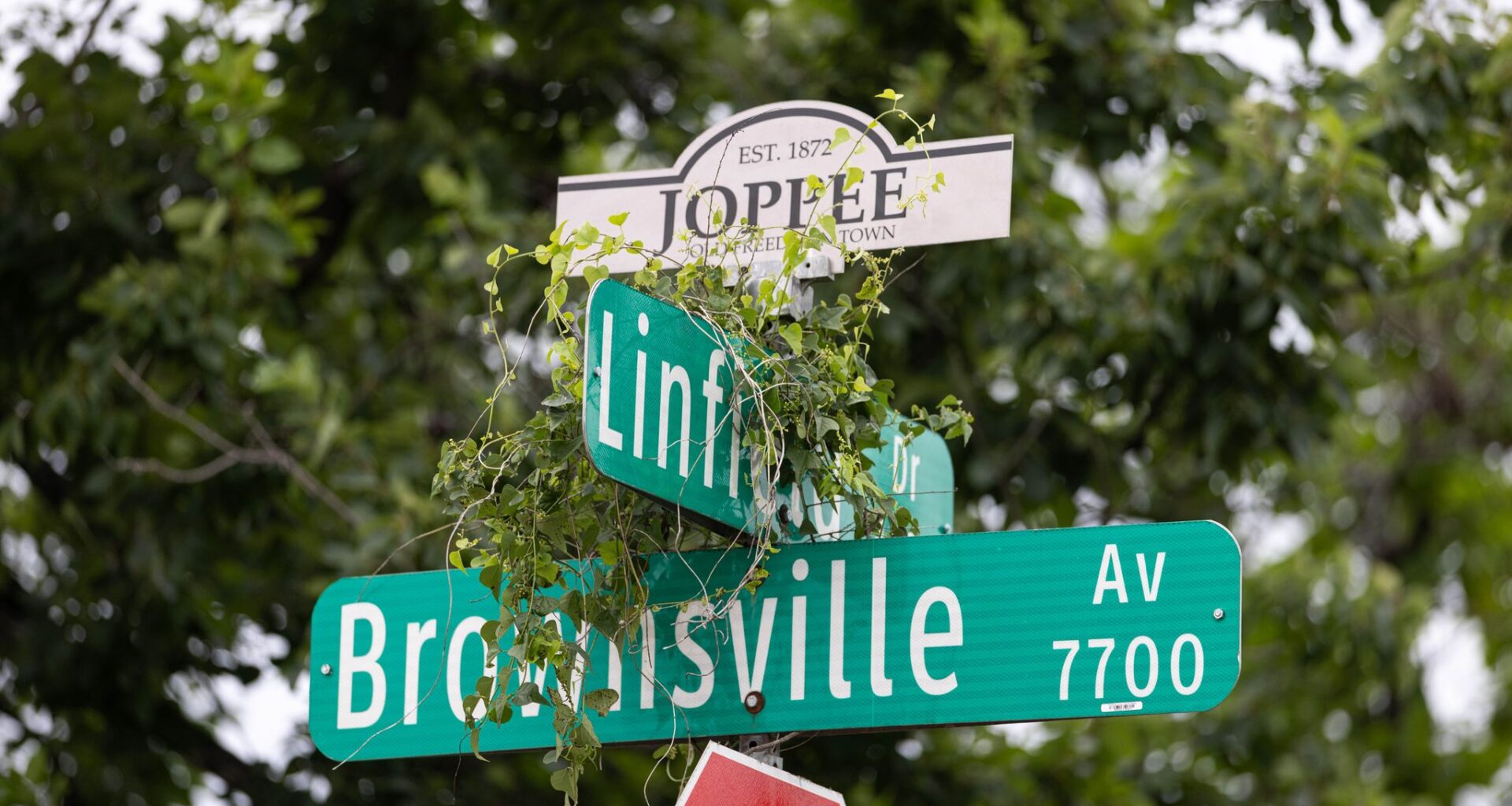
A sign topper for the Joppa neighborhood in Dallas, Tuesday, June 23, 2026.
Angela Piazza/The Dallas Morning News
In southeast Dallas, Joppa residents have lived for decades amid industrial facilities, facing pollution concerns and sparring between advocates and businesses despite the neighborhood’s lush, green environment.

City planners are looking to change that dynamic. They need the community’s feedback to do it.
“Those industrial land uses aren’t there by chance. They’re there by choice,” said Patrick Blaydes, a chief planner for Dallas.
Article continues below this ad
The city’s planning team kicked off community meetings Monday for the former freedman’s town, a small neighborhood tucked between the Trinity River and Union Pacific Railroad tracks. It’s part of the area’s authorized hearing process, which widely addresses future development by way of zoning changes.
The city is reviewing about 660 acres, which adds up to about a square mile.
The review could mean generational change for how land is used in Joppa. It aims to mitigate negative impacts of industry and resolve zoning inconsistencies, among other goals. With modern homes being built, community members have wanted to protect the area’s natural features. The river offers significant environmental and recreational value, according to planners. The goals also align with the city’s wide-ranging land-use plan, ForwardDallas, approved in 2024.
Related: ‘Vindicated’: Dallas City Council rezones neighborhood that once housed Shingle Mountain
“Our father’s fathers, or mother’s mothers, made those intentional decisions about what to put there,” Blaydes said. “That’s part of what ForwardDallas is meant to address. Those industrial-heavy land uses shouldn’t be next to a residential community.”
Despite a lack of air-conditioning in the room at the John C. Phelps Recreation Center, more than two dozen people gathered amid buzzing fans to ask about how the area could change. Blaydes said the community will help make decisions about whether current industrial sites go on to become townhomes, apartments or have other uses when a company leaves.
Yolander Thomas walks through the Joppee Wildlife Institute near the Trinity River wetlands in Dallas, Tuesday, June 23, 2026.
Angela Piazza/The Dallas Morning News
It wasn’t long before questions came up about the area’s air quality, and what would happen to nonconforming properties once the area is rezoned.
“All that dust constantly flying, that’s a great issue for me,” said Henry Hughes, who said he has a business in the area. “I’d like to have something done about that … I don’t even know if Joppa really realizes what’s going on.”
The discussion comes after years of residents requesting the use of amortization, a process that allows cities to close businesses that negatively impact the community. Residents have argued industrial facilities are harming their health and well-being. Companies have said they’ve been responsible neighbors.
Related: Dallas leaders want to know how much it would cost to shut down GAF, TAMKO
A 2022 study showed that residents of Dallas’ Joppa neighborhood are exposed to two to three times more air pollution and experience higher rates of respiratory illness compared with the rest of the city. Earlier this year, the City Council approved hiring a contractor to determine the price tag of closing industrial facilities that have operated for decades in Joppa and West Dallas.
Article continues below this ad
Changing zoning regulations won’t immediately push businesses out, and business owners — not just residents — will have their voices included in the process. City staffers then will blend “as many opinions as possible to come up with the best compromise,” said Jalyn Porchay, the senior planner leading the zoning discussions.
“Over time, the hope is [nonconforming properties] will phase themselves out and begin to go in a different direction as we look at addressing the zoning issues,” he added.
A City Council representative for the area, Adam Bazaldua, clarified that zoning is a completely different process from amortization, one that involves community collaboration to give residents a say in future decisions.
“It’s not a magic wand,” Bazaldua said.
Yolander Thomas, who said she grew up in the neighborhood with her family having several properties, has seen it change as new homes popped up aside older houses. That’s not necessarily a bad thing, she said. That development brings needed infrastructure like sidewalks.
But Joppa has long existed with industrial spaces in the neighborhood, Thomas said, and she hopes that the discussion is handled carefully about how change happens.
“I don’t think you can just wipe out industry,” Thomas said, adding, “We don’t want Joppa to lose its authenticity, the character, its history, and you face possibly losing that when you start putting all these mixed homes right up front.”
Adrian Jackson-Osin and sister Yolander Thomas, in orange, look out at several vacant acres of land in the Joppa neighborhood that used to host a community garden when they were children, they said, in Dallas, Tuesday, June 23, 2026.
Angela Piazza/The Dallas Morning News
She’s in support of the zoning reconsideration, but still wary of how the neighborhood has been treated over the years. She wants the area to see small businesses and other amenities.
“I don’t think the city has acted very responsibly toward Joppa,” Thomas said after the meeting. “I’m not asking for a lot. We just want to be included, because they’re making investments. Invest here.”
Injustices dealt to the community could find a solution in the authorized hearing process, said Tabitha Wheeler-Reagan, a plan commissioner for the Joppa area.
Related: South Dallas, Fair Park area hopes to see development after City Council approved rezoning
Article continues below this ad
Yolander Thomas, Joppa neighborhood property owner and former resident, walks past a home she says her grandmother built in Dallas, Tuesday, June 23, 2026.
Angela Piazza/The Dallas Morning News
Wheeler-Reagan noted to the group that South Dallas completed a wide-ranging plan for its growth last year. Earlier this month, City Council approved new zoning for that area, aiming to welcome needed development while preserving South Dallas’ character.
“I understand the distrust of the past, but this is an opportunity for you all to get what you need,” she said.
The Joppa community meeting Monday was the first of at least three over the next several months. Then, staff recommendations could head to the city’s plan commission for a public hearing before going to the City Council for consideration and final approval.
More information is available, along with an option to submit comments, on the city’s website.
This reporting is part of the Future of North Texas, a community-funded journalism initiative supported by the Commit Partnership, Communities Foundation of Texas, The Dallas Foundation, the Dallas Mavericks, the Dallas Regional Chamber, Deedie Rose, Lisa and Charles Siegel, the McCune-Losinger Family Fund, The Meadows Foundation, the Perot Foundation, the United Way of Metropolitan Dallas and the University of Texas at Dallas. The News retains full editorial control of this coverage.