
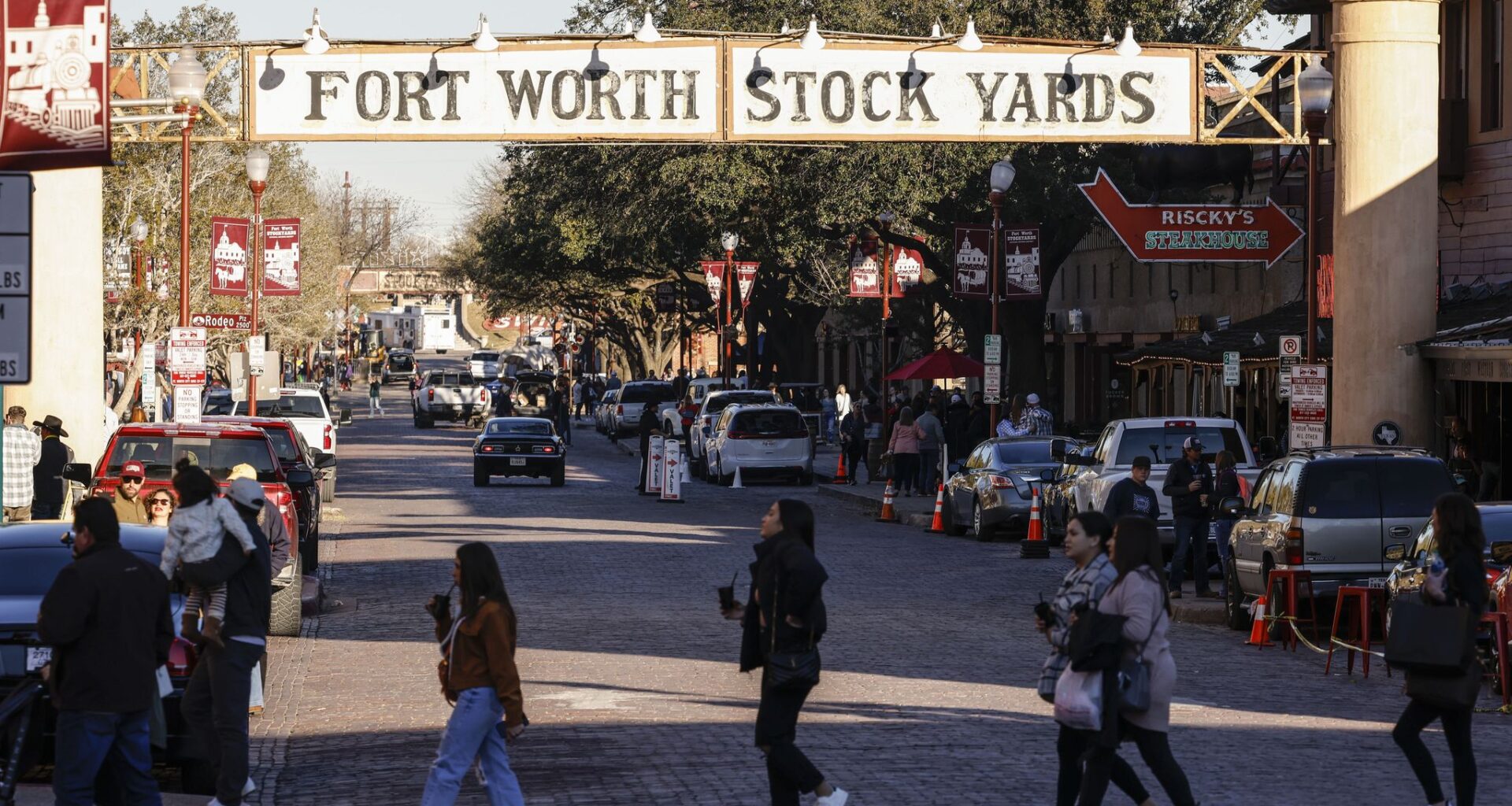
From the historic Stockyards to its world-class Cultural District, Fort Worth has lots to offer on the western side of the D-FW area.

A city with many names, Fort Worth is variously known as the city “where the West begins,” “Cowtown” and “Panther City.” It is also one of the fastest-growing big cities in the United States and recently reached a population of 1 million people.
Michelin-recommended Birrieria y Taqueria Cortez restaurant is in Fort Worth.
Here’s your guide to Fort Worth:
Article continues below this ad
Fast facts
Article continues below this ad
Race / ethnicity
One race, white: 43.6%
One race, Black or African American: 19.1%
One race, American Indian or Alaska Native: 0.7%
One race, Asian: 5.3%
One race, Native Hawaiian: 0%
One race, some other race: 8.1%
Two or more races: 23.1%
Hispanic or Latino origin (of any race): 35.2%
White alone, not Hispanic or Latino: 35.7%
Educational attainment
For ages 18-24 (roughly 10.1% of the population)
Article continues below this ad
Less than high school degree or equivalent: 15.5%
High school graduates (or equivalent): 38.4%
Some college or associate’s: 32.8%
Bachelor’s degree or higher: 13.3%
For ages 25+ (roughly 64%)
High school graduates (or equivalent): 24.85%
Bachelor’s degree: 21.7%
Graduate or professional degree: 11.8%
Housing
397,627 units; 362,403 occupied (91.1%)
Article continues below this ad
210,450 owner occupied
151,953 renter occupied
259,508 1-unit detached
12,573 1-unit attached
118,962 multi-unit
6,069 mobile homes
515 RVs, boats, vans, etc.
Median home value: $330,500
Median rent: $1,630
Compiled by staff researcher Rachel Friend. Data from U.S. Census Bureau, American Community Survey 2024 1-Year Estimates Subject Tables, Tables S0601, S1501, S1903, S2301, DP04.
Article continues below this ad
Longhorns from the Fort Worth Herd relaxed in the shade of a holding pen after being driven down Exchange Avenue in the historic stockyards June 27, 2023.
Tom Fox/Staff Photographer
A brief history
Before it was a town, Fort Worth was a U.S. Army fort built to defend the western frontier along the borders established by the Treaty of Bird’s Fort that Texan settlers signed with local Native American tribes in 1843.
A small civilian community grew near the fort in the 1850s and the fort was vacated in 1853, according to the city’s website. It narrowly won an election to become the Tarrant County seat in 1856, wresting the designation away from Birdville. In 1860, it won another election that reaffirmed its position as the county seat, according to the Texas State Historical Association.
The city was incorporated by the state Legislature in 1873 with a population of around 4,000, according to TSHA. Around that time, the arrival of cattle drives and railroads paved the way for modern Fort Worth.
Article continues below this ad
The cattle drives along the Chisholm Trail saw herds of longhorns move through the city from South Texas to the railheads in Kansas. The drives also brought business to the city as it sought to cater to the cowboys making their journey north, according to the city. These drives gave the city its Cowtown nickname.
The first railroad arrived in Fort Worth by 1876 and was soon followed by numerous other lines. That also brought with it some key advancements like waterworks, a streetcar line and eventually electric lights and a telephone exchange by the 1880s.
A significant meatpacking industry developed in Fort Worth early in the 20th century, helping grow the city to more than 70,000 residents by 1910. The discovery of oil deposits in several towns just west of the city brought another industrial boom for Fort Worth, which soon became central as a refinery and pipeline center, according to the city.
The Fort Worth Water Gardens were built in 1974.
David Woo/Staff Photographer
Notable landmarks
Fort Worth Water Gardens: This public water feature was designed by architects Philip Johnson and John Burgee in downtown Fort Worth and opened in 1974. It is on the former site of the notorious Hell’s Half Acre district that was a hub of gambling, prostitution and other illegal activities in the late 19th century.
Fort Worth Stockyards: Dating back to the days of cattle drives through Fort Worth, the Stockyards are now a lively entertainment district just north of downtown. The area still hosts twice-daily cattle drives on most days.
A platter with brisket, sausage, turkey, ribs, homemade brioche, sides and desserts at Goldee’s Barbecue in Fort Worth.
Chitose Suzuki/Dallas Morning News
Things to do
Bars and restaurants
61 Osteria
Birrieria y Taquería Cortez
Cattlemen’s Steak House
Don Artemio
Ellerbe Fine Foods
Goldee’s Barbecue
Joe T. Garcia’s
Kincaid’s Hamburgers
Lonesome Dove
Panther City BBQ
Reata
A coyote left a creek after drinking from it July 20, 2018, in Trinity Park in Fort Worth.
File Photo/Fort Worth Star-Telegram
Parks and trails
Fort Worth has more than 300 city parks totaling more than 13,000 acres, according to the city’s website. Here are a few standouts:
Arcadia Trail Park
Dream Park
Forest Park
Fort Worth Nature Center & Refuge
Gateway Park
Numerous parks sit along the shores of Lake Worth, including Mosque Point Park, Arrow S. Park and Camp Joy Park
Rosemont Park
Trinity Park
Trinity Trails
Shopping
Hulen Mall
The Shops at Clearfork
The north gallery in the new Renzo Piano Pavilion at the Kimbell Art Museum features Precolumbian and African art.
Staff Photographer
Museums
Amon Carter Museum of American Art
Kimbell Art Museum
Modern Art Museum of Fort Worth
Stockyards Museum
Texas Cowboy Hall Of Fame
Entertainment and sporting venues
Amon G. Carter Stadium
Bass Performance Hall
Colonial Country Club
Dickies Arena
Schollmaier Arena
Texas Motor Speedway
Will Rogers Memorial Center
Sam Houston, the Fort Worth Zoo’s newest Asian elephant calf, was born April 1, 2026.
Fort Worth Zoo
A fun fact
The Fort Worth Zoo is the oldest continuous zoo site in Texas and dates back to 1909, according to its website. Today, the zoo hosts more than 500 species of animals and receives about 1 million visitors a year.