
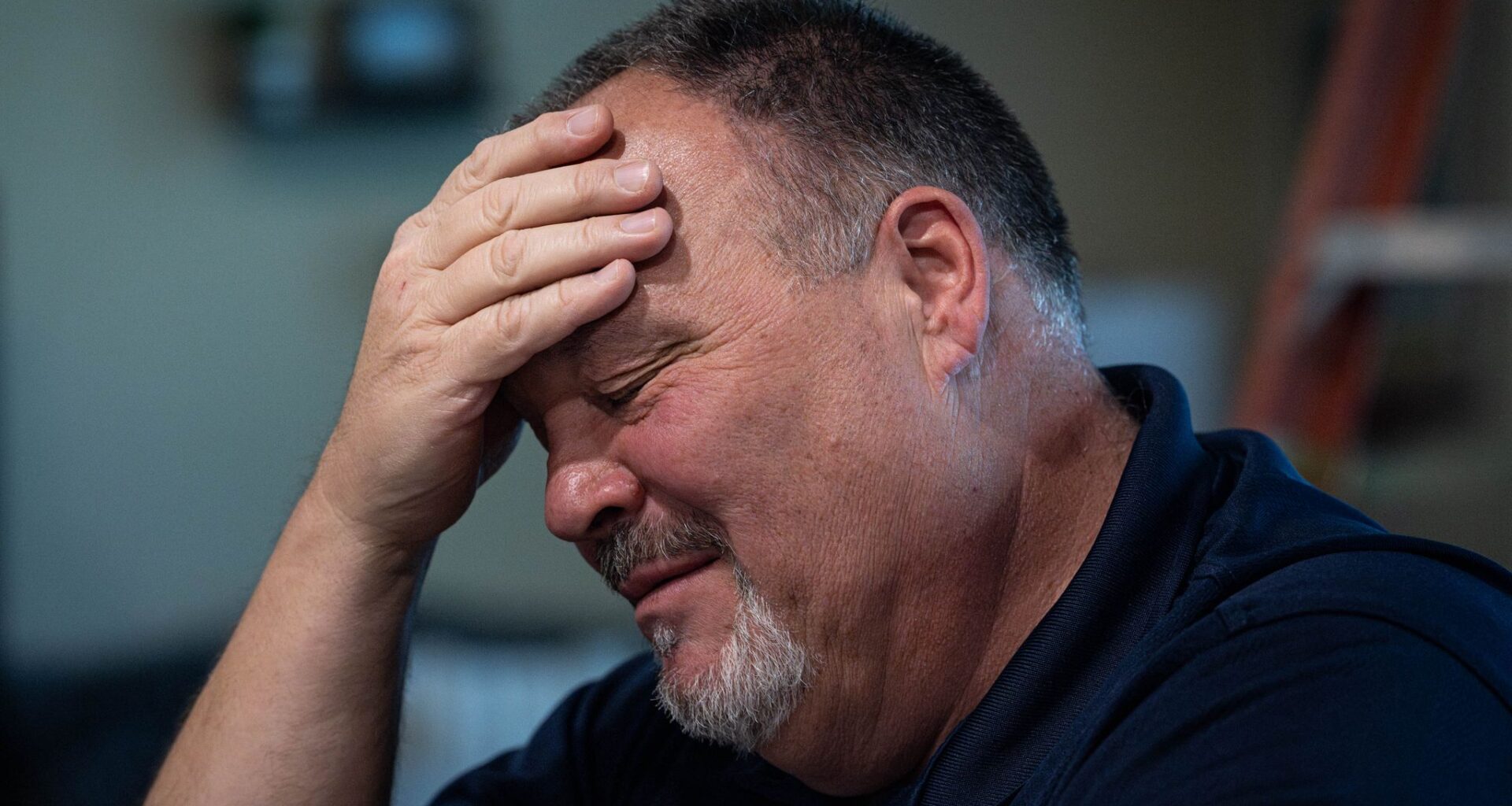
Perry Lynch, 59, rubs his forehead while sitting in the kitchen of his home on the edge of Keller. Lynch is suffering from numerous medical issues following complications from a biopsy, he said.
Angela Piazza/The Dallas Morning News
The procedure, the surgeon explained, was relatively low risk. It was sensitive — any procedure that goes through the nose and toward the brain is bound to be — but it was also fairly straightforward. Just a biopsy.

Perry Lynch, a 59-year-old Texan, turned out to be the exception. In his case, the biopsy of a mass at the base of his skull resulted in a rare complication and marked the beginning of a cascade of medical events that have fundamentally changed his life.
Before the procedure, Lynch was active. He played tennis when he had time, he said, and he regularly rode his mountain bike. Since February 2025, when he underwent the biopsy at UT Southwestern Medical Center in Dallas, that’s changed.
Article continues below this ad
He described his most troubling symptoms like this: He has double vision. He’s sometimes gripped by searing pain through the back of his head. He struggles so much with balance that it is, some days, a Herculean feat to walk to the mailbox and back.
Before the surgery, Lynch worked in orthopedic sales education; Working, at least in the way he was before, is now out of the question. As a result, Lynch and his wife are prepping to sell the house they built more than 20 years ago.
He mourns each of the things that are no longer possible for him, the things that made his life normal.
A calendar showing preparations to sell their home hangs in Perry Lynch’s kitchen. The house, Lynch said, is his dream home. He and his wife built it in 2005. He doesn’t want to sell it.
Angela Piazza/The Dallas Morning News
“I’ll never be able to retire like I could before,” he said. “I’m never going to be able to … play with a dog or ride my bike or play tennis. I’m an avid hunter; I’ll never be able to hunt again.”
Article continues below this ad
UT Southwestern’s media team did not respond to requests for comment. Dr. Sei Chung, who specializes in head and neck surgery and was the lead surgeon on Lynch’s case, also did not respond to multiple requests for comment.
Lynch believes the surgeon at UT Southwestern made an error during his biopsy, leading to the massive hemorrhage that he experienced in the operating room, multiple follow-up procedures and a permanently changed life.
An outside medical expert — Dr. Christopher Graffeo, a neurosurgeon and a faculty member at OU Health, the University of Oklahoma’s academic health system, in Oklahoma City — looked at Lynch’s medical records at the request of The Dallas Morning News and with Lynch’s permission. He came away with a different conclusion. While it’s difficult for anyone who wasn’t in the operating room to determine exactly what happened, Graffeo said, it may be that Lynch’s surgery complications were simply unlucky.
“I think that this is just a combination of bad disease and bad luck,” Graffeo said.
It can be hard to distinguish, too, between impacts of the tumor itself and impacts of the procedures.
Article continues below this ad
Either way, this much is clear: Lynch underwent a low-risk procedure and come out of it with significant complications.
In the wake of the surgeries, Lynch has looked into legal options. So far, he hasn’t found an attorney to take his case.
Now, with little recourse available, he’s left to cope with the fallout as best he can.
Going into surgery
Lynch’s medical records, which he shared with The Dallas Morning News, show that he first went to the doctor for issues with his knee and leg.
Article continues below this ad
The medical providers sent Lynch for scans and, “incidentally,” one of the scans turned up a tumor at the base of his skull, near the pituitary gland. A follow-up scan noted the tumor was “extensive” and “large.” It was unclear, the medical records say, what type of tumor it was.
Perry Lynch, 59, sits at his desk in his home on the edge of Keller. Lynch said he is forced to sell his family’s “dream home” after a tumor discovery and a biopsy with complications set off a cascade of medical issues.
Angela Piazza/The Dallas Morning News
“They really didn’t know if it was a malignant tumor or a benign tumor,” Lynch said.
The medical providers, the records show, thought it was most likely that the tumor was malignant in some form. But to determine that, they recommended a biopsy. The procedure, as the medical providers at UT Southwestern explained to Lynch, would be through his nose.
Any procedure, any medical intervention, has risks. Lynch’s understanding, though, was that this procedure was low-risk. There would be a couple of days of recovery but, he said later, the medical team talked about it the same way they might talk about going to the dentist. He was left with the impression that it was no big deal.
Article continues below this ad
In early February 2025, Lynch arrived at UT Southwestern’s campus in Dallas. He was admitted to the hospital, taken to the operating room, laid on his back and knocked out with anesthesia.
Unconscious, Lynch entrusted himself to the surgical team. He doesn’t know exactly what happened in surgery, because he didn’t witness it. But the medical records, and his own recollection of what the medical team told him afterward, give an outline.
In the operating room
The surgical notes in Lynch’s medical records offer a summary of the procedure.
After Lynch was knocked out, Dr. Chung and the surgical team went up through Lynch’s nasal passages and saw the tumor in his sinus. The plan was to take pieces of the tumor and send them for testing, to find out what it was made of.
Article continues below this ad
“With the first biopsy of this soft submucosal mass,” the surgical notes read, “the tumor briskly hemorrhaged.”
The notes record more bleeding again later in the procedure, as more biopsies were taken. Eventually, the notes say, Lynch underwent “massive hemorrhage” and lost about 2 liters of blood. For reference, the average adult male has about 5 liters of blood in his whole body.
Graffeo, the outside expert, looked at the medical records and said it appears that the biopsy damaged Lynch’s carotid artery. (The carotid arteries — one on each side of the body — are major blood vessels that run up the neck and supply blood to the brain.)
It’s rare, Graffeo said, for this type of procedure to lead to a carotid artery injury. But it is a known complication.
It’s difficult to tell from just the medical records, but Graffeo said he believes the most likely scenario is that the tumor was essentially affixed to the carotid artery. When the surgeon used a tool to take a “bite” of the tumor and then pull it away, Graffeo theorized, the artery wall may have been damaged or broken by the pulling of the tumor.
He added, too, that the tumor may have already damaged the artery.
“It is probably a consequence of very severe disease, where the blood vessel was weakened as a consequence of the very aggressive tumor,” Graffeo said, “and that probably predisposed it to an injury from a biopsy that is typically quite rare to see in that context.”
Graffeo sees the situation as unfortunate, but likely not the fault of the surgical team. Lynch believes the massive hemorrhaging and later complications were caused by medical errors.
Either way, the result was the same.
“I actually bled out on the table,” Lynch said.
The surgical team stabilized Lynch, the notes say, and packed his sinuses to stop the bleeding. The tumor, the test results showed, was a non-cancerous pituitary gland tumor and Lynch would be placed on a medication to treat it.
He was transferred out of the operating room and eventually discharged. But it wouldn’t be long until he was back in the hospital.
Perry Lynch, 59, explains pictures of his brain scans at his home. After biopsy of a tumor at the base of his skull, Lynch said he suffered severe blood vessel damage.
Angela Piazza/The Dallas Morning News
Days after the biopsy, the medical records show, Lynch was in the ER, reporting double vision, headaches and a “swishing” sound in his head. He had severe blood vessel damage; the notes from that emergency visit show a diagnosis of a cavernous carotid fistula and a pseudoaneurysm. In the seven weeks following the biopsy, Lynch underwent three additional procedures to stabilize the blood vessels.
He survived. But, his medical records note, he continued having serious symptoms.
Aftermath
In late April, Lynch’s home office was largely packed into boxes. Photos and wall art were stacked together, leaning against the wall. A yellow-lidded crate sat in the dining room. There were more boxes in the bedrooms, each room of the house packed up or on its way there.
The house, Lynch said, is his dream home. He and his wife built the house, on the edge of Keller, in 2005. He doesn’t want to sell it.
But since the biopsy and the follow-up procedures, Lynch said, he hasn’t been able to work. Lynch worked in orthopedic sales education, training sales reps on medical devices and implants. His work often took him inside the operating room during procedures. It’s a job that, with his symptoms, he can’t do right now.
He‘s lost hearing in one ear, he has double vision, his sense of balance is gone. When he’s stressed, he sometimes gets face palsy — like “a wax figure that’s melting,” he said.
And then there’s the pain.
Pills are stacked near a bible on Perry Lynch’s desk. Lynch frequently speaks with his former pastor after the discovery of a tumor changed his life, he said.
Angela Piazza/The Dallas Morning News
Lynch has episodes that feel, he said, “like somebody’s driving a spike through the back of your head.”
“The pain is excruciating,” he said, “You just want to die, the pain is so intense.”
Amid the pain and the neurological symptoms, Lynch is plagued also by another factor: He feels helpless. He doesn’t see a way to hold anyone at UT Southwestern accountable for the ways his life has changed.
Lynch believes the UT Southwestern surgeon is responsible for the ways his life has changed. But he hasn’t been able to find an attorney to take his case.
In general, in Texas, not being able to find an attorney doesn’t mean that a patient didn’t experience an error. Under Texas medical malpractice law — especially the caps on the amount of non-economic damages that can be awarded — some attorneys are reluctant to take any malpractice cases at all. Even patients with very clear-cut cases may struggle to find an attorney, and there are ways in which Lynch’s case is less clear-cut.
“I’m just the little guy, and I’m getting smushed,” he said.
Lynch’s former pastor — Gregg Simmons — has seen the impact firsthand. Simmons has known Lynch and his family for more than 30 years, first when they were members of his church in the Panhandle and then later when they were members of his church in Grapevine.
Before Simmons retired in 2013, he played tennis with Lynch. The two have reconnected in the wake of Lynch’s surgeries, and Simmons has seen how different his friend is now.
“It’s been devastating, not only physically, but emotionally,” Simmons said. “The change I’ve seen is catastrophic — that’s the word I’d use — on every level.”
Perry Lynch, 59, sits at a table in a room that is partially packed in his Keller home in April.
Angela Piazza/The Dallas Morning News
Lynch is left with this question: What is he supposed to do now?
“They’re like, ‘You need to just go on with your life,’” Lynch said. “And I’m like, ‘Well how do I do that?’”
Lynch and his wife are prepping their home on the edge of Keller to go on the market, and then they plan to move into a farmhouse in a town northwest of Fort Worth. It’s a house that’s been in Lynch’s family for years.
It’s not what Lynch thought his life would look like as he approaches his 60th birthday. But for now, it’s the only thing he can think to do.