
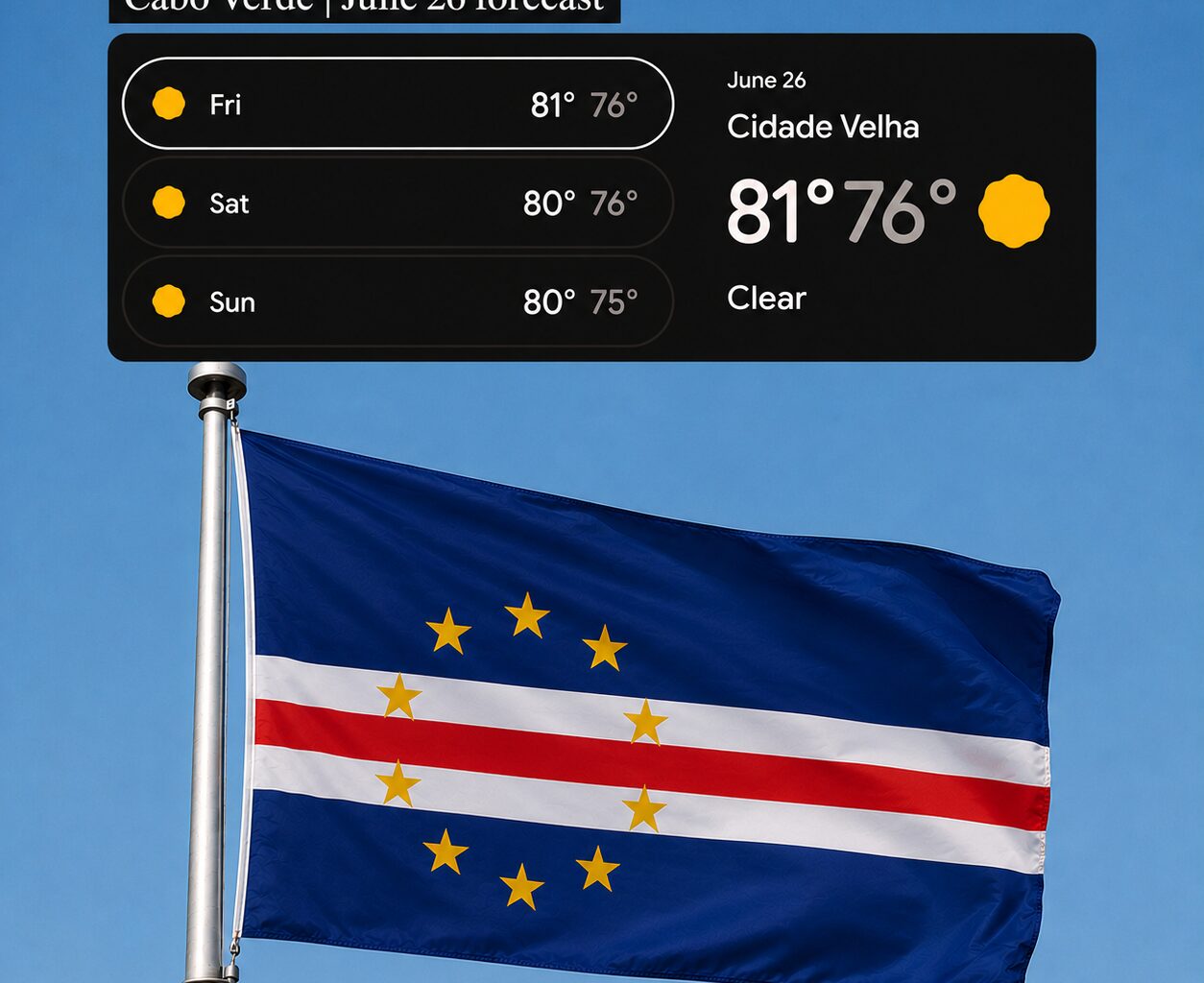
The city will host its fifth FIFA World Cup match Friday when Cabo Verde faces Saudi Arabia in the Bayou City. With Houston’s forecast spinning its wheels in a familiar pattern of sunshine, Saharan dust and little chance of rain, let’s compare our Gulf Coast weather with the breezy tropical Atlantic climate on the islands of Cabo Verde and the scorching desert environment of Saudi Arabia.
Like we said, the local forecast continues to remain fairly stable. High atmospheric pressure remains firmly in control of Houston’s weather, keeping rain chances near zero and afternoon temperatures in the lower to mid-90s. Peak daytime temps likely won’t threaten daily records, but heat index values, or humidity-driven “feels like” temps, could exceed 105 degrees and create dangerous conditions for World Cup fans.
While a plume of Saharan dust will continue creating hazy skies across Southeast Texas, concentrations are not expected to be particularly high.
By the time Cabo Verde and Saudi Arabia kick off their match Friday evening, temperatures would have fallen into the 80s. Although the stadium will be climate-controlled, fans waiting in line outdoors before the match should prepare for a especially warm evening.
Cabo Verde might be more familiar with the kind of weather gripping Houston these days.
The island nation in the far eastern Atlantic is currently in its dry season, with abundant sunshine, limited rainfall and temperatures that generally top out in the low to mid-80s. While Houston’s weather is shaped by the Gulf of Mexico instead of the open Atlantic, both locations experience warm nights and a strong maritime influence.
Cabo Verde also sits along the path of the same Saharan dust plumes that occasionally cross the Atlantic and reach Texas, including the haze currently lingering over Houston.
Like much of Texas, Saudi Arabia certainly knows heat. A look at Riyadh’s forecast shows daily highs hovering around 110 degrees with overnight temperatures in the mid-80s, highlighting just how extreme summer heat can become across the Arabian Peninsula.
Humidity is where the comparison really breaks down, though. Houston’s summer air is loaded with atmospheric moisture coming off the Gulf of Mexico, but Riyadh’s desert climate remains exceptionally dry. In fact, overnight dew point temperatures, which can indicate how saturated the air is with water vapor, can be lower in Riyadh year-round than what Houston often experiences only during winter.
That leaves Houston somewhere between the two climates. It is hotter than Cabo Verde but far more humid than Saudi Arabia, creating a weather profile that is uniquely Gulf Coast.