
A Tesla Cybercab with a driver behind the wheel is seen in Austin on Monday, Feb. 23, 2026. Unlike prototypes that have been seen on streets around Austin since January these had no rearview mirrors. Tesla CEO Elon Musk has said the purpose-built robotaxi will begin production by April.
Jay Janner/Austin American-Statesman
Most Texans have never ridden in a robotaxi but they have strong feelings about their legality, questions about state regulation — and nearly half think the technology powering Tesla Inc.’s robotaxis should be illegal.

A new poll by a group called Safe Autonomous Vehicles Everywhere in the United States, or Save-US, surveyed almost 1,100 registered voters across Austin, Dallas and Houston about the state of robotaxis. Among the more than 350 surveyed in Austin in late May, 44% said the vehicles “aren’t ready to be driven on most roads and can’t perform close to humans.”
Article continues below this ad
A slightly smaller portion — 40% — said robotaxis have capabilities that meet or exceed human drivers for many use cases. The rest either said autonomous vehicles will never be able to safely transport humans or they weren’t sure.
“Some people are very excited about autonomous vehicles and some people are honestly terrified of them, and I can understand both sides of that,” said Shua Sanchez, national campaign director of Save-US. “I’m not sure how this whole thing will shake out. It seems likely that as long as there aren’t massive catastrophes that happen, we’re going to hit a point where there are autonomous vehicles everywhere in the country, and they just become a normal part of life.”
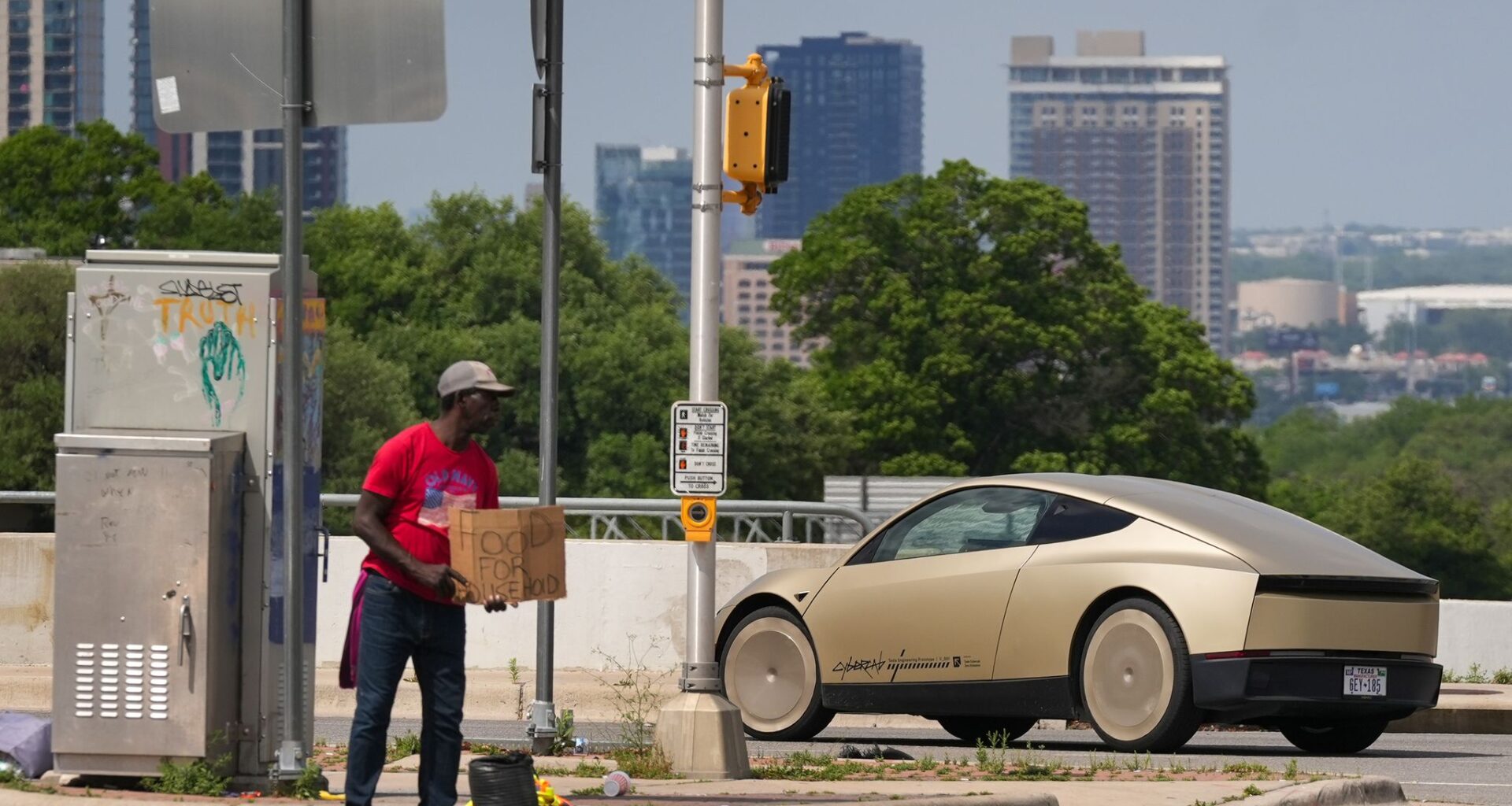
A Tesla Cybercab drives past a man panhandling on the I-35 frontage road at Oltorf Street in Austin, Tuesday, April 14, 2026.
Jay Janner/Austin American-Statesman
As that possibility looms, Austin residents expressed concern about Tesla’s Full Self-Driving technology. Forty-four percent said they somewhat or strongly believed the tech should be illegal while 35% said it should be legal. Another 21% aren’t sure.
Article continues below this ad
San Antonio Express News Logo
Make us a Preferred Source on Google to see more of us when you search.
Add Preferred Source
Waymo, the industry leader that has more than 600 vehicles operating in Texas, inspires higher confidence with 34% of Austin respondents saying its self-driving cars should be illegal and 52% saying they should be legal.
Sanchez, along with Save-US founders Sam Haass and Bob Somers (a former engineer at Zoox), are leading the road safety organization that launched in the fall with the goal of establishing responsible safety regulations for autonomous vehicles.
Sanchez said that’s important because about 60 companies in the U.S. are working to build autonomous vehicles right now.
Article continues below this ad
“We’re really concerned that state legislatures are going to look at companies like Waymo and say, ‘Wow, look, AVs are incredibly safe, let’s just legalize them with no state oversight whatsoever.’ And then next thing you know, there’s going to be all of these other companies that don’t have nearly as good of a safety track record that suddenly get authorized as well without any kind of oversight,” he said.
A Waymo obotaxi navigates around a rollover crash at West 15th and San Antonio streets in Austin, Tuesday, May 26, 2026.
Jay Janner/Austin American-Statesman
In Texas, companies are required to receive authorization by proving readiness on several fronts, including equipping vehicles with a recording device, demonstrating they can comply with state and federal laws, and that they bring minimal risk if the self-driving tech becomes inoperable. The Texas Department of Motor Vehicles has administrative authority to issue and revoke authorizations.
Save-US is pushing for “California style” policy goals for state legislators across the U.S., including strong data sharing rules, multiple testing permits and multiple sensors to guide vehicles.
Article continues below this ad
The group is also calling for legally defining driver assistance features and strong truth-in-advertising laws. Notably, Tesla has faced regulatory scrutiny over allegedly misleading marketing of its Autopilot and Full Self-Driving systems.
In the Save-US poll, Texans shared high concern over Tesla’s operations. In Austin, 72% of respondents said they would support TxDOT revoking Tesla’s authorization to operate its robotaxis as a paid ride-hailing service until it can demonstrate safe and lawful operation. In Houston, where support for revoking authorization was lowest among the polled cities, 56% still said the state should cut it.
Similarly high disapproval was found for the prospect of Tesla’s purpose-built robotaxi, Cybercab, operating as a commercial taxi. Opposition reached 59% in Houston and 66% in Austin.
Open-ended responses revealed specific concerns about robotaxis. “I see them create chaos daily,” one respondent said, while another said they should perform better in “non-typical situations.”
Article continues below this ad
Another response expressed dissatisfaction with the rigor of testing before the vehicles were deployed in Austin.
“We already have enough traffic issues. It’s like adding hundreds of new student drivers all in one area,” the respondent said. “They cause confusion and uncertainty which leads to other drivers having to make split-second decisions, which can lead to accidents … I think the rush to try this new technology and realize a profit from them superseded safety concerns.”