

Election Day is here for Texans casting ballots to decide on 17 proposed changes to the state constitution.
Residents of some cities and school districts in Dallas and Collin counties will also weigh in on a slew of city council races, bond questions, tax increases and other local issues.
Voters cast ballots on 17 changes to the state constitution on Tuesday, including significant property tax reductions. Also on the ballot were local bond issues, municipal office and one state Senate special election. Off-year elections often receive little attention, but have meaningful races that sometimes go unnoticed.
When are voting centers open?
Polls are open from 7 a.m. to 7 p.m. and a list of voting locations can be found here for Dallas County and here for Collin County.
Breaking News
Turnout ahead of Election Day through in-person and mail early voting was sparse. Roughly 7% of Dallas County’s 1.4 million registered voters cast a ballot during the two-week early voting period as of the end of day Friday, according to elections department data.
Dallas County Elections Administrator Paul Adams, who took over the department Oct. 1 after overseeing elections in Lorain County Ohio, said “local issues are always what drives turnout,” which may explain some of the thin numbers so far.
What’s on the ballot in Texas elections?
Besides the statewide constitutional amendments, local issues appear on the ballot only for the cities of Duncanville, Farmers Branch, Glenn Heights, Mesquite and Sunnyvale. The independent school districts of Garland and Richardson also have tax and bond questions, respectively. Adams said early voting numbers have been higher in these areas than the county overall, but there is time to make up for it on Election Day.
“All the more reason for people to get out there and vote,” Adams said. “The weather’s been relatively good so this is a perfect opportunity for people to show up.”
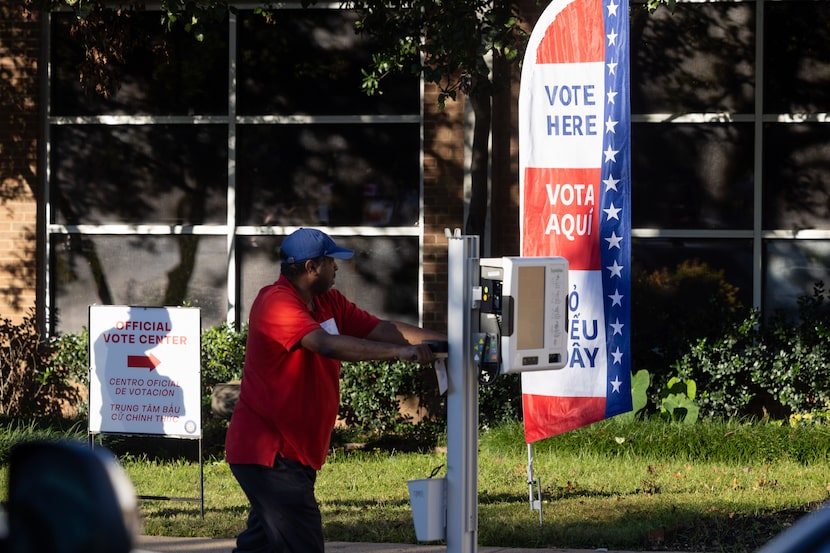
A poll worker wheels back a curbside voting machine at the Duncanville Public Library vote center in Duncanville on Tuesday, Nov. 5, 2024.
Juan Figueroa / Staff Photographer
About 8% of Collin County’s 755,390 registered voters had cast a ballot during the early voting period.
Kaleb Breaux, elections administrator for Collin County, said early voting has gone normally so far, despite the county implementing new rules under which voters have to bubble in their ballot by hand and rolling out a new voter registration system.
In June, the county Commissioners Court voted to adopt hand-marked paper ballots following an executive order by President Donald Trump aimed at changing how elections are run across the country. The hand-marked ballots will still be tabulated by a machine within the polling place and will not be hand-counted.
“We’ve had a few voters that want to know why we’re going back backwards with technology. I think a few voters missed the ballot-marking devices,” Breaux said, “But outside of that, the process itself has been relatively smooth.”
Related

Residents across Collin County will vote on creating an emergency services district to fund fire and ambulance services in unincorporated parts of the county. In Anna, voters will decide on a host of amendments to the city’s charter, and in Princeton ISD, voters will elect two members to the district’s board of trustees — among a slew of other local issues in cities and utility districts across the county.
The lengthy ballot includes the same 17 amendments for all Texas voters. They include whether to cut property taxes, expand who can be denied bail, commit more sales tax revenue to address water infrastructure and supply concerns, and other issues.
Dallas County voters
It was a crisp 55 degrees when Yolanda WrightDavis went to vote in East Dallas shortly after polls opened with her 14-year-old chihuahua Mercy Isaac in tow.
Ahead of election day, she reminded her friends to make sure they were registered and attended all the voter information sessions held at her senior living home.
“It’s our right to speak out and protect your chance to make change,” WrightDavis, 62, said.
Although voter turnout so far has been sparse, WrightDavis said all 17 propositions on the ballot were important to her because they affect every aspect of life in Texas.
“It has a greater effect than people realize on their lives,” WrightDavis said.
Until Tuesday, Justin Mahood, 36, said he had never shown up for off-year elections without a presidential race on the ballot.
But as he watched news over the last year about what he described as “the Republican party trying to dismantle democracy,” his concern caused him to pay closer attention to state and local issues.
“It wasn’t until last year that I really started paying attention to local government,” Mahood said.
When he reviewed the 17 constitutional amendments on the ballot, he was most concerned about the proposed ban on capital gains taxes and the change the makeup of the State Commission on Judicial Conduct, both of which he opposed.
Norma and Paul Terrell said they vote in every election no matter what’s on the ballot, but they wish more people would show up for odd-year elections.
Norma Terrell, 71, said she was overjoyed to see a mother at the Exall Recreation Center lift her young son up so he could insert her ballot in the tabulator. The couple worried about the decline of media literacy as news outlets shrink, saying it has led to people being less informed about what’s on their ballot.
“Voting is one of our key duties as citizens in a democracy,” Terrell said.
As Dallas residents, the couple didn’t have any local issues on the ballot but said each of the 17 propositions facing voters this year was critical.
They were especially concerned about the proposed amendment to change the makeup of the State Commission on Judicial Conduct, which would remove attorneys from the panel.
“It’s changing the balance,” said Norma Terrell, who opposed the change.
Garland voters
About 250 people have cast ballots so far at the South Garland Library, where a brief line of voters formed late Tuesday morning.
The parking lot remained partly empty earlier in the day, but residents continued to show up steadily. A few campaign workers stood in the middle of the lot speaking with voters and encouraging participation.
Among those at the polls was Letiany Rodriguez, who has lived in Garland for 25 years and works in Garland ISD. Rodriguez said Proposition A was a key motivator for her vote.
“I work in the school district here in Garland, and it was important for me to come vote, especially on Proposition A,” Rodriguez said. “It will affect my requirements at work if it doesn’t pass. That’s why it was very important for me to put my vote.”
Diane James, who has lived in Garland for eight years, also came to cast her ballot.
“It’s important for me to come vote so my voice can be heard,” James said. As the morning continued, a new wave of voters arrived, quickly forming a line inside the polling site.
Collin County voters
Brian Baumgarner, 41, came out to vote in Collin County because of the 17 state constitutional amendments on the ballot. He voted to oppose Proposition 2, which would prohibit taxes on capital gains if approved.
“It really just relates to more tax breaks for billionaires,” Baumgarner said outside the community room of the Prosper ISD Children’s Health Stadium, where he cast his vote.
Baumgarner was also motivated to vote on Proposition 3, which would allow judges to deny bail in certain cases, and Proposition 12, which would give the governor greater authority over selecting members of a statewide commission that disciplines judges.
“I don’t want him to be able to exceed his power when it comes to managing the way our judges preside over cases,” Baumgarner said of Gov. Greg Abbott.
The Celina resident said that he thought certain issues on the ballot should not become enshrined in the state constitution based on an off-year election.
“We need to be able to vote on those [things] every couple of years, instead of making it a permanent amendment in the Texas Constitution,” Baumgarner said.