
At 9:12 Wednesday morning, there were few empty seats among the 250 in council chambers at Dallas City Hall. I slid into one on the back row at the far right, between a woman who later identified herself as a Dallas police officer (“Just here to watch,” she said) and a man named Lonnie Smoots, who’d never before stepped inside the building.
I didn’t go to City Hall Wednesday to cover the meeting. I went to meet folks like Smoots. The first-timers. The rookies. The residents of this great city who had no idea what a not-great time they were in for. Someone like Smoots, a soft-spoken man in khakis and flip-flops who was happy to be there. Until he wasn’t.
Smoots said he was there to speak on behalf of his daughter, a longtime participant in the Dallas Tennis & Education Academy at Oak Cliff’s Kiest Tennis Center. The council would be voting later in the day — much, much later, it turned out — on replacing the beloved nonprofit with a for-profit operator out of McKinney that already controls three other Dallas-owned tennis complexes.
Because there’s always a penny to squeeze out of parks, some hidden revenue city officials always think lurks beneath all that green meant for the public good. This proposal has been discussed and debated by the Park Board for a year. The parents were there Wednesday to fight back; the kids, too.
Article continues below this ad
“The community wants to make sure we are heard,” Smoots told me as we waited for the mayor to call the meeting to order — late, as always, more than half an hour beyond the scheduled 9 a.m. start time. “It would be a travesty to take away something successful in developing kids and the next young leaders in the community. So it’s kind of an honor to represent the community and the city of Dallas today. I am glad to be here.”
The Dallas City Council’s chambers were packed Wednesday morning, with nearly all 250 seats full.
Robert Wilonsky/Staff writer
I told Smoots: Love the enthusiasm. But I cautioned he’d best settle in for a long day. And, likely, night. The meeting ended a little past 12:45 a.m. Thursday.
Article continues below this ad
The last meeting before the council goes on its — thank God — summer recess is always a long one. Some are just more torturous than others.
Especially for the kids who’d come to save their tennis program. The kids, some as young as 5, who spent a day of their summer vacation being held hostage by the council after the mayor promised an hour-long break and then disappeared for more than three. The kids, who, when they finally got their turn at the podium around dinnertime, found the mayor was long gone.
The kids who saw Dallas police officers usher a former Dallas City Council member away from the public’s microphone simply because he took a few extra seconds to wrap his remarks about sparing the Jefferson viaduct.
“It’s like they’re trying to beat us down,” said Julie Altenau, a 71-year-old Oak Cliff native who’d come to City Hall for the first time to support the Kiest tennis program. “I certainly feel beaten down. My mind is blown by how disrespectful all of this is.”
Bob Stimson, the former Dallas City Council member, went about five seconds over his allotted minute speaking time Wednesday, which resulted in two Dallas police officers shutting him down and making sure he went back to his seat.
Dallas City Hall
Which brings me to Bob Stimson, once Oak Cliff’s rep at the horseshoe and among the nearly 90 speakers signed up to talk about those bridges over the Trinity River, their speaking time trimmed to a lousy 60 seconds. Stimson, also a longtime Oak Cliff Chamber of Commerce chair, said his part of town was owed an apology, having been “treated as an afterthought in this entire process.” He asked council and staff to “go back to the drawing board” to keep from rerouting Jefferson around the convention center.
Article continues below this ad
City secretary Bilierae Johnson twice told Stimson his minute was up. He persisted for five whole seconds in the reasoned, respectful tone of a former council member. Nonetheless, two police officers hustled to the podium to slam down the mic and direct Stimson back to his seat.
Stimson tried to brush it off. “You guys got a new rule,” he said. But I saw him several hours later in the Flag Room, and he said he was “shocked” by the whole thing. “Taken aback.” That it was “beyond weird.” The mayor had said nothing.
During the three-hour break, I spent a little time with Gabriel Beltran, Dallas Area Rapid Transit’s assistant vice president of vendor management and the father of two kids who grew up in the Dallas Tennis & Education Academy, which has long made a country club sport free and accessible to kids from the community. Beltran’s 18-year-old son Cruz is ranked among the country’s best in his age group, and 13-year-old daughter Inez hopes one day to be as good as her big brother.
“People don’t come here for happy things,” Beltran said about his first visit to City Hall since high school. “We’re hoping that changes. The city is looking for revenue sources, so they’ve suddenly ID’d Kiest as a jewel after years of neglecting it. They’ve ignored us in the past. Just keep ignoring us. Look the other way. Let us handle it.”
Inez spent the council’s three-hour break writing and rewriting her speech in a spiral-bound notebook. She had to cancel a guitar and singing lesson as she waited and wondered where the council had gone.
Article continues below this ad
Gabriel Beltran on coming to Dallas City Hall for the first time since he was in high school: “People don’t come here for happy things.” Usually.
Robert Wilonsky/Staff writer
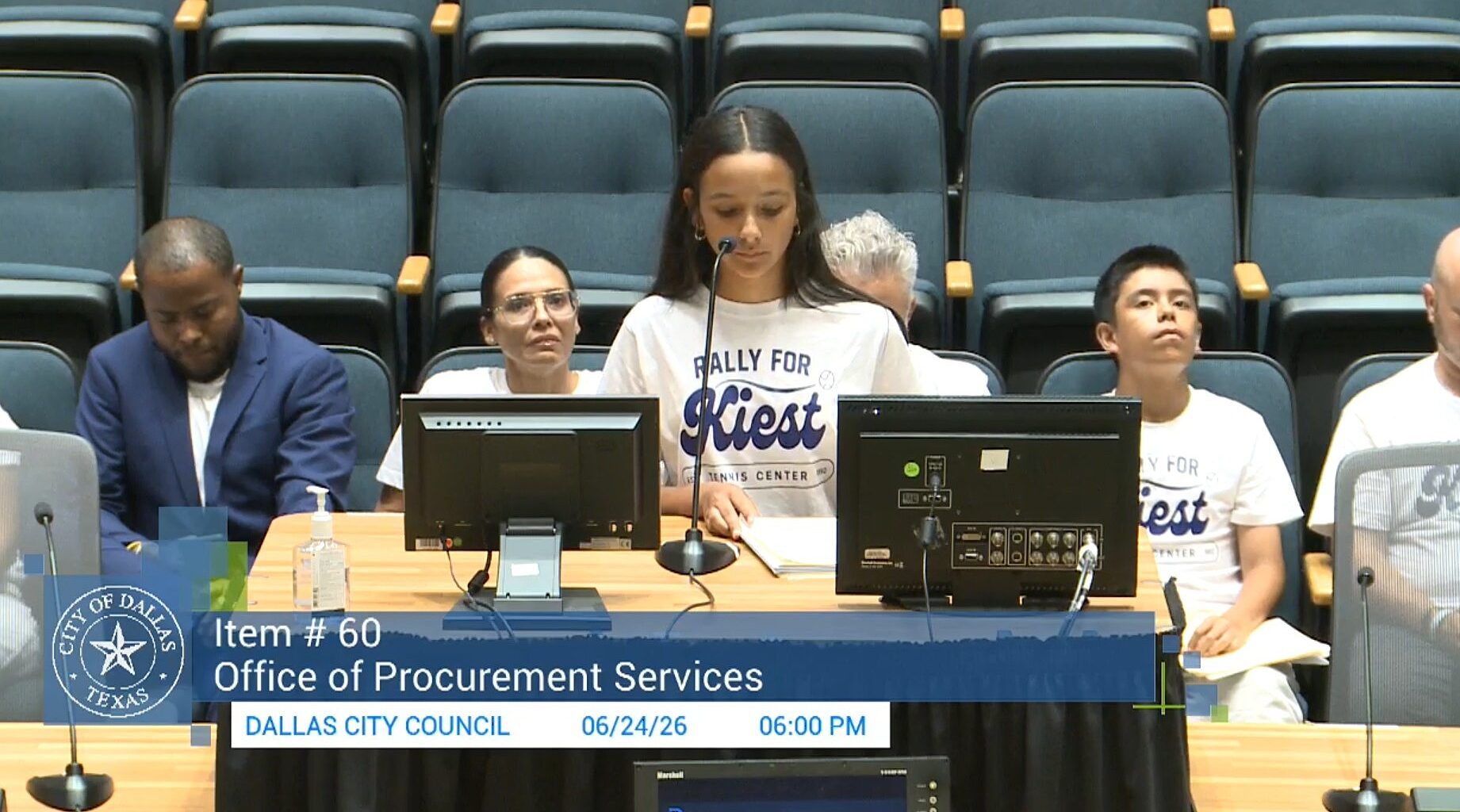
“It’s frustrating waiting all this time,” said the student at Irma Lerma Rangel Young Women’s Leadership School. “But I am ready. It’s just very cool being able to speak at this young age.”
Which she finally did. At 5:59 p.m. After the convention center vote. After chambers had cleared out. After the mayor was long gone.
Inez stood at the podium and said Kiest was “more than a tennis center, it’s a family,” and pleaded with the council to “keep it in the hands of the community.” She said that “decisions like this affect real children and families,” and begged the men and women at the horseshoe: “Don’t just think about the numbers. Think about the families and kids like me who look forward to coming to Kiest every day.”
Other kids spoke, too. Like Julian Williams, a high-school student who talked about how the program at Kiest taught her “the importance of community service, leadership, giving back.” Liliana Heard, a 13-year-old, said the tennis program at Kiest helped her through a difficult time in school, where she was bullied.
Article continues below this ad
Dallas City Council member Maxie Johnson came out to congratulate the kids and parents from the Dallas Tennis & Education Academy, who came to support keeping the nonprofit at Kiest Tennis Center.
John Wilson IV/Courtesy
“I felt isolated and struggled with my confidence,” she said, until her coach “reminded me that I mattered.”
Vance Dick, a 17-year-old who’s been attending the Dallas Tennis & Education Academy for 13 years, said he was going to tell his story, too. “But you’ve seen middle-schoolers come up here and speak better and more eloquently than most adults can,” he said. “That is not normal.”
Lonnie Smoots never did get his chance to speak. I saw him a few times throughout the day — going to lunch, coming from lunch, cooling his heels in the Flag Room while the council hid behind closed doors. I saw him leave, too, about eight hours after we first shook hands.
Article continues below this ad
There was some hand-wringing from some on the council about $13,000 in lost revenue, but they decided quickly — and unanimously — to let the nonprofit remain in charge at Kiest. At least until the Park and Recreation Department can issue another request for proposals from outside operators.
A reminder that nothing good is safe in this city. Not for long. Certainly, not forever. If the children are the future, tomorrow can’t get here fast enough.