
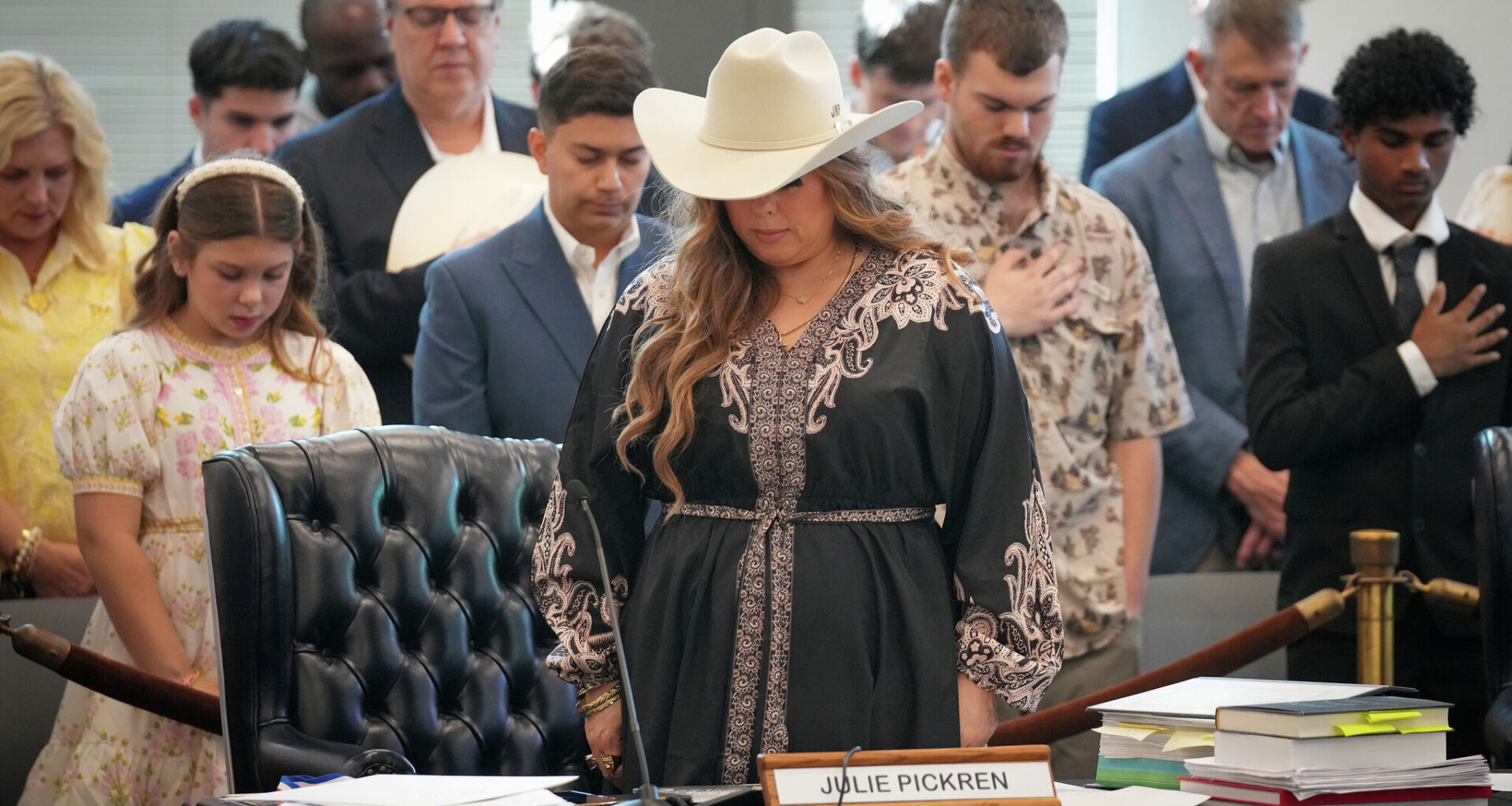
State Board of Education member Julie Pickren prays during the invocation before a meeting on social studies standards at the Barbara Jordan Building in Austin on Friday, June 26, 2026. The board is considering revisions that would place greater emphasis on Christian history and biblical content in public school classrooms.
Jay Janner/Austin American-Statesman
State Board of Education Chair Aaron Kinsey, left, and Secretary Will Hickman talk at a meeting on social studies standards at the Barbara Jordan Building in Austin on Friday, June 26, 2026. The board is considering revisions that would place greater emphasis on Christian history and biblical content in public school classrooms.
Jay Janner/Austin American-Statesman
State Board of Education member LJ Francis votes on an amendment to a proposed required reading list during a meeting on social studies standards at the Barbara Jordan Building in Austin on Friday, June 26, 2026. The board is considering revisions that would place greater emphasis on Christian history and biblical content in public school classrooms.
Jay Janner/Austin American-Statesman
State Board of Education member Rebecca Bell-Metereau speaks during a meeting on social studies standards at the Barbara Jordan Building in Austin on Friday, June 26, 2026. The board is considering revisions that would place greater emphasis on Christian history and biblical content in public school classrooms.
Jay Janner/Austin American-Statesman
State Board of Education Secretary Will Hickman listens during a meeting on social studies standards at the Barbara Jordan Building in Austin on Friday, June 26, 2026. The board is considering revisions that would place greater emphasis on Christian history and biblical content in public school classrooms.
Jay Janner/Austin American-Statesman
The State Board of Education on Friday gave the final approval to a literary list that will require students to read a dozen passages of the Bible, enshrining Christianity as part of classroom instruction for all 5.5 million students in Texas public schools.

The Republican-led board passed the reading list in a 9-5 vote. The board also continued to debate new social studies requirements for kindergarten to eighth grade, with a final vote expected late Friday evening.
Article continues below this ad
Biblical concepts and figures are embedded in both plans, which are among the most aggressive efforts to mandate the teaching of Christianity in the country.
READ MORE: See the Bible verses and books Texas public school students will now be required to read
The reading list will be worked into annual standardized exams, and will be rolled out into classrooms in phases beginning with elementary school in the 2030-2031 school year.
Republicans trumpeted the new standards as a victory for Judeo-Christian values and classical ideals. Proponents say that Bible-infused provisions, including required lessons on Jesus, Abraham and Moses, are designed not to evangelize but help children develop moral compasses and appreciate American exceptionalism.
Article continues below this ad
“We are bringing the Bible back into schools this week for the first time in 60 years,” SBOE member Brandon Hall, R-Aledo, said during a prayer session outside the hearing this week.
One Republican, Evelyn Brooks of Frisco, voted against the list, saying it would remove autonomy from teachers.
Critics say the board has pursued a narrow view of history and literature through the lens of Christianity at the expense of racial and religious diversity, eliminating a world cultures course and trimming down lessons on the stories of Blacks, Hispanics and other minority groups. Some said they believe the dictates violate constitutional principle of separating church and state, forecasting potential legal challenges ahead.
“Texas is telling millions of children that one religion deserves the government’s seal of approval, while everyone else is an afterthought,” said Annie Laurie Gaylor, president of the Freedom From Religion Foundation. “That’s government-sponsored religious favoritism — and the First Amendment strictly forbids it.”
Article continues below this ad
The provisions that do touch on non-Christian faiths cast them in problematic lights, advocates have said. Rabbis and Jewish community groups testified that odd pairings of certain books and lessons on the Holocaust could “absolutely lead to anti-semitism” in classrooms.
The few references to Islam generally involve violence, including requirements that students learn about the “Muslim invasion” of Christian lands during the Crusades and the role of “jihad” in 21st-century terrorism.
“You have tied Muslim history to warfare, piracy and radicalism, then voted on purpose to strip out the algebra and astronomy contributions Muslims have made,” said Amina Ishaq of the Fort Bend Coalition for Justice. “You have decided which children inherit greatness and which only inherit suspicion.”
The standards are just the latest moves Texas lawmakers have taken to inject religion into public schools in recent years, following the passage of a law requiring the Ten Commandments be displayed in every classroom and the adoption of Bible-infused, state-developed textbooks, known as Bluebonnet.
Article continues below this ad
But unlike the textbooks — which are optional and so far have been adopted by just one-third of districts — the standards discussed Friday will become mandatory for every child in all public schools, including charter schools.
The book list makes Texas the only state in the country to issue its own literature requirements, rather than leaving the choices up to teachers or districts. It is being issued to comply with a 2023 state law calling for “at least one” book per grade level, though the proposal passed Friday was far more expansive, requiring 30 texts in some grades.
Texas is also so far the only state to mandate the reading of direct religious texts. Students will analyze around a dozen Bible passages and stories, from David and Goliath in second grade to the Book of Job in tenth grade.
Though teachers may still select other books to supplement the list, many testified prior to the vote that the required list was already too long to be taught within a single school year.
Article continues below this ad
“The lists will eat up weeks of valuable instructional time,” said Diane Miller of the Texas Council of Teachers of English Language Arts. “It’s a bridge too far to cross.”
Meanwhile, the social studies requirements the board was poised to approve Friday evening would mark a dramatic shift in pedagogy. The board pursued a history-heavy approach, significantly boosting the number of terms and figures students must know while largely discarding skills-based lessons like creating timelines or learning the cardinal directions.
Kindergarteners, for example, would be expected to learn stories of the explorers Cabeza de Vaca, Coronado, the Native American figures Squanto and Massasoit, flagmaker Betsy Ross, the priest Damian Massanet, former Gov. Sam Houston, Benjamin Franklin and Texas rancher Charles Goodnight.
Students would encounter complex topics far earlier than they do now, with slavery and the Civil War introduced in first grade rather than in fifth grade, for example. Second graders would learn about the American Revolution and the War of 1812, while third graders would cover ancient Israel, Greece and Rome, as well as the Ten Commandments.
Article continues below this ad
The social studies drafts moved through an unusual process over the last year, with an appointed panel of nine content advisors playing an elevated role, directly drafting outlines and providing amendments to the board. Several have been accused of having inappropriate ties to conservative groups and right-wing think tanks. Democrats accused one of receiving improper outside payment for his influence.
The task of drafting and shaping the standards had traditionally fallen to work groups made up largely of classroom teachers. But teachers played a diminished role this year after a previous effort to revamp social studies in 2022 failed, with Republicans calling the proposals assembled by work groups “woke.”
Over months of back-and-forth debates, the board’s 15 members generally leaned towards American “heroes,” expanding lessons on George Washington, Harriet Tubman, and others, while trimming down references to historical antagonists like the Ku Klux Klan. The standards also emphasize the “dangers of communism” in accordance with a state law passed last year.
The board inked hundreds of last-minute changes this week, with multiple marathon hearings that stretched well past midnight. In several cases, members boosted faith-infused references further, adding in the evangelist pastor Billy Graham and a provision asking students to examine the negative impacts of divorce.
Article continues below this ad
Race proved a consistent flashpoint, with members sparring over which civil rights figures were worthy of inclusion and stripping out mentions of slave revolts and racial segregation. Republicans also voted to remove language that said Africans were enslaved in the United States “because of the color of their skin,” though several joined Democrats to maintain a provision recognizing slavery as a central factor in the Civil War.
In the end, the board failed to finish debate on high school courses and punted them for reconsideration in September.
This is a developing story and will be updated.
Article continues below this ad