
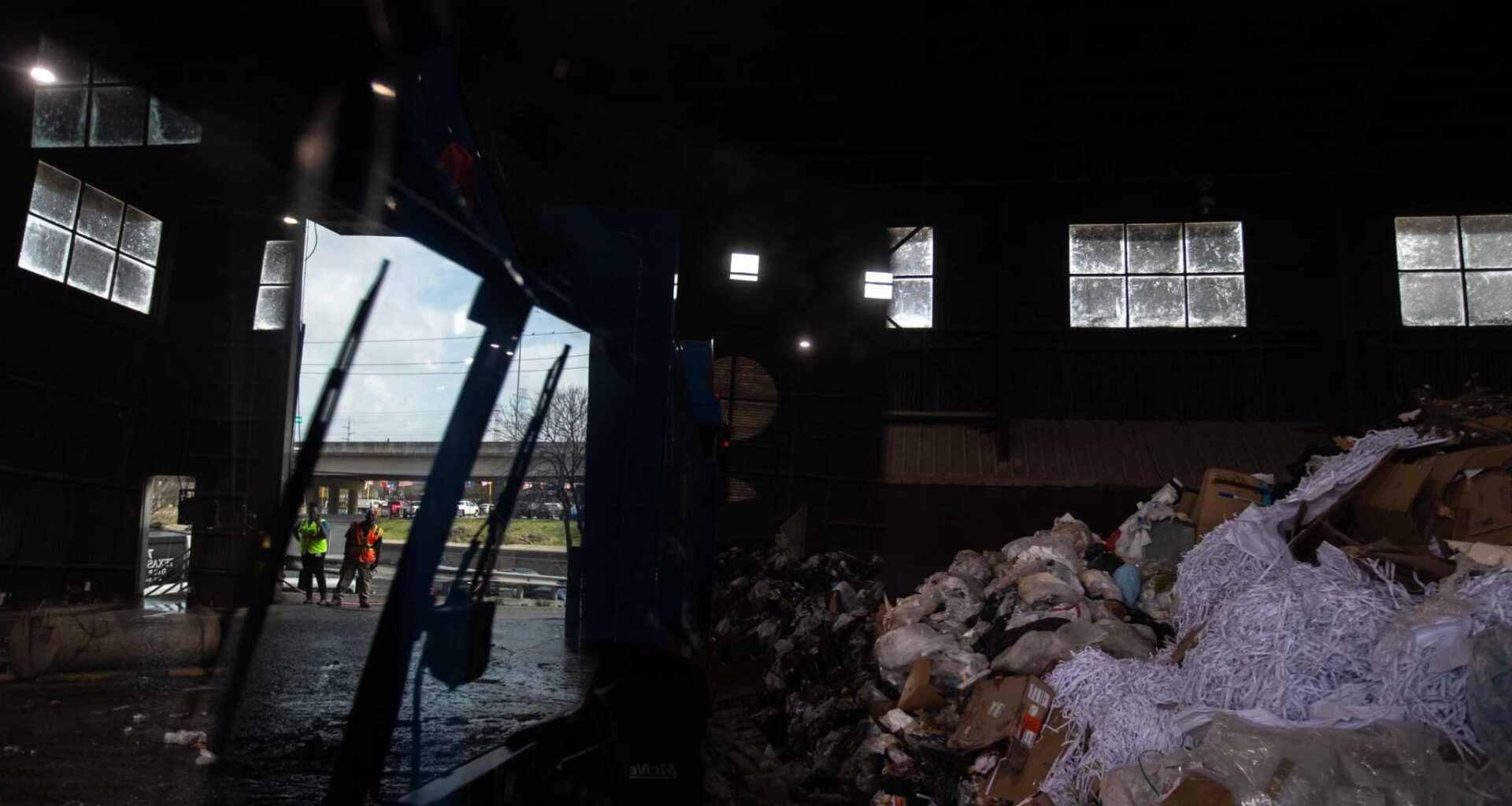
Trash is visible at a waste transfer station on March 29, 2022, in Houston.
Marie D. De Jesús, Houston Chronicle / Staff photographer
The Houston official overseeing city waste services says Mayor John Whitmire’s new $5 monthly trash fee might never increase if the city improves waste operations properly, contrary to the city’s stated plan and to the experience of other cities.
The disconnect underscores the looming political challenge facing City Hall. The mayor’s budget closed a serious deficit and passed city council 15-1, but could grow more divisive as the fee rises to $25 a month by 2031 – as city officials say it must to avoid burdening the city utility system, which now funds solid waste services.
Yet Whitmire has not publicly committed to exceed $5 a month. And Houston Public Works Director Randy Macchi, too, said the fee could remain the same if the city ran its waste “transfer stations” differently.
Article continues below this ad
TRASH FEE APPROVED: Houston City Council passes Mayor John Whitmire’s $7.5B city budget, paving way for a $5 trash fee
Macchi now oversees waste services, as the new budget moved the Solid Waste Management Department into the city utility system within Houston Public Works.
“If we do this right, we may not need to get above $5, because solid waste is a revenue generating machine,” Macchi said at a budget hearing last month.
Houston has five transfer stations across the city where city trucks drop trash to be trucked to the landfill. Only three are operating. All are run by contractor Republic Services, which gives the city a cut of the revenue generated. It’s unclear how much; the rates in the city’s contract with Republic are redacted.
Article continues below this ad
Macchi suggested the transfer stations could boost revenue for the city if they were made available to private companies, for a fee.
A consulting firm the city hired to study waste operations agreed Houston could consider taking over one or more of its transfer stations to generate more revenue, saying the city “may be able to leverage this additional revenue to keep rates low.”
PERFORMANCE MEASURES? Houstonians curious about how the new $5 fee will improve trash service will have to wait
But the same study said Fort Worth has used revenue generated by the landfill it owns to “keep residential rates low” – and that city charges $25.75 per month, according to the study.
Council Member Joaquin Martinez believes in Macchi’s vision, saying the city could earn up to $20 million in additional revenue from operating its transfer stations.
Article continues below this ad
A spokesperson for the city of Phoenix – which, like Houston, owns its transfer stations and hires a contractor to operate them – said its facilities generated $16 million last year. Another spokesperson for Washington D.C. – which owns and operates its transfer stations – said the city brings in more than $5.8 million.
“If the private industry is interested in our transfer stations, then by all means, there’s money to be made,” Martinez said. “We need to figure out what that looks like.”
But even such a figure would not cover much of Houston’s solid waste budget, which is $134 million in the coming fiscal year.
The new $5 monthly fee is projected to generate $24 million. The rest of the solid waste budget will be covered by revenue from residents’ water and sewer bills.
Most big Texas cities do not make much, if any, money from their transfer stations.
Article continues below this ad
Dallas makes $2.6 million a year operating one of its three transfer stations. El Paso, Austin and Fort Worth do not operate any, and El Paso does not generate revenue from what it owns.
David Biderman, who runs a Virginia-based consulting firm for solid waste companies, said it’s unclear how much Houston could bring in from changing transfer station operations, noting the cost to make its facilities operable could be significant.
A draft version of the solid waste operations study obtained by the Houston Chronicle warned the facilities had been neglected, referencing a 2023 city study that estimated it would cost $55 million to upgrade solid waste infrastructure.
A $17.7 million replacement of the Northwest Transfer Station is part of the city’s capital projects plan the council approved Wednesday.
Article continues below this ad