
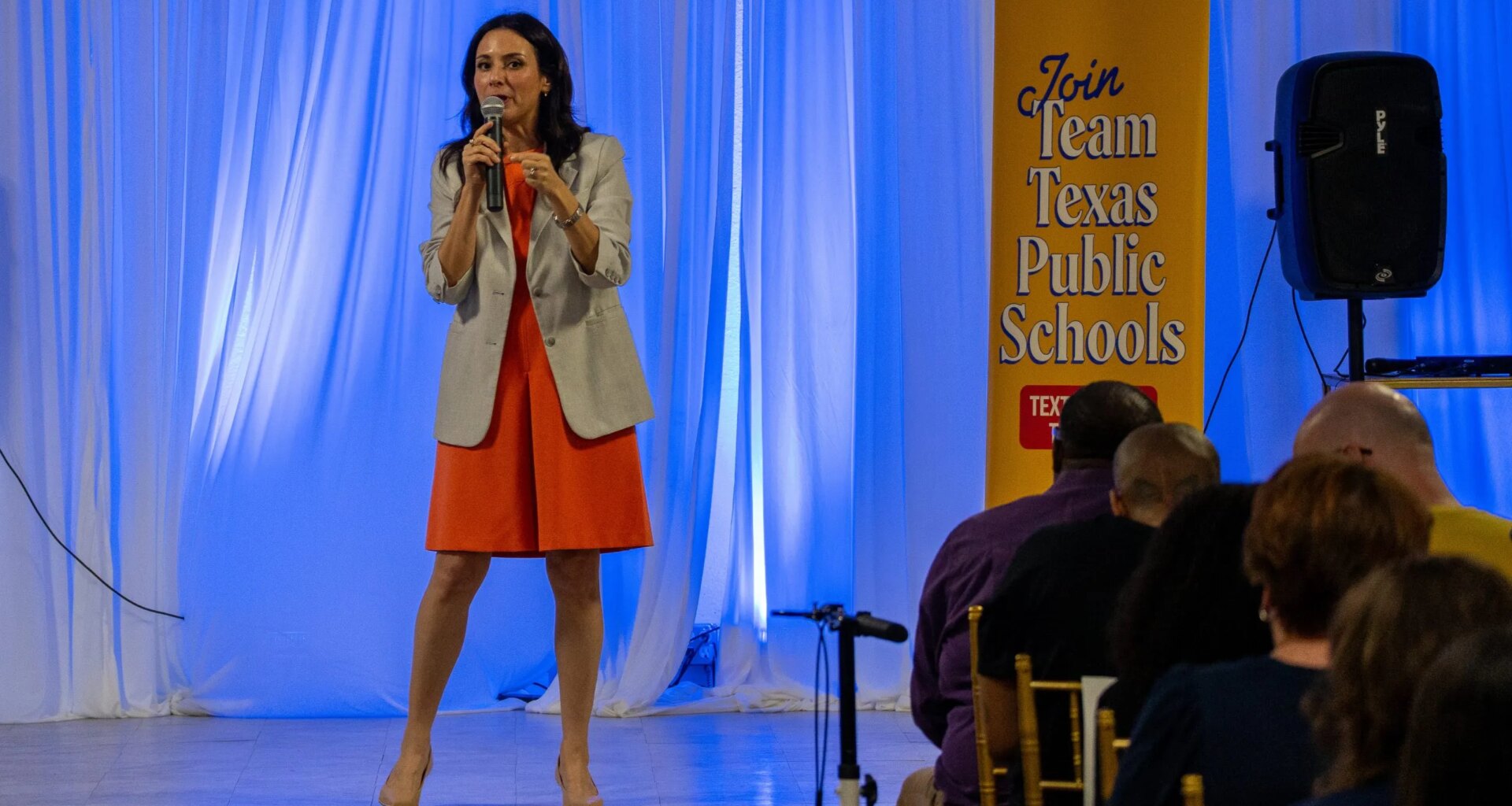
Adrienne Haynes left Democratic gubernatorial candidate Gina Hinojosa’s June 9 Fort Worth town hall with the same question she brought into it.
If Texas returns control of schools to local communities, who makes sure struggling districts actually improve?
Haynes, a Fort Worth ISD parent, said she understood the Democrat’s message against school closures, the voucherlike education savings account program and state intervention in districts. But she wanted more than a campaign argument against Gov. Greg Abbott.
“I didn’t hear anything that made me say she’s the candidate for me,” Haynes said. “What I didn’t hear was things that targeted me and my community that I can say, ‘OK, we’re going somewhere.’”
Hinojosa, a state representative and former Austin ISD trustee, is betting on public school frustration as her path to governor. While school issues affect every Texan, experts told the Fort Worth Report that turning complex debates over funding, closures, accountability and state intervention into a message specific enough to satisfy parents — and simple enough to move voters — is difficult.
The candidate spoke to a crowd in a city where the stakes are real: Fort Worth ISD is under state intervention. District leaders are moving forward with school closures. Families have spent months asking what local control, accountability and school improvement will look like under state-appointed oversight.
Hinojosa cast those issues as part of a statewide crisis.
She blamed Abbott’s support for education savings accounts, the state’s A-F academic accountability system and what she described as stagnant public school funding.
Hinojosa also promised to remove Texas Education Commissioner Mike Morath if elected and said she would work to end the A-F accountability ratings and STAAR.
That promise has already become a rallying cry for some Fort Worth ISD takeover opponents. In recent months, speakers at district meetings have criticized the state-appointed board of managers and ended their remarks by urging people to vote for Hinojosa.
“Our public schools cannot survive another four years of Greg Abbott,” Hinojosa said.
Abbott’s campaign team did not respond to a request for comment. Republican lawmakers state Sen. Phil King and state Reps. Brad Buckley, John McQueeney and Charlie Geren also did not respond.
 Gov. Greg Abbott greets a judge at the start of an investiture ceremony on Sep. 19, 2024, at Texas A&M University School of Law. (Camilo Diaz | Fort Worth Report)
‘Rarely deciding factors’
The challenge for Hinojosa is not convincing voters that schools matter, said Joel Leader, a University of Texas at Arlington education professor. It is making public education a central voting issue in a state where education debates have become more polarized.
“I think the challenge is really motivating it as an issue,” Leader said.
Jim Riddlesperger, an emeritus professor of political science at Texas Christian University, said that challenge is significant because the education issues most likely to move elections are often wedge issues. Those include vouchers, transgender students, critical race theory, the Ten Commandments in classrooms and similar debates.
The core work of public education is harder to turn into a campaign slogan, he said.
Reading, math, school budgets and state interventions involve long-running decisions that are difficult to explain quickly, Riddlesperger said. That makes them less likely to become deciding issues for undecided or swing voters, even when they matter deeply to families.
“As a result, the core issues that affect education — largely not partisan issues at all — are rarely deciding factors in elections,” Riddlesperger said.
That means Hinojosa has to do more than say she supports public schools, Leader said. Voters should look for specific positions on teacher recruitment and retention, funding, school safety, campus buildings, local control and accountability.
Parents, especially, are not a single political group, he said. What families want in Fort Worth may not be the same as what families want in rural West Texas.
“If I’m a parent, I want to know what you are going to do for me and my community,” Leader said. “What are you going to do for me and my child and the elementary school across the street?”
School closures are complicated
 Students from Fort Worth ISD’s Edward J. Briscoe Elementary hold up signs reading “Keep Briscoe Open!” and “Don’t let Briscoe close” during a board meeting May 20, 2025, at the District Service Center. (Mary Abby Goss | Fort Worth Report)
That was Haynes’ concern. She heard Hinojosa make a statewide case against Abbott. What she did not hear, she said, was a plan that sounded built for Fort Worth ISD.
Haynes supports intervention in Fort Worth ISD because the district reached the point after years of problems with student outcomes and unequal access to resources. But she said the state takeover has also created anxiety because parents do not know what will replace the programs and positions being cut.
“I trust intervention,” Haynes said. “But the hard part is not knowing what the end result looks like.”
At Dunbar High School, Haynes said, her son has seen academic support disappear at a moment when he needs guidance for life after high school. Her son transferred from Young Men’s Leadership Academy, an A-rated Fort Worth ISD campus, and is now trying to navigate scholarships, graduation requirements and college preparation.
When staff positions are eliminated, parents are left trying to figure out where to turn, Haynes said.
“It leaves our kids in limbo.”
That is why school closures, for Haynes, are about more than campus facilities.
“For them, it seems like they’re just buildings,” Haynes said. “But for us, it’s our foundation for how we live our lives.”
Hinojosa was pressed after the town hall on how she would respond to districts facing declining enrollment and lower birth rates — pressures that can leave districts with too many buildings and not enough students to fill them.
Fort Worth ISD is already facing that pressure: The district has room for about 95,000 students, enrolled about 69,500 the most recent school year and is projected to fall to about 64,000 students within five years.
“Some of that declining enrollment is because of decisions that are being made at the state level,” Hinojosa said. “When you shut down a school, people leave the whole school system.”
Kendall Pace, a former Austin ISD trustee who served on the board at the same time as Hinojosa, said school closures are rarely caused directly by state policy. More often, closures are the downstream result of years of unresolved enrollment declines, structural overspending and delayed local budget decisions.
The Austin American-Statesman reported this month that Austin ISD faces a $181 million shortfall after district leaders avoided hard decisions around school closures and staffing for years.
State funding formulas shape the environment districts operate in, Pace said, but local leaders still make choices about staffing, programs, buildings and spending priorities.
“The state makes a convenient villain, but the decisions about staffing levels, program design, campus footprints and spending priorities were made locally,” Pace said.
Still, Pace said those two points do not leave the state off the hook. Districts should be accountable for local spending decisions, she said, while Texas should also consider tying the basic allotment to inflation so school funding does not lose value between legislative sessions.
What does academic accountability look like?
 The Fort Worth ISD board of managers listens to speakers during a meeting on April 28, 2026. (Maria Crane | Fort Worth Report/CatchLight Local/Report for America)
Fort Worth ISD’s takeover was triggered after Leadership Academy at Forest Oak Sixth Grade received its fifth consecutive failing state accountability rating. Hinojosa said she wants to replace STAAR and A-F ratings with a national norm-referenced test and a fairer accountability system. She said local districts and communities could play a role in that system, but did not offer specifics on what the replacement would look like.
“We don’t have that,” Hinojosa said. “I will work with them to strike that right balance.”
Leader said that answer points toward a larger debate over what accountability should measure. A national test could compare students across states, he said, but it would still be one test. Districts also need ways to show whether students are learning to think critically, solve problems, communicate and succeed beyond test day, he said.
“Nobody says, ‘I want my kid to be able to take a test,’” Leader said.
For Hinojosa, the accountability question is prescient because it is where support for local control can collide with demands for results. Fort Worth ISD’s elected board was replaced after years of low academic performance at one campus. Some parents want local control restored. Others, like Haynes, want to know who steps in if local control does not produce better outcomes.
Mandy Drogin, a senior fellow with the Texas Public Policy Foundation, an Austin-based conservative think tank that supports school choice, said Hinojosa’s argument misses the mark.
Drogin said Abbott — who assumed office in 2015 — has done more than any governor in the country to respond to what she described as a broken education system.
However, Texas students’ national test results remain uneven. The National Assessment of Educational Progress, often called the Nation’s Report Card, is a national exam used to compare student performance across states. In 2024, Texas’ fourth- and eighth-grade reading scores dropped, while eighth-grade math fell 4 points and continued a decline dating to 2011. Fourth-grade math was the bright spot, rising 2 points and climbing six spots nationally.
Drogin rejected the argument that the state’s education savings account program is responsible for most district budget problems, saying districts already lose funding when students leave for another school system. Families will begin using education savings accounts this fall.
Arlington ISD educators Anne Stovall and Amy Gibbons, who attended Hinojosa’s event, framed those pressures as state-level concerns, while saying they felt supported by their district leaders.
Stovall said districts have limited control over the funding they receive and the accountability rules they must follow.
“Public schools are doing a great job, but they’re doing the best they can with what they have,” said Stovall, who has taught in public schools for 28 years.
Gibbons said the state’s voucherlike program puts public schools in jeopardy by pulling students — and the funding attached to them — away from public campuses.
“We need to have state leadership that supports public education,” Gibbons said.
For Haynes, the test of any candidate’s message is whether it answers the questions families are asking now. By that measure, she said, Hinojosa’s Fort Worth town hall fell short.
“It was nothing of detail that let me know that she sat in her office and made a plan for a district like ours,” Haynes said. “It just sounds like general rhetoric.”
Matthew Sgroi is an education reporter for the Fort Worth Report. Contact him at matthew.sgroi@fortworthreport.org or @matthewsgroi1.
Disclosure: FWISD manager Pete Geren leads the Sid W. Richardson Foundation, a financial supporter of the Fort Worth Report. FWISD manager Laurie George is a member of the Report’s reader advisory council. News decisions are made independently of our board members and financial supporters. Read more about our editorial independence policy here.
This <a target=”_blank” href=”https://fortworthreport.org/2026/06/27/texas-public-schools-are-central-to-gina-hinojosas-bid-for-governor-will-voters-care/”>article</a> first appeared on <a target=”_blank” href=”https://fortworthreport.org”>Fort Worth Report</a> and is republished here under a <a target=”_blank” href=”https://creativecommons.org/licenses/by-nd/4.0/”>Creative Commons Attribution-NoDerivatives 4.0 International License</a>.<img src=”https://i0.wp.com/fortworthreport.org/wp-content/uploads/2021/04/cropped-favicon.png?resize=150%2C150&ssl=1″ style=”width:1em;height:1em;margin-left:10px;”>
<img id=”republication-tracker-tool-source” src=”https://fortworthreport.org/?republication-pixel=true&post=632645&ga4=2820184429″ style=”width:1px;height:1px;”><script> PARSELY = { autotrack: false, onload: function() { PARSELY.beacon.trackPageView({ url: “https://fortworthreport.org/2026/06/27/texas-public-schools-are-central-to-gina-hinojosas-bid-for-governor-will-voters-care/”, urlref: window.location.href }); } } </script> <script id=”parsely-cfg” src=”//cdn.parsely.com/keys/fortworthreport.org/p.js”></script>