
Since 2020, population growth outside El Paso’s city limits has grown seven times faster than within the city, with smaller cities and towns showing some of the largest gains in El Paso County.
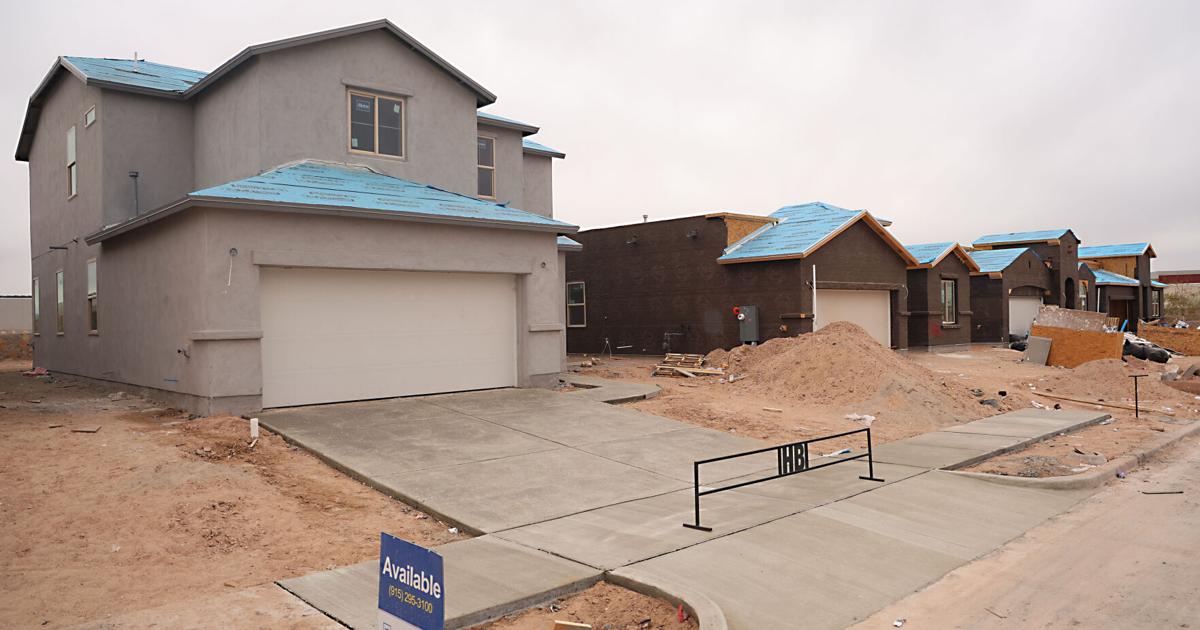
From Horizon City and Socorro to Vinton and Clint, populations are growing as El Paso evolves from a city surrounded by rural communities into a region with true suburbs and exurbs. New housing developments, improved infrastructure and changing perceptions about county living are drawing residents beyond the El Paso city limits.
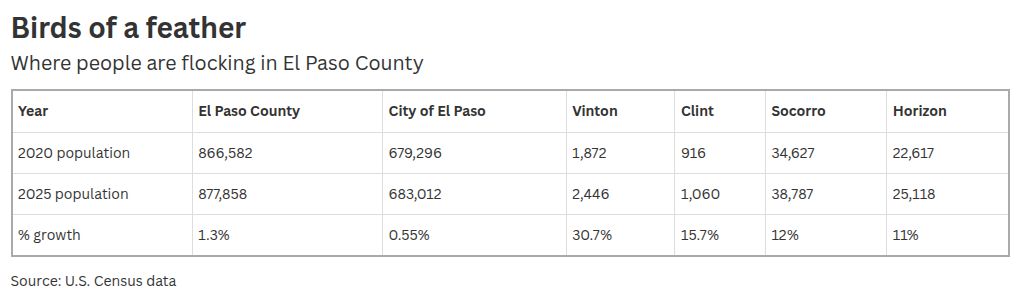
The population within the El Paso city limits increased 0.5% – from 679,296 in 2020 to 683,012 in 2025 – while the population in county areas outside the city jumped 4% from 187,286 to 194,846, according to U.S. Census figures.
East of El Paso, the city of Socorro grew 12% during the same period, Horizon City grew 11% and the town of Clint had a spike of more than 15%. West of El Paso, the village of Vinton had a population surge of more than 30% – from 1,872 people in 2020 to 2,446 in 2025.
“These numbers reflect what we’re seeing across our region,” said El Paso Mayor Renard Johnson. “Growth is happening throughout El Paso County, especially in areas where new housing is being built.”
Historically, one of the biggest obstacles to building and buying homes in areas outside the city has been limited infrastructure, particularly water and sewer service, along with a lack of public amenities like parks and green spaces, roads, sidewalks and libraries. But the county government has spent years exploring ways to provide – at least for new developments – access to services comparable to those available within the city of El Paso.
Another challenge has been abandoned lots with generations of fractionalized ownership, which has complicated development efforts. County leaders say recent state legislation has helped to address those issues, potentially clearing the way for new neighborhoods with modern infrastructure.
Developers have also been pulled in as partners with the cash-strapped county government through the creation of public improvement districts. Under that arrangement, developers finance infrastructure improvements for new subdivisions and are repaid over time through assessments paid by homeowners.
“That allows us to not have to retroactively go and provide some of these additional services,” said El Paso County Commissioner Sergio Coronado, whose district encompasses a large swath of county land to the west of El Paso.
Aided by those programs, perceptions about building and living outside of the city limits have been shifting, county and municipal leaders said.
No longer is it seen as a step down into a makeshift neighborhood lacking basic services. Now, living outside the city limits has a new narrative – affordable homes with amenities and infrastructure, built in communities with growing business sectors and within driving distance of urban El Paso.
In Horizon City alone, more than 3,000 homes are expected to be built in the next few years.
Horizon City Mayor Andres Renteria estimates that those developments will translate to about 10,000 new residents in his city.
“There’s this real excitement for Horizon City,” he said. “Now we get phone calls all the time from professionals from every industry looking to build in Horizon City because they see the growth.”
Renteria describes a scenario repeated by other leaders: With the expansion of new homes, businesses will follow.
“Commercial businesses follow the rooftop numbers,” he said.
Census figures show the city of El Paso lost more than 2,000 residents between 2024 and 2025. But city and county leaders say that does not necessarily indicate people are leaving the region. Instead, many are relocating from the city into county subdivisions.
“We know that a lot of the growth that we’re seeing in Far East El Paso is not necessarily new people moving to the El Paso area, but rather people who already live in El Paso but are relocating to Far East, usually out in the unincorporated areas,” said El Paso County Commissioner Iliana Holguin, whose district includes eastern El Paso County.
Holguin said changing family dynamics may also be contributing to the trend as birth rates decline, along with El Paso’s traditional household arrangements – married or coupled children living with parents into adulthood. More young people are earning college degrees, improving their earning potential and looking for greater independence.
“You have people who were living in multi-generational households who are now getting married, becoming employed and wanting to move out into their own homes,” Holguin said. “With subdivisions expanding outside of the city limits, it’s a natural shift.”
As the city of El Paso loses population to surrounding communities, another trend is emerging: the rise of suburbs and exurbs, terms not traditionally associated with the region.
Suburbs refer to residential communities immediately outside of a city, and exurbs are those beyond the suburbs. Both are characterized by a reliance on the metro area for work, entertainment and shopping.
Once relatively independent of the city, many smaller municipalities – Clint, Socorro, Horizon and Vinton – have grown at a double-digit rate since 2020, increasingly becoming legitimate suburbs of El Paso.
“They’re not that far out there,” said Coronado about the communities once separated by long stretches of empty land. “They are contiguous,” he said.
While San Elizario and Anthony have grown by less than 1% since 2020, other areas further out are in various stages of development and poised to increase the county’s population. Saratoga Homes, for example, recently purchased more than 4,000 acres for a development in the old Mountain Shadow Lakes property. According to company materials, home sales could begin in 2027.
Johnson alluded to El Paso’s emerging suburb and exurb communities, describing them as fueling the economic engine of the whole region.
“I don’t see this as one community growing at the expense of another,” he said. “When families choose to stay in our region, that’s a win for all of us. We’re one region, and our success is shared.”
“The city of El Paso remains the economic, healthcare, education and cultural center of our region,” Johnson added. “People from across the county come into the city every day to work, learn, access services and enjoy what El Paso has to offer.”
Leaders in the county’s growing municipalities and towns say they are embracing the growth and anticipate much more.
“For years and years, Horizon City was the retirement community. We had the golf course, and that was about it,” said Renteria, Horizon City’s mayor. “The population was very small. There were no schools in the area. Since then, so much has changed.”
Victor Reta, public information officer at the city of Socorro, said city leaders are looking forward to a growing population, which is now about 37,000.
“Because of the landlocked nature of the west side of El Paso County, more people are looking at residing in East El Paso County,” he said. “I don’t think there’s any way that the city of Socorro wouldn’t grow. We’re witnessing a boom in housing and in population growth.”
While Realtor.com listings show some homes outside El Paso’s city limits are priced lower than comparable homes within the city, most still hover in the upper $200,000 range.
Homebuyers are often attracted by the fact that residents in unincorporated areas do not pay El Paso municipal property taxes. However, experts caution that buyers of homes within public improvement districts should seek a clear understanding of the costs.
A group of about 100 new homeowners in Denton, a city within the Dallas-Fort Worth metro area, made headlines after discovering they had purchased homes in a PID. They were shocked by their first tax bill, which added thousands of dollars for infrastructure and neighborhood amenities.
Attorney Rachel Khirallah, who was hired by the group, told CBS News she believed the “PID shock” would be a growing concern throughout the state.
“I think it’s probably happening all over Texas,” she said. “I think as public improvement districts start to become more popular and more widely used, it will continue to happen.”
“Anyone who’s watching this, if you hear the word public improvement district, make sure you understand what that is and force the builder to tell them what it is and to give you the amounts of that cost,” Khirallah told CBS News.
Erich Morales, an El Paso County assistant attorney and division chief for public works, also emphasized the need for home shoppers to research the pros and cons of PID neighborhoods.
“This is a more non-traditional way of providing housing and amenities, and buyers may not be fully aware of all the additional expenses that they’re taking on,” he said. “You’re paying a premium for the newer amenities that may not be reflected in your mortgage or your housing price.”