
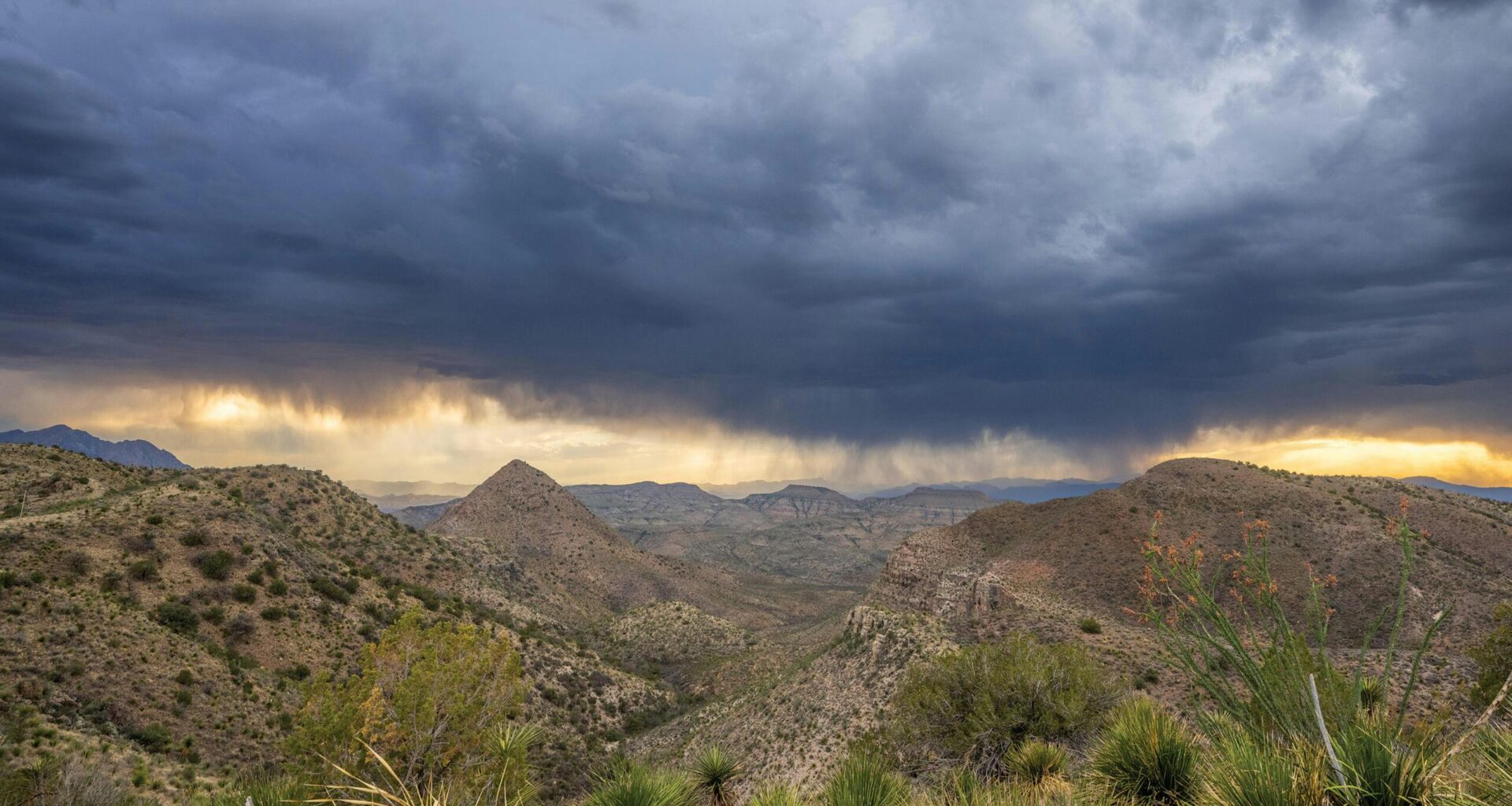

Thirty-two miles southwest of Marfa, where the blacktop on Ranch Road 2810 gives way to dirt, there’s a road that forces you to ponder your odds of survival. Out here, cell service is a faraway notion, and help might be hard to come by. You might even travel the road’s length without seeing another soul.
The folks who do get on Pinto Canyon Road drive its twenty-some miles because it’s considered one of the most beautiful in Texas. Or because they’re on their way to the Chinati Hot Springs, northeast of Ruidosa, where my boyfriend, Nim, and I are headed for the evening. You could try your luck in a city sedan, but you’d be tempting fate; opt for a high-clearance vehicle or one with four-wheel drive. At the precipice of the yawning canyon, I shift my Toyota 4Runner into first gear to avoid burning out the brakes on the dizzying descent. Our two-ton vehicle crawls forward as jagged stones ricochet with sharp pops from beneath my tires. What if I get a flat? What if we become stranded?
Nim and I start taking stock of our provisions. We packed a small Yeti cooler with perishables—a couple of fancy French yogurt cups, two apples, a half-full bag of clementines, a jar of marinara, an onion, and a brick of Parmesan—as well as some shelf-stable supplies. We should eat the things liable to rot first, I suggest, envisioning myself gnawing on the hard cheese. But what about the raw ground beef we bought to make Bolognese tonight? Nim counters. We didn’t bring a camp stove.
Steak tartare? No—neither of us is partial to the stuff, and the grocery store ground chuck we bought probably wouldn’t pass muster. I propose finding a flat rock and building a fire beneath it. We have a lighter, and there’s certainly enough dry tinder around. Perhaps if we flattened the meat into paper-thin patties, enough heat would transfer through the stone to properly cook them. How many days could we survive like this? Our biggest concern would be water. We brought only a few bottles, and a six-pack of Coors Light. We could stretch that with the meltwater from the ice in our cooler.
I learned a lot about survival while living in the region, in the nearby town of Presidio, for three years. In the desert, where precipitation is scant but tends to fall in torrents, flora and fauna are immensely opportunistic. A rash of rain has the power to transform the landscape: Skeletal ocotillos plump up with leaves and extend red blooms like painted fingernails; the ground crawls with finger-wide millipedes. In this way the desert becomes legible, like a script. Scan the expanse of cacti and scrub, and wherever the thirsty terrain gives way to a grove of oak or pine or juniper, you can guess that there’s some, if infrequent, source of water. This is where rainfall gathers into a trickle that swells into a stream during monsoon season. (Beware of traveling during stormy weather.)
Kicking up dust on Pinto Canyon Road.
The Chinati Mountains are no longer a distant silhouette; we are among them. I point to a stand of trees in the distance. If our faithful chariot stalls, or if our tires puncture, we could head over there for shade and—if we’re lucky—maybe even a trace of water. Worst case, we could split open one of the prickly pears dotting the landscape and hydrate ourselves with its succulent flesh.
From where we are, the Rio Grande lies less than twenty miles away, though it feels much farther. Distance is relative in the desert. I think back to what one local landowner, outraged, as much of the community is, about a potential border wall through Big Bend, told me: If you managed to survive the gauntlet of the desert, with its radiant hostility, getting past the wall would feel like the easiest part of the journey.
My reliable 4Runner doesn’t give out, and I continue to drive, slowly, slowly, downward through the canyon. Once the slope levels off, I switch back to automatic. And then, a soul. “Longhorns!” I exclaim. A small herd lazes in the dirt beside the fence line, as otherworldly to me as if I’d happened upon unicorns or centaurs. They stare unblinkingly back at us.
Explore More Drives
The directions offered by the Chinati Hot Springs website emphatically declare: “Do not use G.P. S. or Google. They will get you lost.” Instead, visitors are told to follow the signs. With our phones rendered useless, we keep our eyes peeled for the turnoff and arrive safely at our shelter for the night.
It’s unseasonably warm for early March, so we head up to the hotel’s swimming pool first, dangling our legs in the water and watching the sun set behind the Sierra Madre mountains. Once we’re sufficiently cooled, we head back down to the small stone basin that contains the thermal, lithium-rich hot springs. It’s dark now, and the sky opens up, revealing a vast, hidden cosmos. We reach for a couple of beers from the cooler—no longer a precious source of hydration but just something to enjoy.
Service Stations
The Chinati Hot Springs, a historic retreat with mineral springs, was developed in 1937 into a resort with a bathhouse and seven cabins. In the nineties, minimalist artist Donald Judd purchased the property and closed it to the public so that only he and his friends could use it. After he died, in 1994, it returned to its public status. Our cabin, Las Palmas, was small but comfortable, equipped with AC, a mini fridge, and a coffee maker. Rates start at $150 a night.
An abbreviated version of this article originally appeared in the July 2026 issue of Texas Monthly with the headline “Journey of Faith.” Subscribe today.