
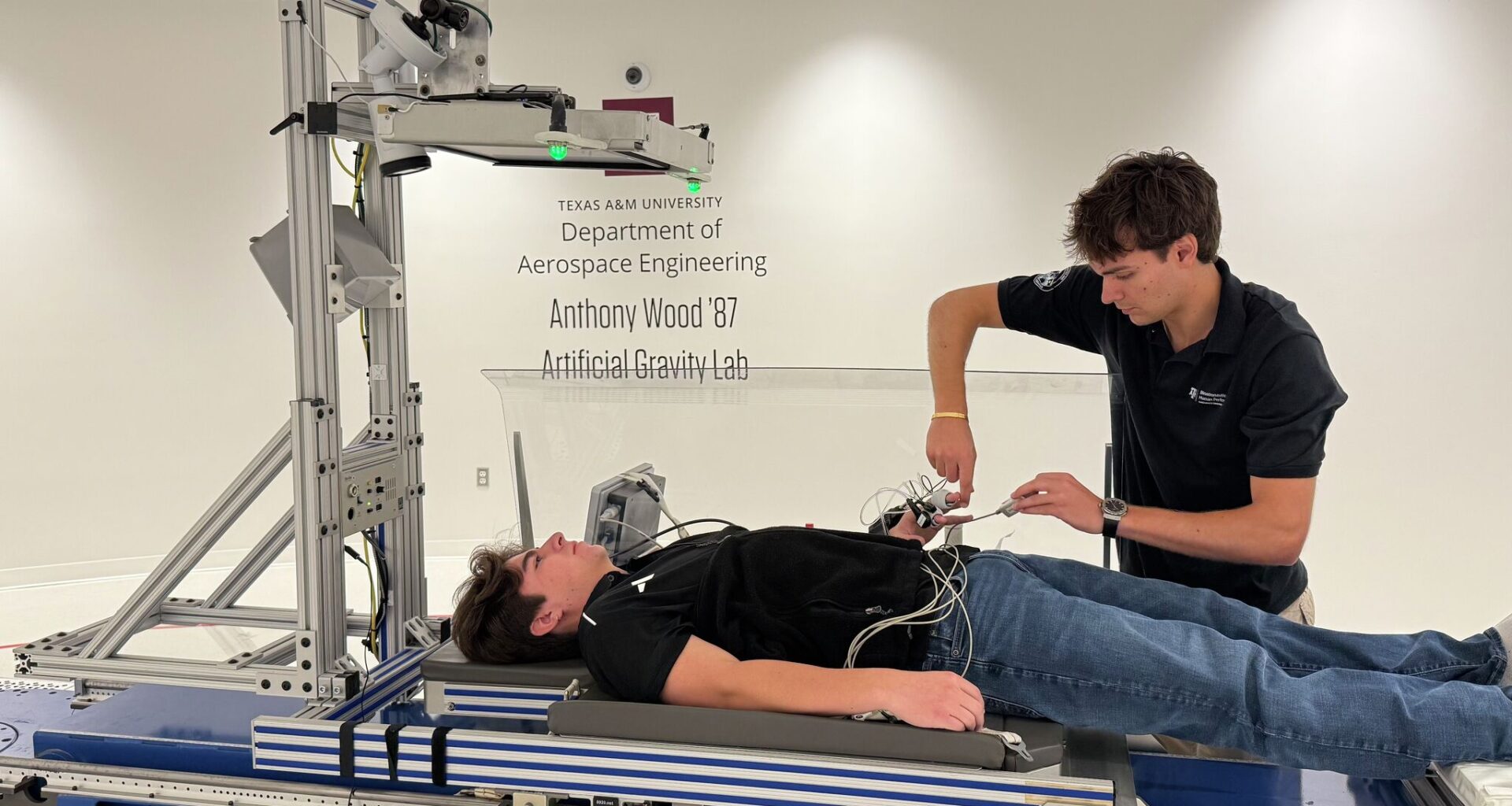
Huc Pentinat Llurba, right, a graduate student at Texas A&M University, prepares Santiago Carrasco, an undergraduate student, for a spin in the university’s centrifuge in College Station, Thursday, June 11, 2026. Texas A&M is using the centrifuge to learn how the human body responds to low-gravity environments like those seen on the moon or Mars.
Andrea Leinfelder/Houston Chronicle
Huc Pentinat Llurba, right, a graduate student at Texas A&M University, prepares Santiago Carrasco, an undergraduate student, for a spin in the university’s centrifuge in College Station, Thursday, June 11, 2026. Texas A&M is using the centrifuge to learn how the human body responds to low-gravity environments like those seen on the moon or Mars.
Andrea Leinfelder/Houston Chronicle
Santiago Carrasco, an undergraduate student at Texas A&M University, prepares for a spin in the university’s centrifuge in College Station, Thursday, June 11, 2026. Texas A&M is using the centrifuge to learn how the human body responds to low-gravity environments like those seen on the moon or Mars.
Andrea Leinfelder/Houston Chronicle
Huc Pentinat Llurba, top, a graduate student at Texas A&M University, prepares Santiago Carrasco, an undergraduate student, for a spin in the university’s centrifuge in College Station, Thursday, June 11, 2026. Texas A&M is using the centrifuge to learn how the human body responds to low-gravity environments like those seen on the moon or Mars. Carrasco will watch Looney Tunes while he spins.
Andrea Leinfelder/Houston Chronicle
Bonnie J. Dunbar, left, an aerospace engineering professor at Texas A&M University and former NASA astronaut with a Ph.D., and Huc Pentinat Llurba, a graduate student at Texas A&M University, prepare Santiago Carrasco, an undergraduate student, for a spin in the university’s centrifuge in College Station, Thursday, June 11, 2026. Texas A&M is using the centrifuge to learn how the human body responds to low-gravity environments like those seen on the moon or Mars.
Andrea Leinfelder/Houston Chronicle
Huc Pentinat Llurba, left, a graduate student at Texas A&M University, and Bonnie J. Dunbar, Ph.D., an aerospace engineering professor at Texas A&M and former NASA astronaut, prepare Santiago Carrasco, an undergraduate student, for a spin in the university’s centrifuge in College Station, Thursday, June 11, 2026. Texas A&M is using the centrifuge to learn how the human body responds to low-gravity environments like those seen on the moon or Mars.
Andrea Leinfelder/Houston Chronicle
Santiago Carrasco, an undergraduate student at Texas A&M University, is seen on the screen as he spins in the university’s centrifuge in College Station, Thursday, June 11, 2026. Texas A&M is using the centrifuge to learn how the human body responds to low-gravity environments like those seen on the moon or Mars.
Andrea Leinfelder/Houston Chronicle
KBR Project Engineer Danny Nolan, back left, Texas A&M University graduate student Huc Pentinat Llurba, center, and Texas A&M Aerospace Engineering Professor Bonnie J. Dunbar, Ph.D., watch a centrifuge from the control room at Texas A&M University in College Station, Thursday, June 11, 2026. Texas A&M is using the centrifuge to learn how the human body responds to low-gravity environments like those seen on the moon or Mars.
Andrea Leinfelder/Houston Chronicle
Huc Pentinat Llurba, a graduate student at Texas A&M University, films a centrifuge as it spins at Texas A&M in College Station, Thursday, June 11, 2026. Texas A&M is using the centrifuge to learn how the human body responds to low-gravity environments like those seen on the moon or Mars.
Andrea Leinfelder/Houston Chronicle
From left, Bonnie J. Dunbar, Ph.D., an aerospace engineering professor at Texas A&M and former NASA astronaut, Huc Pentinat Llurba, a graduate student at Texas A&M University, Santiago Carrasco, an undergraduate student, and Dimitris Lagoudas, Ph.D., interim head of the Texas A&M Department of Aerospace Engineering, pose for a picture in front of the university’s centrifuge in College Station, Thursday, June 11, 2026.
Andrea Leinfelder/Houston Chronicle
Santiago Carrasco lay on his back, looking at the paused “Looney Tunes” intro while a graduate student attached ECG electrodes to his chest and strapped a blood pressure cuff to his arm. A four-point harness secured him to the bed that would soon start spinning.
The lights dimmed, and operators in the next room turned on Porky Pig. The cartoon, playing on a screen directly above Carrasco’s face, would help prevent the 20-year-old from moving his head — controlling the Coriolis effect that might otherwise make him sick.
The spinning began gradually. Carrasco’s feet were pulled into the footplate as he reached a steady speed. And it felt like he was standing on the moon — not lying on a centrifuge spinning 17 times a minute at Texas A&M University.
Article continues below this ad
“I couldn’t feel myself rotating,” said Carrasco, an undergraduate student at Texas A&M. “I knew it, like mentally, but I couldn’t physically feel it.”
MOON: Texas companies win and lose NASA contracts as the agency pushes toward a moon base
Texas A&M is using the centrifuge to better understand how the human body responds to low-gravity environments such as those on the moon and Mars, where NASA wants to send its astronauts.
Humans evolved to live in Earth’s gravity, and scientists have spent 25 years studying weightlessness on the International Space Station. But what happens between those two extremes? The moon is one-sixth the Earth’s gravity, and Mars is three-eighths the Earth’s gravity.
Article continues below this ad
“We don’t have that data because we haven’t been on the moon for long periods of time and we haven’t had humans on Mars,” said Bonnie J. Dunbar, an aerospace engineering professor at Texas A&M and former NASA astronaut. “We want to use those environments to study the changes in the cardiovascular system, for example, and other physiological systems so we can really prepare for those long missions.”
The Texas A&M centrifuge was previously owned by NASA. It was built during the agency’s Constellation Program, a prior moonshot, and put into storage after that program was cancelled.
It was later transferred to Texas A&M and Dunbar, who has a doctorate in engineering and was elected to the National Academy of Engineering. KBR has a contract with Texas A&M to operate the 4,000-pound centrifuge and provide new displays and instrumentation systems at the Anthony Wood ’87 Artificial Gravity Lab in College Station.
NASA has been using a facility in Germany to conduct its centrifuge and bed rest studies, where people can spend weeks in a bed to mimic the effects of weightlessness. The new Texas A&M centrifuge and its surrounding facilities, which include beds, are aiming to bring those studies to College Station.
The first NASA-funded centrifuge study will begin this summer.
Article continues below this ad
“We call it repatriated back here,” Dunbar said. “The only other facility that’s equal to this right now is the one in Germany.”
Lying flat
Unlike centrifuges used by military pilots — who sit upright in seats similar to the airplanes they fly, sometimes experiencing up to nine times the Earth’s gravity — the Texas A&M centrifuge will have participants lie flat to recreate low-gravity environments.
To be clear, these individuals cannot truly shed Earth’s gravity to experience weightlessness or the gravity on the moon and Mars. Instead, they will be part of an analog that mimics different levels of gravity, ranging from the microgravity felt by astronauts floating on the International Space Station to the full gravity of Earth.
SPACE INSTITUTE: Preparing for a trip to the moon or Mars? New Texas A&M facility to allow testing of crucial tech
Article continues below this ad
The centrifuge works as an analog because bed rest mimics weightlessness.
On Earth, a person’s heart, muscles and bones work less when they’re lying down. It’s more comparable to microgravity than standing, where the heart must work against the Earth’s gravity to move blood from the legs to the chest and head. Muscles and bones also fight to stay upright.
So if lying flat is similar to being in microgravity, then the centrifuge’s spinning will increase the force on a person — from head to feet — so they’re no longer “weightless” but on the moon or Mars, depending on how fast they spin.
Studying the heart
The Texas A&M centrifuge will initially be used to study how the heart responds to these different gravity levels. Dunbar said this will help establish the relationship between gravity and cardiovascular health, such as blood pressure, heart rate and other cardiac functions.
Article continues below this ad
This information will keep astronauts healthy as they travel farther from Earth.
Ana Diaz Artiles, an associate professor of aerospace engineering at Texas A&M who has a doctorate in aeronautics and astronautics, is the primary investigator working alongside Dunbar on the centrifuge’s first NASA-funded study. The centrifuge data will complement information they have collected from other analogs, including parabolic flights and tilt tables.
Artiles, Dunbar and Deanna Kennedy, an associate professor in the Texas A&M Department of Kinesiology & Sport Management who has a doctorate in kinesiology-motor neuroscience, also have a NASA-funded grant that will use the centrifuge to study hand-eye coordination on the moon and Mars.
Future studies could revolve around Dunbar’s other passion: using digital engineering to create custom spacesuits for Mars. Dunbar wants to know if gravity affects how the body rejects heat, which could influence spacesuit designs.
“There’s so much we don’t know,” Dunbar said, “and so we’re starting at some simple studies here.”
‘One of the main priorities’
Texas A&M has partnered with NASA for decades.
NASA’s first astronauts traveled to Texas A&M for computer training in the 1960s. The university’s low-speed wind tunnel was later used to test space shuttle models.
More recently, students hired at the Texas A&M NASA Space Food Research Facility have helped make shelf-stable meals for the International Space Station. Aerospace medicine is a focus at the School of Medicine, and the Space Institute is preparing to open near NASA’s Johnson Space Center to recreate the terrain of the moon and Mars for companies and researchers to test their hardware.
“(Space) is one of the signature programs, one of the main priorities, for Texas A&M University Engineering and the Texas A&M University System,” said Dimitris Lagoudas, interim head of the Texas A&M Department of Aerospace Engineering. “All of these will create an environment for education and research. And we are going to train the next leaders who will then be going beyond the moon to Mars.”
ARTEMIS: NASA names Artemis III crew for mission that will set up future moon landing
Dunbar joined the Texas A&M College of Engineering in 2016 and has helped the university expand its focus on human spaceflight. She’s made human systems integration — ensuring engineers understand how to keep space travelers alive and healthy in the habitats and spacesuits they design — a key component of her teaching.
Carrasco, the student who took a spin, works in Dunbar’s Aerospace Human Systems Laboratory. He’s entering his senior year as an undergraduate student, working toward a bachelor’s degree in aerospace engineering, and wants to stay in College Station for his master’s degree.
Carrasco is passionate about NASA and its missions to the moon and Mars, and he wants to become a flight director who oversees these endeavors.
“Being able to contribute, any amount I can while still being in college, is just super meaningful to me,” Carrasco said.