
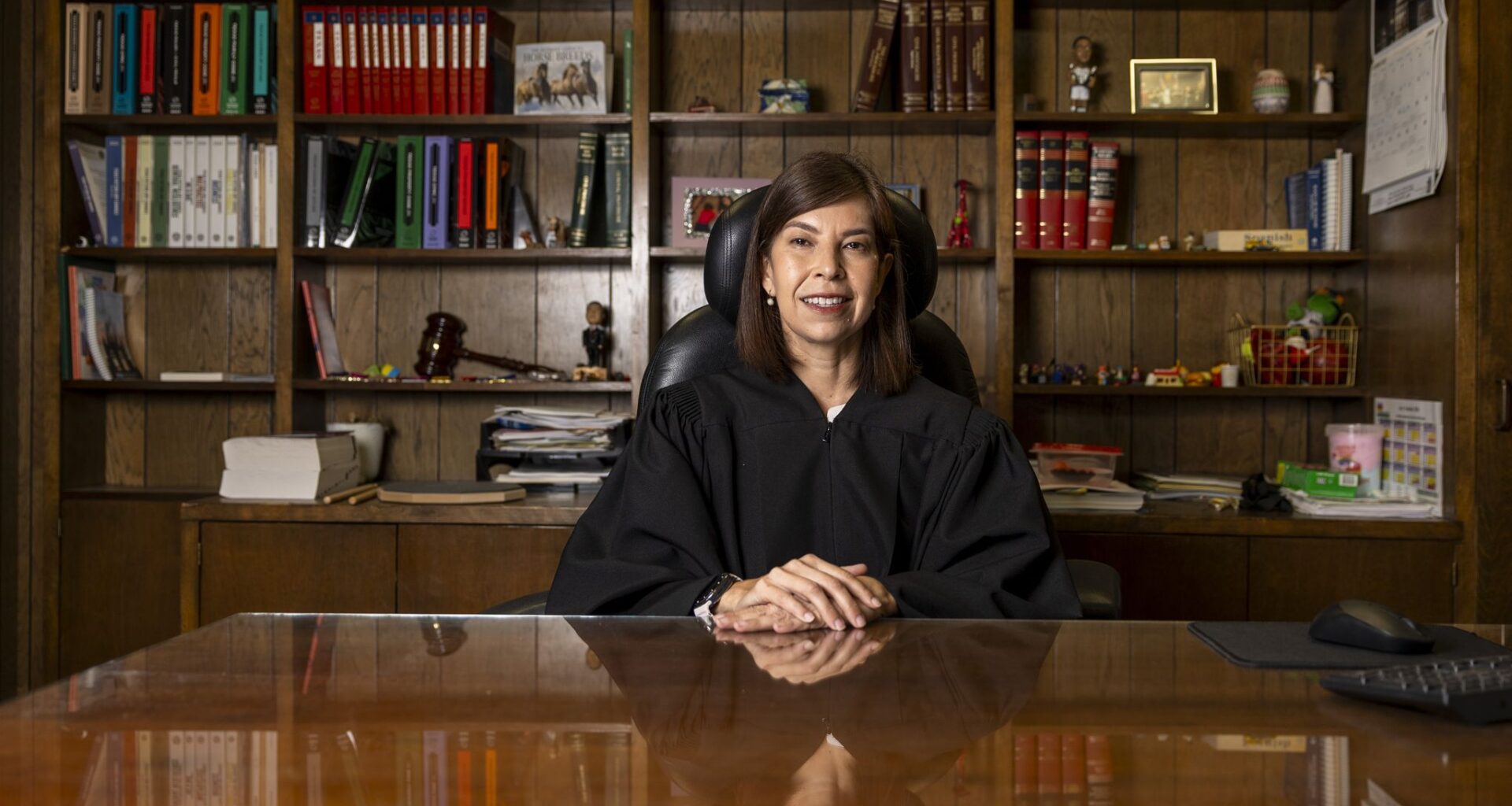
Judge Christine Hortick, shown in her chambers, was elected to the 225th District Court in 2022.
Andrew J. Whitaker/San Antonio Express-News
When Christine Hortick ran to become a judge, she did not set out to remake Bexar County’s civil court system.

But the battle that has come to define her tenure — an effort to break from a system she says is inefficient, costly and can be hard on children — reveals a judge shaped by conviction and a willingness to stand apart from her colleagues even as personal and political costs mount.
Article continues below this ad
She is taking on a status quo that for more than six decades has seen the county’s civil district courts operating under a rare centralized docketing system that shares cases among judges rather than having them handled by one from start to finish.
Hortick, 47, a longtime family law and child-welfare attorney, said she ran for the 225th District Court because of its long association with Children’s Court matters. After taking the bench in 2023, though, she found herself at odds with colleagues over whether her court would retain priority in child-welfare matters — a dispute that ultimately led her to withdraw from the system altogether.
She argued it has encouraged inconsistent rulings, allowed attorneys to exploit gaps between judges and prevented her from performing the role she believes voters elected her to. Her effort, which has won the apparent support of the Texas Supreme Court, triggered a bitter courthouse dispute, strained relationships with colleagues and exposed deep divisions over whether the system works.
Article continues below this ad
“As the newly elected judge of the 225th District Court, I had no idea that I would have to defend the statutory preference exercised by my predecessors or ever withdraw from the presiding system,” she said, referring to the state law giving the 225th preference to hear child-welfare cases. “As judge, I have an obligation to both the community I serve and to the bench itself. It was that sense of duty that led me to defend this bench and challenge the status quo.”
READ MORE: How two judges’ exit from a decades-old Bexar County court system is sowing discord
Hortick formally exited the system March 1 and now manages her own docket independently, scheduling hearings herself while continuing to press for priority in child-welfare matters — the issue that originally set her on a collision course with many of her fellow judges.
Article continues below this ad
Her fight has earned her both supporters and detractors.
“I’m impressed by her courage, frankly,” said San Antonio attorney Henry B. Gonzalez III, who has practiced for more than three decades. “I admire strong women. I like when I see a strong woman say, ‘Look, this is what I believe in and I’m willing to take the heat for it.’ That’s uncommon.”
Judge Benjamin Robertson, who is challenging Hortick for the 225th bench in November, said he initially disliked the county’s system before briefly serving on the civil bench in 2024. He now argues the system should be reformed rather than abandoned and has made preserving it the central theme of his campaign.
“I think reasonable people can disagree,” Robertson said. “But what I don’t think was reasonable is the rush out of (the system) when there was no plan put in place.”
Article continues below this ad
Southeast Side upbringing
Born in 1978, Hortick grew up on San Antonio’s Southeast Side, the only child of Larry Hortick and Rosa Vasquez, both civil service employees. Her father worked at Air Force bases in the city while her mother was employed with the Social Security Administration. They divorced when she was about 7.
Much of her childhood revolved around tennis, pets and school. An only child, she filled the house with animals — cats, dogs, birds and fish — while spending years on the tennis court, playing competitively through college.
The possibility that her stepfather might one day be stationed in Germany led Hortick to enroll in Brackenridge High School’s German-language program. She studied the language for seven years, though the family never relocated overseas.
Article continues below this ad
By the time she graduated, Hortick planned to become a doctor. She enrolled at Boston University as a biomedical engineering pre-med major, joining a group of friends determined to leave San Antonio for colleges across the Northeast.
RELATED: Judges threaten legal action after leaving Presiding Court; Bexar County hires lawyers
But a car accident during her sophomore year altered her trajectory.
The crash left her with head, neck and back injuries severe enough to force her to miss too many classes and temporarily leave school. Not wanting to lose the semester entirely, she enrolled at the University of Massachusetts-Boston, where a Spanish class she took for “an easy A” unexpectedly shifted her academic interests toward Latin American studies and political science.
Article continues below this ad
She eventually transferred to UMass full time and began considering law school.
Hortick traces that turn in her life back to a sandwich shop’s error.
“There was a problem with my sandwich, and I had to go back in,” she recalled. “Had I not gone back in, we would have missed that accident. So I always say I became a lawyer because of a tuna sandwich that I had to have.”
An internship in Sen. Edward “Ted” Kennedy’s Boston office turned into a staff job after Hortick finished college. The experience gave her an early glimpse into institutional power and public service — worlds she would eventually enter.
Article continues below this ad
Law school
Hortick’s time in Kennedy’s office was short-lived. Though she had hoped to attend law school in Washington, she instead returned to San Antonio to attend St. Mary’s University because of her grandmother’s declining health.
She entered law school without a clear specialty in mind.
“I thought maybe I would do business litigation and then later realized that would be so boring,” she said with a laugh.
Article continues below this ad
After graduating, Hortick planned to launch a law firm with several classmates. As graduation approached, most abandoned the idea for more stable jobs. Hortick stayed with it, though, opening a solo practice that initially focused on criminal defense before expanding into family law, probate and civil litigation.
She came to child-welfare work reluctantly.
An aunt who worked as a Child Protective Services investigator encouraged her for years to take such cases but Hortick resisted, wary of the emotional toll in matters involving abused and neglected children. She eventually agreed after another attorney convinced her the work both served the community and provided stability for a young lawyer.
Over time, the cases reshaped her approach to clients and the law itself.
Article continues below this ad
Becoming a parent, she said, made her tougher.
“I rode my parent clients a lot harder,” Hortick recalled. “My goal was always, whether I represented parents or children, was to have the family reunified, if at all possible. So I was always pushing them to do what they needed to do to be reunified.”
Running for office
Despite her interest in politics, Hortick long viewed herself as better suited to working behind the scenes than running for office. Still, she had quietly considered seeking the 225th District Court bench for years while Judge Peter Sakai occupied the seat.
Article continues below this ad
With no indication Sakai planned to leave, Hortick instead ran in 2020 for the Precinct 3 Bexar County commissioner seat after Kevin Wolff announced his retirement.
During the campaign, the health of her husband, Robert Blackburn, deteriorated rapidly from what was initially believed to be early-onset Alzheimer’s before doctors determined he suffered from a far more aggressive form of dementia.
He died shortly after Hortick won the Democratic primary in March 2020. Days later, the pandemic shut down much of public life.
Republican Trish DeBerry defeated Hortick in the general election that November.
Not long after, rumors began circulating that Sakai — who had spent years helping build Bexar County’s nationally recognized Children’s Court system — planned to step down from the 225th bench to run for county judge.
Article continues below this ad
When Sakai made it official in 2021, Hortick immediately saw the opening as a continuation of the work she had spent years doing as a lawyer. She viewed the 225th’s statutory preference for child-welfare matters as central to the identity of the court she hoped to inherit.
Hortick defeated Republican Renee Yanta in 2022 and began her first term believing the 225th would continue operating much as it had under Sakai.
Taking the bench
But the bench Hortick won was not the bench she inherited.
Article continues below this ad
An administrative order signed before she began her term essentially stripped the 225th District Court of its preference for child-welfare cases as the Legislature intended, Hortick said.
Judge Nadine Nieto, who also left the centralized docket system in March, said Hortick viewed the change as a fundamental alteration of the bench she believed she had been elected to serve. Nieto said many of the other judges expected Hortick to simply accept the new structure.
“They pretty much told her, ‘This is life now. Get used to it,’ ” recalled Nieto, who sits in the 285th District Court. “And she said, ‘That’s not what I ran for.’ ”
But Hortick increasingly came to view the system itself as inefficient, arguing that it forced litigants to repeatedly explain their cases to different judges during pretrial proceedings. She said that was especially hard on children, who had to relive the details of disputes as they were rehashed before different judges. She also said some attorneys were “playing games” by trying to “fix” rulings made earlier in a case by other judges.
Article continues below this ad
She said she repeatedly tried to reach compromises with the other judges to give her court priority in child-welfare matters.
“Because I do like to explore every option before I go nuclear,” she said with a chuckle.
Ultimately, Hortick concluded leaving the system was the only way to guarantee she would handle the Child Protective Services matters assigned to her court. In August 2024, she said she was taking her argument to the Supreme Court.
‘Was not fun’
The courthouse became a hostile environment as Hortick carried out her plan, she said.
Article continues below this ad
“Like saying good morning to someone and them just staring at you and walking past,” she recalled. “Not being friendly. Not being polite. It was not fun.”
Nieto said she experienced a similar reaction to her decision.
“The culture here is that if you don’t accept what the majority wants … then you will be treated like a pariah,” she said. “I am being treated that way now.”
Ten judges who were already on the bench when Hortick and Nieto were elected were contacted for comment. Some did not respond. Others referred questions to Judge Angelica Jimenez, the local administrative judge.
Article continues below this ad
Jimenez described the judges as professional despite the disagreements.
“We’re all cordial,” she said. “We’re just here to do our jobs and help our community.”
Hortick described a far different atmosphere.
“I do joke with some people that if I had the cure for cancer and they all had cancer, they would not take it from me because it’s coming from me,” she said. The stress has caused her headaches and sleepless nights.
Article continues below this ad
As the dispute escalated locally, broader questions about centralized dockets were also surfacing statewide.
In February 2025, the Texas Supreme Court asked its advisory committee to study whether centralized docket systems should be replaced with systems assigning cases to individual judges.
Breaking away
Against that backdrop, Nieto unveiled plans in January to leave the system effective March 1. Hortick decided to leave at the same time. Jimenez signed the order allowing it.
Article continues below this ad
In late March, the Supreme Court finalized statewide rule changes emphasizing that individual judges — not centralized docket systems — remain responsible for cases assigned to them, even when judges exchange benches. It required cases to be randomly assigned and clarified that the originally assigned judge retains responsibility absent a formal transfer.
But it wasn’t that simple.
Though Hortick and Nieto viewed the order as validation of their decision to leave the central docket system, Jimenez interpreted it as allowing Bexar County to continue operating the system so long as judges retained responsibility for their assigned cases.
Robertson, who serves on the 226th Criminal District Court and is challenging Hortick in November, argued the system’s flaws could be addressed without dismantling it altogether. He said Bexar County lacks the staffing and courtroom space of larger urban counties such as Harris and Dallas, making centralized docketing a practical necessity for quickly handling emergency hearings and moving cases.
Article continues below this ad
Robertson said he has heard from attorneys who have had difficulty obtaining hearings in Hortick’s and Nieto’s courts since the judges exited the system, though both judges disputed that characterization.
“You can both exchange benches and retain control of cases, and that’s what I’d like to reform our system to,” he said.
Gonzalez, the San Antonio attorney who has praised Hortick, said the split may ultimately force both sides to improve.
“While some attorneys may not like the idea of two systems, I think what Judge Jimenez envisions will result in laboratories of innovation,” he said. “Two courts having the freedom to offer alternative courtroom management ideas with the other 12 considering improvements to the … system. I believe that we will see a healthy competition result in improved services to the citizens of Bexar County.”
Article continues below this ad
Unresolved dispute
In a May 11 order, Judge Sid Harle, the presiding judge of Texas’ 4th Administrative Judicial Region, acknowledged the Legislature’s preference language for the 225th and 285th district courts to handle certain cases. But he declined to determine how it should be implemented and continued blocking Hortick’s effort to direct certain child-welfare cases to her court. He said the proposed system would be “unfair and unduly burdensome” to the county’s other civil district courts.
She is in the process of filing an administrative complaint with the Supreme Court over implementation of the preference language, arguing the Legislature intended the 225th to hear child-welfare matters.
The dispute remains unresolved.
Article continues below this ad
Beyond the courthouse politics, Hortick has a lighter side. Until recently, she did not own a gavel — one does not come with the job. Instead, she kept a referee whistle and a penalty flag in a drawer, props she jokingly threatened to use when lawyers refused to stop arguing.
Away from the courthouse, she spends time with her two draft horses at a stable near Fort Sam Houston, where she says grooming and riding them helps relieve the stress that’s come with her battles at the courthouse.
More recently, she has tried learning the drums — another thing she wanted to do as a child but never had the chance.
“I’m trying to be a well-rounded interesting person on paper because at some point that’s all I’ll be — is something on a piece of paper,” she said.
Article continues below this ad
As for the fight that has defined much of her first term on the bench, Hortick said she has only one regret.
“I wish I’d done it sooner.”