
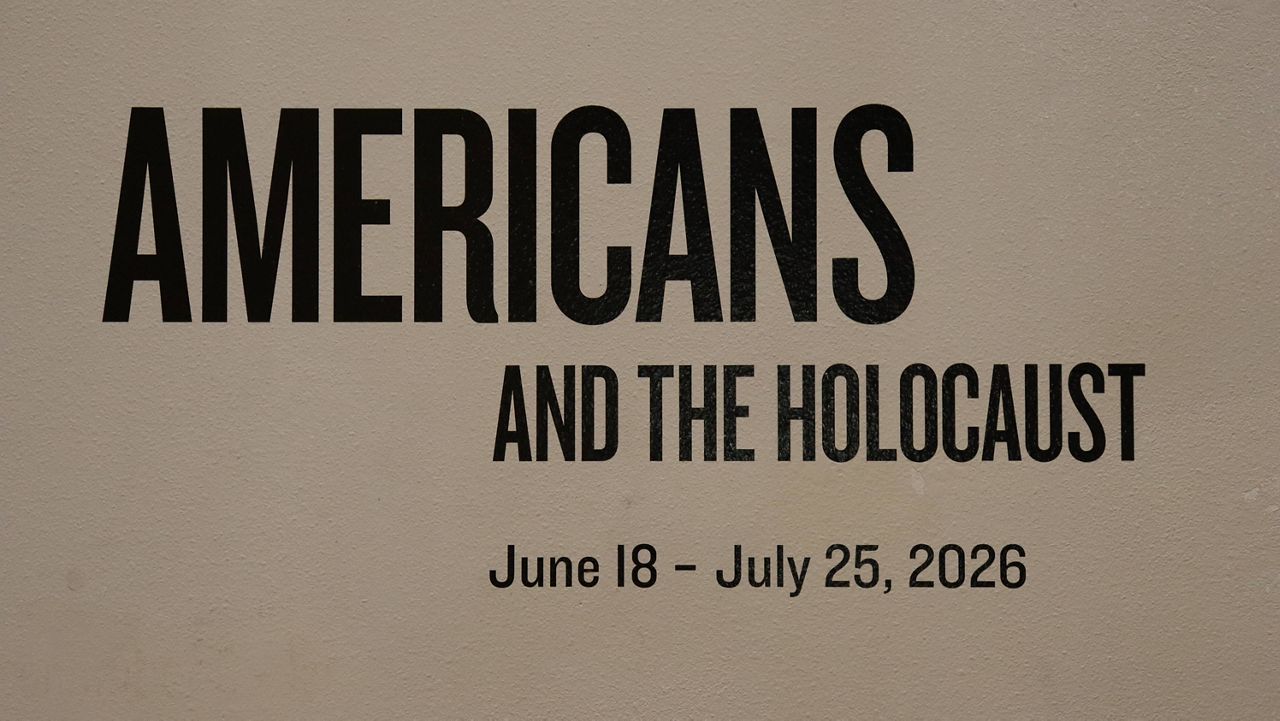
TEXAS — The San Antonio Central Library was selected to display the “Americans and the Holocaust” traveling exhibit, one of 50 public libraries in the country to participate in the exhibit’s tour.
The tour is led by the United States Holocaust Memorial Museum and the American Library Association. Baylor University Libraries was also chosen to participate in the tour earlier this year.
“I had the honor of seeing it in another state a couple of years ago when I was traveling,” said Leslie Davis Met, the director of the Holocaust Memorial Museum in San Antonio. “When I learned that it was being brought to San Antonio, I was thrilled. This is not information that is shared on a regular basis.”
“The focus in Holocaust education has traditionally been Europe. It’s been about the Holocaust, the concentration camps, and the ghettos. It’s been about the Allies’ response overseas,” she said.
Met says, however, that this exhibit focuses on the American response to the Holocaust, saying it is often not tapped into by museum-goers.
“What was going on in our country during that time and how we responded to the atrocities going on in Europe as the information began to unfold and become public,” said Met.
The exhibit’s display in the Alamo City is not the only tie to the Holocaust San Antonio has.
According to the Holocaust Memorial Museum in San Antonio, the San Antonio Jewish Social Services Federation helped with refugee resettlement, despite strict guidance from the U.S. government to not allow refugees into the country.
The museum features an online exhibit detailing the children who came to San Antonio, as well as meeting excerpts from the 1930s laying out efforts to raise funds and resettle refugees.
“There is no way to determine the exact number of refugees who were settled in San Antonio,” reads an excerpt from the museum’s exhibit page.
At the library, visitors can expect special presentations that accompany the panels in the display room.
Dr. Isaac Amon, a law lecturer at Washington University and a former investigator of ISIS war crimes, spoke at the exhibit’s debut on June 18, detailing how Americans responded to the Holocaust and the slow momentum to get involved.
“We have it, as Thomas Paine said, ‘To make the world again. We have it in our power to make it new.’ After the total defeat of Nazi Germany and the Axis in World War II, there’s almost this ability to create a new world, a better world,” he said.
Like the city of San Antonio, Amon also has a personal connection to the Holocaust and World War II.
“My extended family was murdered in the Holocaust. My grandfather served in the United States Army in World War II, enduring antisemitism in his own unit,” he said. “80 years on, we’re facing rising antisemitism again, and the generation that lived through it is nearly gone, so now the question and the responsibility falls to us to carry it forward to the next generation.”
Amon also draws connections between major milestones in both the Holocaust’s history and the history of the United States.
“You know, 2026 is simultaneously the 250th anniversary of the United States and the 80th anniversary of the Nuremberg Trials. I see parallels between these milestone anniversaries,” he said. “America, by fighting in World War II, problematic to some extent [of] how they entered, in sense it was following that vein of the founding of the United States — fighting for religious freedom, fighting for freedom of speech, or to try and rid the world of tyranny. That’s something the American Revolution, to a large extent, was fought about.”
Visitors to the San Antonio Central Library can see the exhibit on display through July 25.