
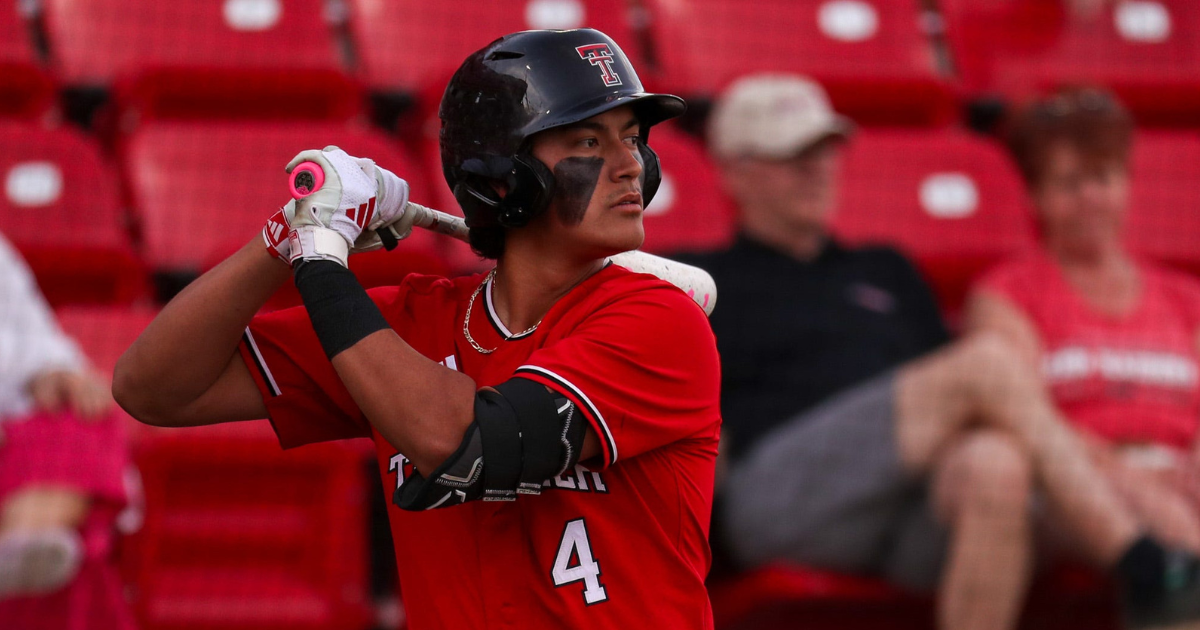
The Texas Longhorns saw some historic seasons from Carson Tinney and Aiden Robbins at the plate. Both players came from the portal and provided immediate impacts as two of the best hitters in the SEC. Can the Longhorns replicate that success out of the portal? The advanced data suggests they may have already done so.
[Sign up for Inside Texas for $1 then get 50% off your first year!]
Although it seems ridiculous to suggest that Texas could potentially replace two 20 home run hitters. It’s important to remember that while Tinney did hit 17 home runs at Notre Dame, Aiden Robbins only had five home runs the previous year. Much of his jump to 24 home runs he attributes to the coaching at Texas.
Data Glossary
Whiff % – measures the percentage of a player’s total swings that result in a complete miss
IZ Whiff% – measures the percentage of a player’s total swings that result in a complete miss on pitches inside the zone
OOZ Whiff % – measures the percentage of a player’s total swings that result in a complete miss on pitches outside of the zone
Chase % – measures the pitches a batter swings at that are located outside of the strike zone
K % – measures the frequency with which a pitcher strikes out opposing hitters, or a batter strikes out, calculated as total strikeouts divided by total batters faced
BB % – measures the percentage of a player’s total plate appearances that result in a walk
xWOBA – measures a hitter’s true offensive skill based on the quality of contact (exit velocity and launch angle) rather than the actual results
Avg EV – measures the speed of the ball immediately after contact, calculated by dividing the sum of all batted ball speeds by the total number of batted ball events
90th EV – measures a batter’s exit velocity on the hardest 10% of their batted balls, mathematically excluding flukes or weak contact
Barrel % – measures the frequency with which a batter hits the ball with the ideal combination of exit velocity and launch angle
Pull AIR % – measures the percentage of a batter’s hits that are non-groundballs, which are hit to the pull side
Before we start to compare the new transfers to the previous ones, let’s take a look at the difference in the advanced data from both Tinney and Robbins before and after they joined Texas.
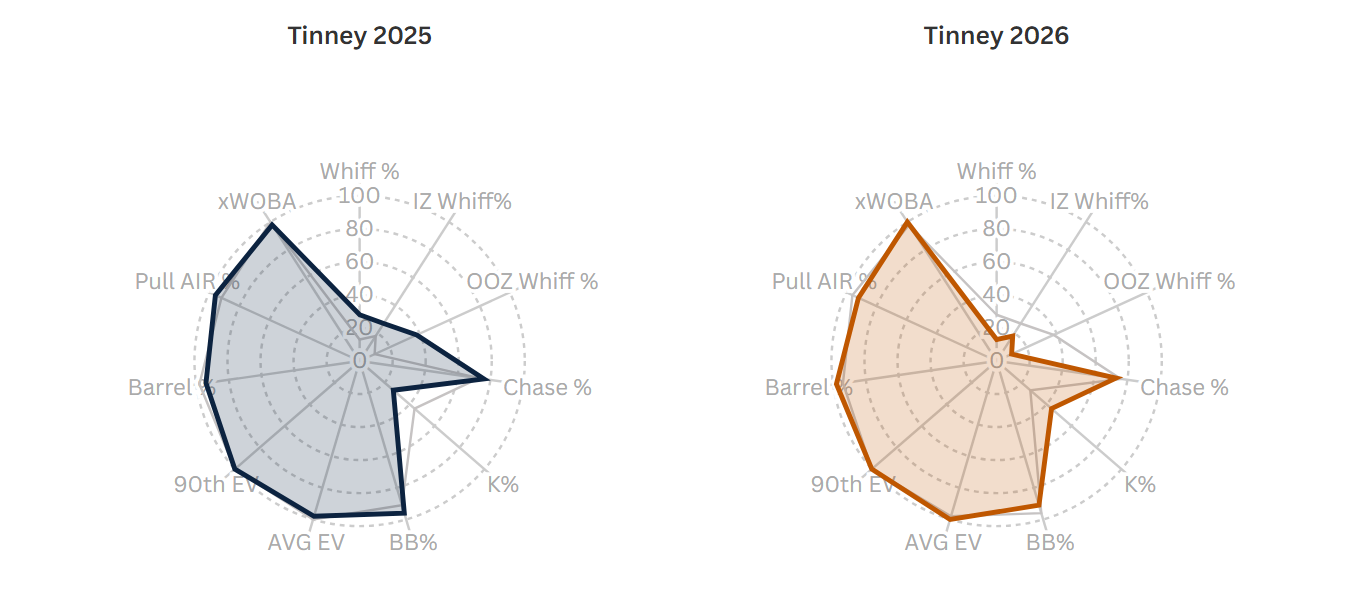
Tinney at Notre Dame was a monster at the plate. He was 100th percentile in the following statistics, xWOBA, Avg EV, and 90th EV. He was also exceptional in BB%, barrel %, and pull air % in his time at Notre Dame. The underlying foundation for the elite power we saw in 2026 that resulted in 22 home runs was there.
Robbins was similar in a few stats, but understandably dropped in some other areas as he went to face elite pitching in the SEC. Just like Tinney, Robbins before joining Texas was elite in BB%, Avg EV, 90th EV, barrel %, and xWOBA. As we now know, he remained elite in those same categories.
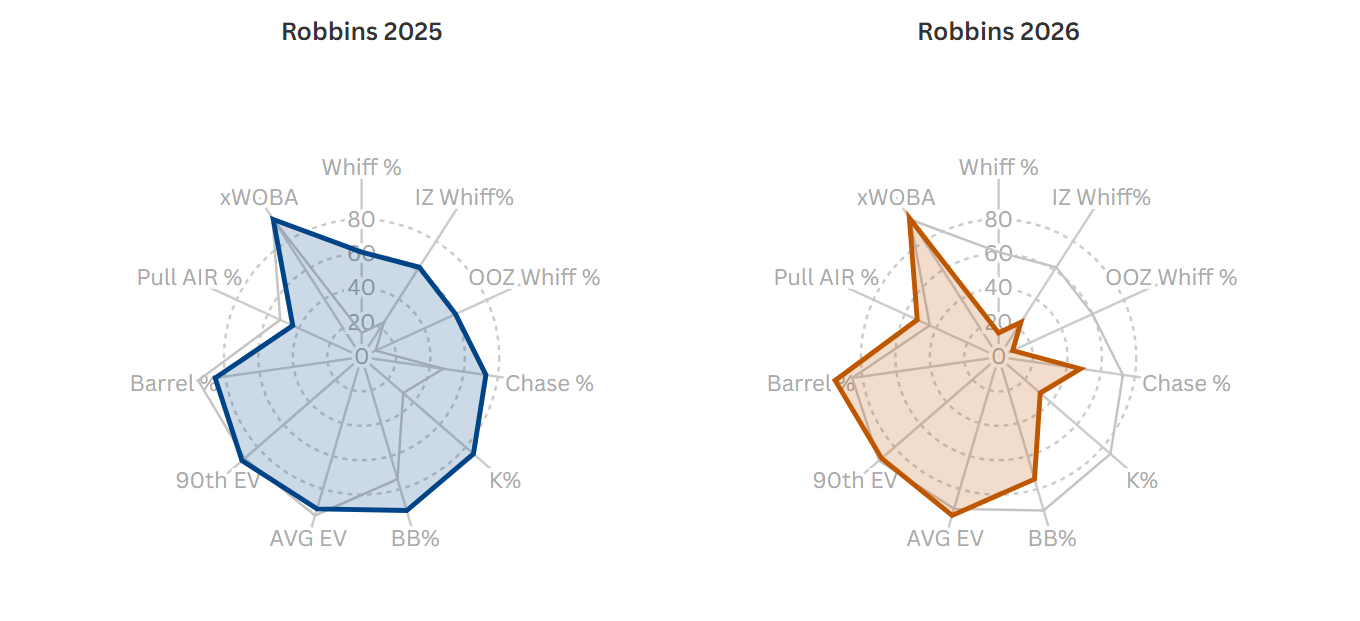
The only categories that you can see a dramatic difference in percentile among Division I batters are Whiff %, IZ Whiff %, OOZ Whiff %, Chase %, and K %. All of those stats make sense to see a drop in with the quality of pitching faced going to another level for both batters. However, the percentiles for quality of contact, eye at the plate, and power at the plate were present prior to joining Texas.
It is probably safe to assume that the transfers for this next 2027 Texas team will follow a similar path.
With that in mind, let’s now look at how some of these new transfers compare to the previous two when they were headed to Austin before leaving a historic mark.
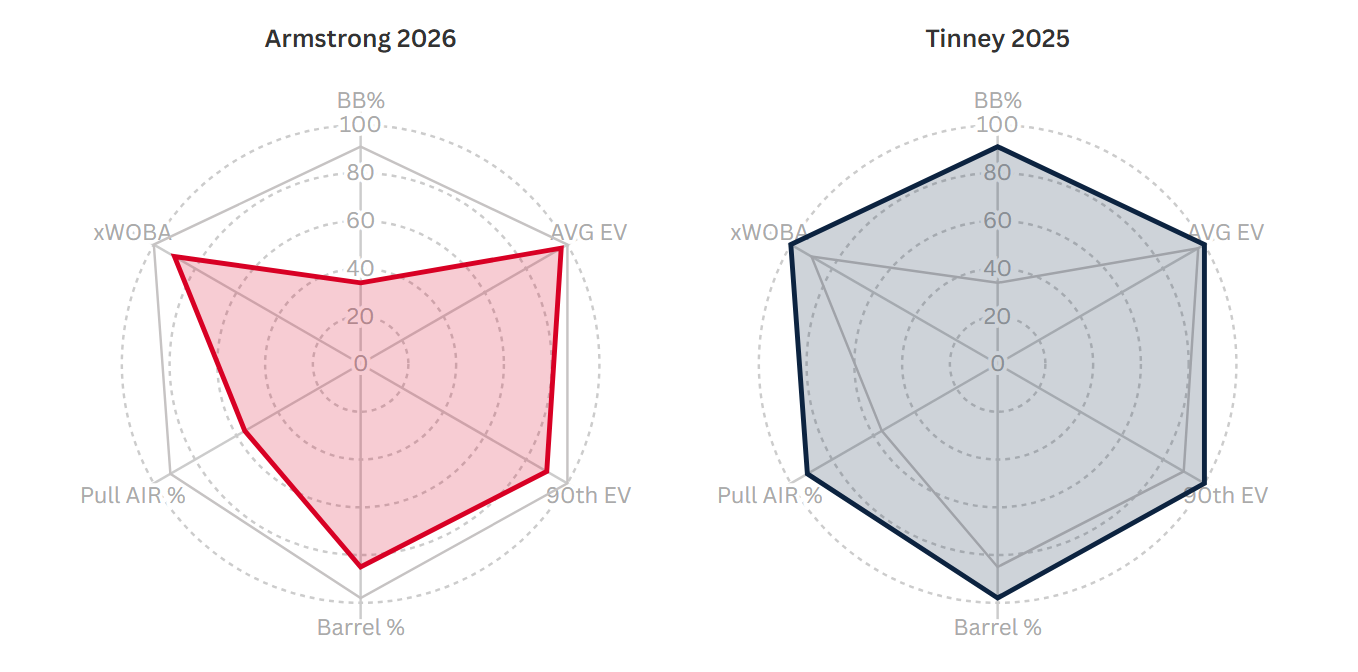
When looking at Ian Armstrong compared to the catcher he is replacing in Tinney, he offers a promising amount of potential at the plate. With a 97th percentile in Avg EV (Tinney 100th) and a 90th percentile in 90th EV (Tinney 100th), he has plenty of juice in his bat with only a small drop off in how fast the ball is leaving his bat. Armstrong is within 13 percentiles of Tinney in both barrel % and xWOBA as well.
As far as making quality contact with the ball is concerned, Linkin Garcia’s exit velocity numbers and barrel percentage slightly edge out what Robbins was able to do at Seton Hall. Though Robbins has a significant advantage over Garcia in bases on balls percentage, as well as a good margin in the ability to pull the ball in the air.
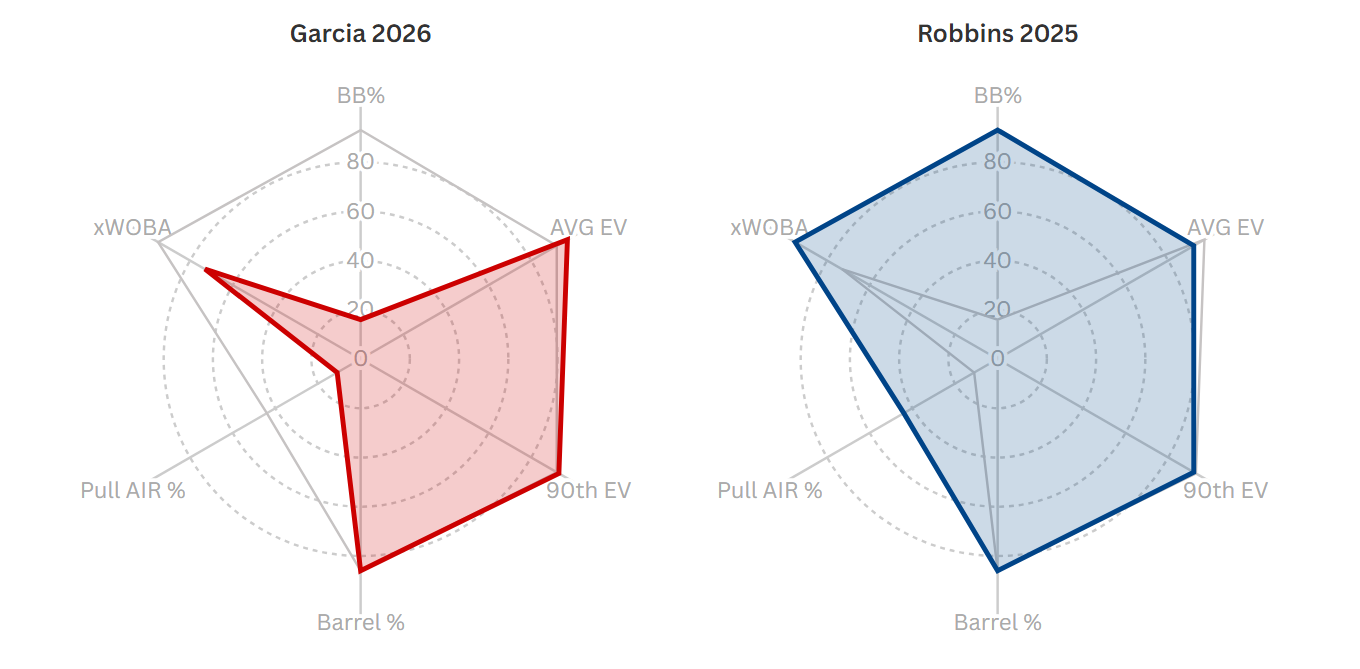
Garcia’s four home runs in 2026 don’t scream out a player who is going to be able to lift the ball out of the Disch often in 2027. But his exit velocities do. The same can also be said for Armstrong. Both of the transfer candidates have nearly identical exit velocities and barrel rate numbers, the only difference being Armstrong has more pull air rate. It should come as no surprise that he has solid home run numbers with a 12-bomb margin over Garcia.
Enter Troy Tulowitzki. One of the players who benefitted from Tulowitzki’s teachings the most was Anthony Pack Jr. Though his pull air rate at 34th percentile leaves some to be desired, most of his 12 home runs were from pulling the ball and lifting it. Granted, he was a player who literally didn’t have fences in high school, so it’s hard to judge his power. Pack Jr. never really thought of himself as a home run hitter until his time at Texas.
The hope is that Tulowitzki can get Garcia to be able to lift the ball, and pair that with some elite exit velocity and barrel rate numbers. If that can happen, there should be a noticeable surge in home run production from the transfer out of Lubbock.
It is unlikely that Texas will be able to reproduce two transfer players coming in as 20+ home run hitters in 2027, but there are players that have the bats to get it done. It will come down to how receptive they are of the offseason conditioning from strength coach Matt Couch and the teachings of Tulowitzki and Jim Schlossnagle.
Like this story0Share article