
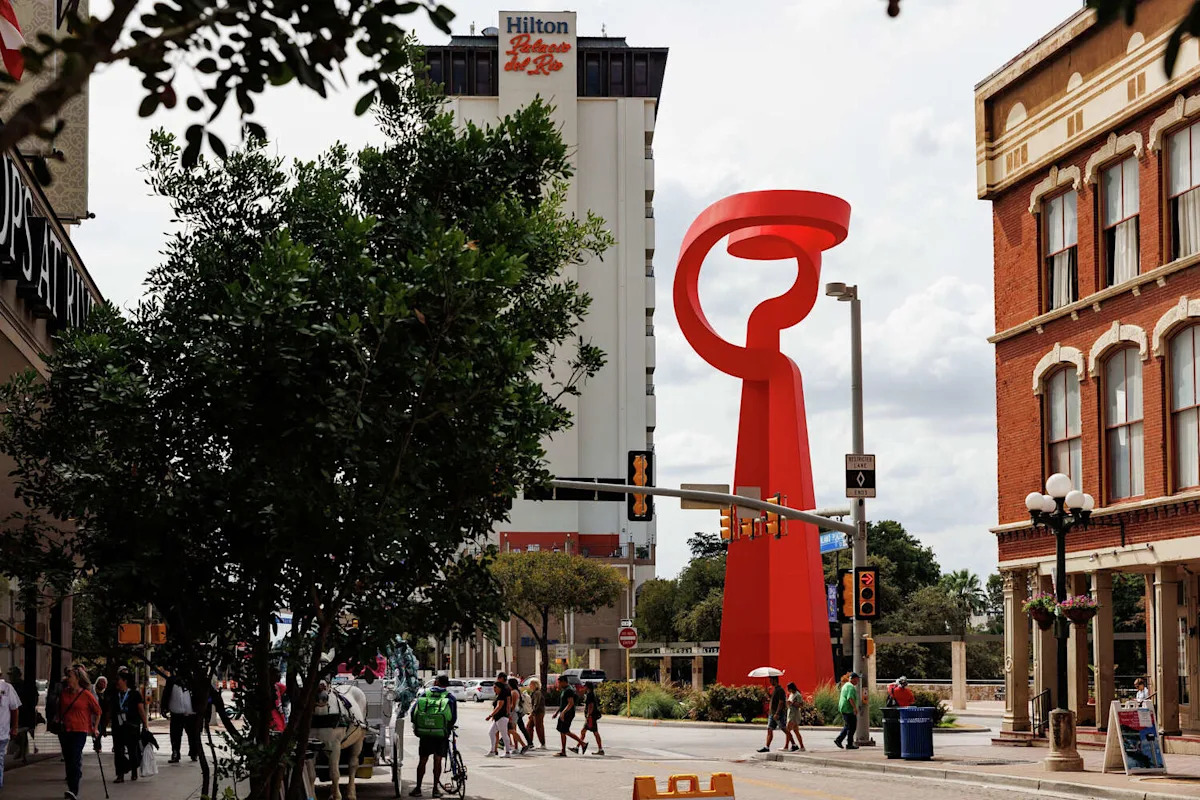
The grand steel sculpture with a brilliant red hue has captured the attention of downtown visitors for over 20 years.
“The Torch of Friendship” – or “La Antorcha de la Amistad” in Spanish – was created as an act of goodwill. Its creation, though, wasn’t an entirely well-received gesture. Criticism surrounded its 2002 unveiling, though there was plenty of enthusiasm for the unique piece of highly visible public art.
This week’s San Antonio Explained looks at the origins of the “The Torch of Friendship” sculpture and its place in local history.
Its origins
Intended to be a tribute to the friendship between Mexico and San Antonio, the sculpture was created by renowned Mexican artist Sebastián, a well-known contemporary sculptor who had created about 120 monumental public art pieces for cities around the world.
The Asociacion de Empresarios Mexicanos, a group of Mexican business people, commissioned the artist to create the artwork that would be presented as a gift to the city. Many of the the group’s members had made San Antonio their second home. The sculpture was meant to be a symbol of the “complex” and “harmonious” bonds between the U.S. and Mexico, according to historical archives.
The group worked with the Mexican Consulate and the city of San Antonio to make the sculpture a reality.
On May 23, 2002, San Antonio City Council unanimously approved an ordinance authorizing the city manager to accept the donation of the $650,000 sculpture. The Historic and Design Review Commission, which oversees public art projects, had already approved placing the sculpture at its proposed location – a traffic circle where Commerce, Alamo and Losoya streets converge.
ALSO READ: San Antonio Explained: How a sculpture garden with historic significance was created
Its creation
Sebastián worked on the sculpture in six pieces, which were transported from Mexico and assembled in San Antonio in the weeks leading up to its summer unveiling. Four flatbed tractor-trailers were used to transport the art pieces that weighed about 45 tons. A crane, three elevated platforms and ropes were used to assemble the pieces.
As the 65-foot sculpture was being erected, its full scale was understood. Some passersby watched in awe. Those who had already questioned the sculpture’s abstract design raised more concerns, newspaper archives show.
Some critics addressed City Council, questioning how such a “monstrosity” was approved. Some criticized that the sculpture’s classification of “gift” meant it wasn’t subject to the same intensive review required of public art pieces funded through city programs. The San Antonio Express-News published several letters to the editor criticizing the sculpture’s color, design and size. One letter writer likened the sculpture to Gumby, writing that it looked like the claymation character was “delivering a pizza.”
Some critics, including the Conservation Society of San Antonio, thought the sculpture’s modern design didn’t fit with the historic buildings downtown. Some were concerned that placing the grand sculpture in such a heavily traveled spot would be a traffic hazard. Supporters said the location was a perfect spot because it helped blend the old with the new, symbolizing progress, the Express-News reported.
Some thought the sculpture’s abstract design and its vivid color reflected the city’s bright future and complemented downtown’s “Enchilada Red” Central Library, which also was designed by a Mexican artist and initially had its detractors.
The artist and those who commissioned the sculpture defended its modern design as progressive. They brushed off criticism, saying it’s to be expected because art is meant to evoke different responses.
In media interviews, Sebastián said the sculpture’s two columns (or “legs” as he called them) are intended to look like “a torch rising from the ground.” He said the columns, which twist before intertwining at the sculpture’s highest point, are meant to represent U.S. and Mexico. The sculpture’s different angles project varying points of view, the artist said, much like how he sees the “complex” relationship between the two countries.
“You will observe that one of the legs is shorter than the other, representing the differences between the two countries – but the relationship on the top is complex, as the two legs move together to create a ring,” Sebastián told an Express-News reporter in Spanish, as he monitored workers welding the art pieces together.
Its unveiling
“The Torch of Friendship” was unveiled on June 27, 2002 in a morning ceremony attended by Sebastián, San Antonio Mayor Edward Garza, Secretary of Foreign Affairs for Mexico Jorge Castañeda Gutman and other dignitaries. Mexican President Vicente Fox was slated to attend, but he canceled his trip to Texas about a month prior.
A giant blue, red, white and green curtain, representing the colors of the U.S. and Mexico flags, covered the base of the sculpture before its unveiling. In a second ceremony that evening, the sculpture was illuminated in front of a gathered crowd of hundreds.
ALSO READ: Luminaria arts festival returns to downtown San Antonio this fall
During the morning ceremony, Garza alluded to the controversy that brewed over the sculpture’s downtown location.
“I think this is the most appropriate location. We had a little debate – that’s not new in San Antonio,” Garza told the crowd, drawing a few laughs.
Many of those who turned out to see the morning unveiling and evening illumination complimented the artwork and congratulated the artist, according to reports of the day’s events.
Though criticism continued for weeks after the unveiling, greater acceptance of “The Torch of Friendship” seemed to be taking hold.
“The piece is progressive, colorful and beautiful and not only brings that space together but signals that San Antonio is not only historic but also has its foot planted in the future,” a reader wrote in a July 2002 letter to the editor published in the Express-News.
Its significance
“The Torch of Friendship” remains one of the city’s signature pieces of public art. It’s included in an internet portal documenting the city’s art collection that the Department of Arts & Culture debuted this year.
“Since its addition to the skyline, it has become emblematic of San Antonio and one of its best-known public artworks. This piece, and other Sebastian works in our city, characterize San Antonio’s long, fruitful, and hopeful relationship with Mexico,” the portal’s description of “Torch of Friendship” reads.
In June 2019, the sculpture went gray as work on restoring its vibrant color got underway. The “facelift” involved stripping the sculpture of its color, revealing a monochrome base. The new paint job was celebrated that summer.
Sebastián’s relationship with San Antonio has remained friendly. More than 100 pieces of the sculptor’s work were displayed in an October 2019 citywide retrospective. And, in 2020, Sebastián donated a new piece, “The Door of Equality/La Puerta de la Igualdad,” to the city. The 33-foot-tall cobalt-blue sculpture stands in the roundabout near the Central Library downtown.
Two public art pieces created by Sebastián will be installed this summer outside UT San Antonio’s new $131 million San Pedro II building: “Águila Bicentenario” (2010), a nearly 10-foot-tall steel sculpture; and “Celosia Borunda” (2008), an 8-foot-tall red steel sculpture.
Subscribe
There’s more to San Antonio with the Express-News. Subscribe today for just 25¢.
This article originally published at San Antonio Explained: Why was downtown’s ‘Torch of Friendship’ created.