
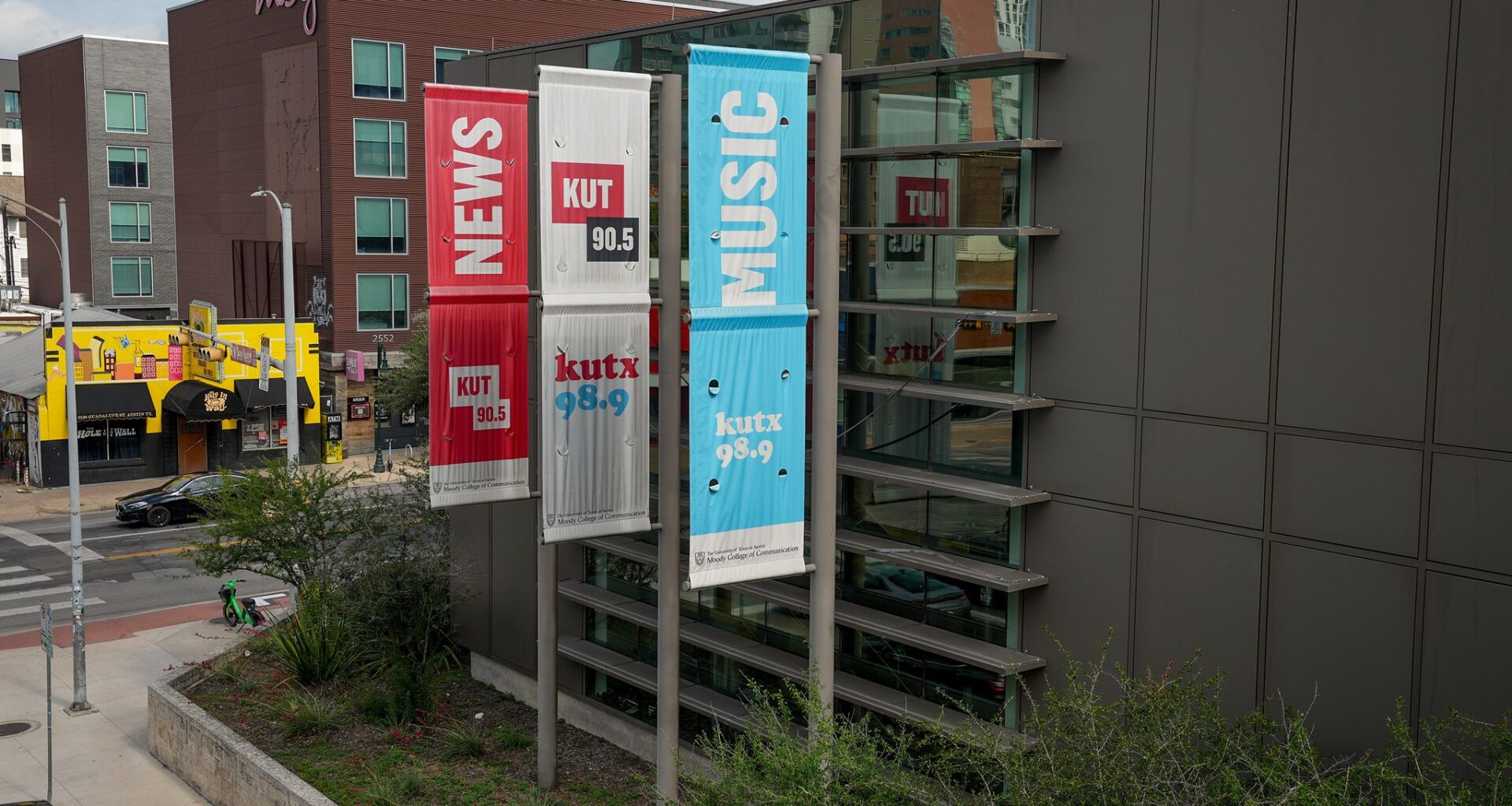
The offices of radio stations KUT and KUTX are seen on the University of Texas campus. Public radio and red-state universities can play in the same sandbox, Gary Susswein writes. Give KUT and UT time to repair the damage and restore trust.
Jay Janner/Austin American-Statesman
I was the spokesperson for the University of Texas at Austin in 2012, when the Regents considered a proposal to purchase a second FM radio license and launch another public radio station, KUTX, alongside KUT. What was supposed to be a routine vote was delayed when Regents questioned the cost, structure and timeline.

Underlying those on-the-record concerns, however, was one concern we kept hearing informally: Should our public university really be in the business of owning public radio stations?
Article continues below this ad
Questioning the relationship between UT and public radio felt shocking — even subversive — at the time. But today, it’s at the top of many Austinites’ minds after the university’s and KUT’s clashes over a festival and the firing of general manager Debbie Hiott (who was previously a colleague of mine at the Statesman and is an outstanding journalist).
It’s tempting to say the answer should be a resounding “no.” But as a crisis communications professional, I know the worst decisions are sometimes made in moments of anger, stress and broken trust, and I believe the right path forward is to recognize that our public university really should be in the business of owning public radio stations.
In many ways, the recent blow-up felt inevitable.
While KUT’s local reporting is fiercely independent and fair, the station is part of a national network that unquestionably leans left.
Article continues below this ad
At the same time, the UT administration is moving away from the politically progressive approaches that have anchored higher education administration.
University backers see this as an overdue correction to reflect statewide values and restore public trust. Some faculty members may warn that it is an overreaction that stifles free speech and harms the school, but UT is continuing to climb in national academic rankings, applications and fundraising.
Against this backdrop, there have always been uncomfortable questions about whether journalists should be employed by a huge public agency that is part of a state government they must cover objectively and thoroughly.
SIGN UP FOR THE AUSTIN ANGLE and get Statesman commentaries in your inbox
Article continues below this ad
During my years at UT, I sometimes disagreed with university decisions. But my role as a public employee was to get on board and implement them. That’s more challenging for a journalist covering the institution, surrounded by tenured faculty members who enjoy academic freedom.
These realities came crashing together around safety policies at the KUT Festival, which featured Democratic Sen. Cory Booker as a headliner, and became a Rorschach test of how Austinites view the responsibilities of the free press and the political leanings of higher education. They set off a chain of events that led to the firing of a respected journalist and, now, to KUT listeners calling for a breakup.
Yet despite all of this, it feels too easy — and too much of a copout — to say our public university and public radio station should go to their own corners. It would be another sign of the cultural and political polarization that is undermining our society.
And if there were ever two institutions that can show leadership in breaking that cycle, they are the independent press and a constitutionally mandated “University of the first class.”
Article continues below this ad
KUT’s mission statement says it “creates experiences that deepen understanding and connect people,” while UT’s says it “preserves and promotes the arts, benefits the state’s economy, serves the citizens through public programs and provides other public service.”
Even if one leans left and the other is moving right, they are building on the same foundation.
Tearing them apart at a moment when emotions are raw and trust is nonexistent would be a powerful declaration that public radio and red-state universities just can’t play in the same sandbox. It would model and normalize that approach for students, listeners, alumni and elected officials.
Let’s take a breath and give the station’s new leadership time to repair the damage, rebuild relationships and restore trust.
Article continues below this ad
The UT Regents of 2012 were not exactly a collaborative or touchy-feely crew. But after raising questions about launching KUTX, they made some adjustments and approved the deal. It was the right decision, launching a successful new chapter for UT and public radio.
We need the steady leadership to do the same today.
Gary Susswein is the principal owner of BandOne, an Austin-based communications and strategy firm. He previously served as Chief Communications Officer at UT Austin and Metro Editor at the Austin American-Statesman.
Article continues below this ad