
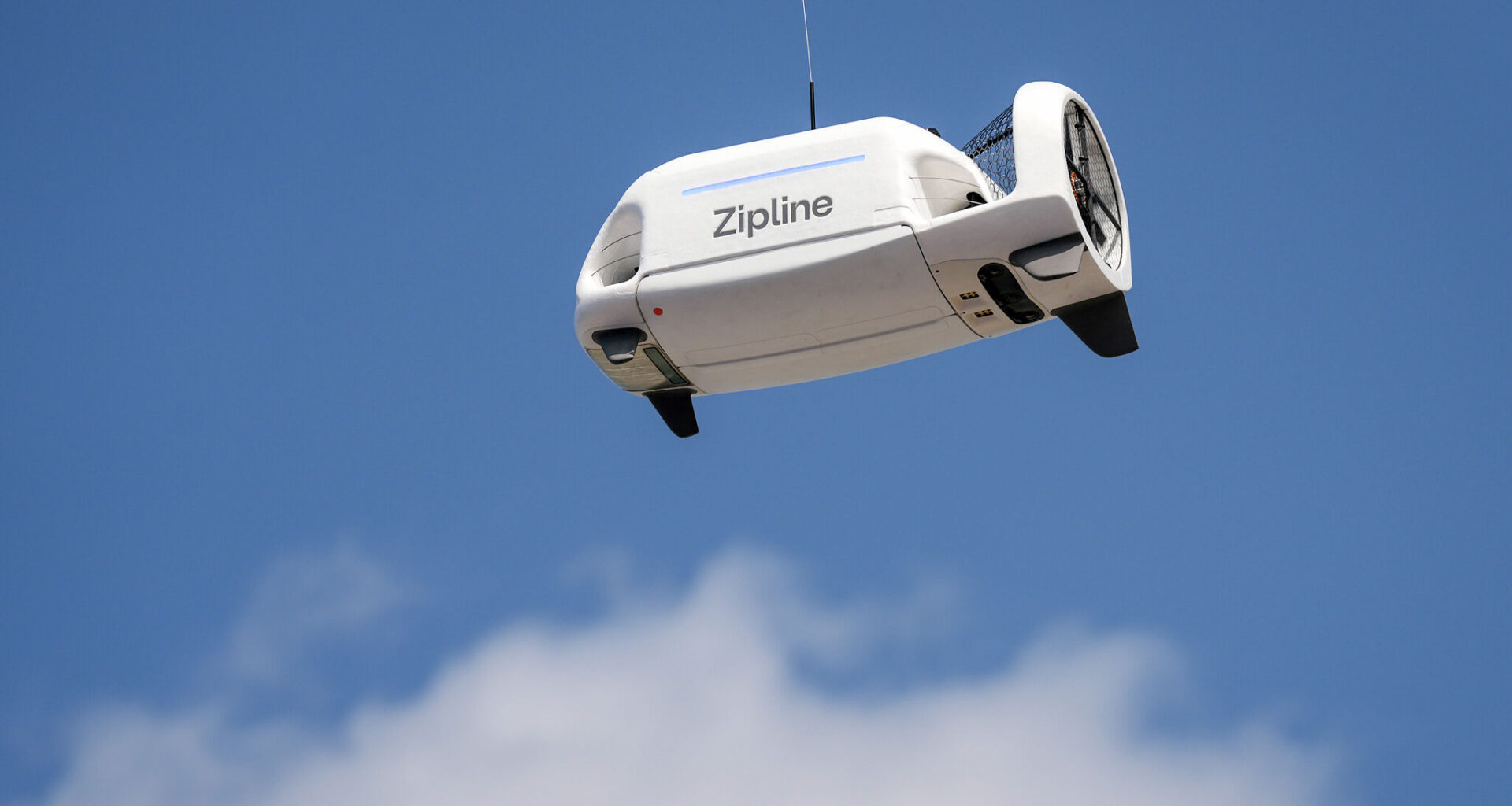
A Zipline drone returns to its docking station during a delivery demonstration in North Austin. The company plans to launch autonomous food, grocery and prescription deliveries in Austin later this year.
Jay Janner / Austin American-Statesman
Your next taco delivery may come from above.

Zipline, the world’s largest autonomous drone delivery company, is expanding service into Austin later this year, bringing food, groceries and even prescriptions straight to customers’ yards.
Article continues below this ad
A delivery pod is lowered from a Zipline drone during a demonstration in North Austin. The company plans to launch autonomous food, grocery and prescription deliveries in Austin later this year.
Jay Janner/Austin American-Statesman
“We get a lot of people who say it feels a lot like ‘The Jetsons,’ ” said Zach Hill, a Zipline spokesperson. “But it’s here and it’s happening now.”
How to order a drone delivery
Taking on food-delivery firms such as DoorDash and Grubhub, Zipline relies on fully autonomous drones to take orders directly to customers who order from partner stores such as Chipotle, Walmart, Crumbl Cookies, local restaurants and, eventually, pharmacies.
Article continues below this ad
The Texas Board of Pharmacy recently gave Zipline the green light to begin delivering prescriptions, Hill said.
Ross Pontes, flight operations integration manager for Zipline, loads a delivery pod with an order during a demonstration in North Austin.
Jay Janner / Austin American-Statesman
RELATED: Veho launches pilot program to add dog-like robots to parcel delivery service in Austin
After a customer places an order, the store prepares it while a nearby drone charges at a docking site. Once the order is ready, the aircraft launches and flies to about 300 feet above the store.
Article continues below this ad
Hovering overhead, it lowers a pod by cable. Store employees either place the order inside or use a passcode-protected drop box that allows the drone to retrieve it automatically.
The drone then carries the order to the customer, lowering it by cable into a designated drop-off location such as a front or backyard. Customers can track the delivery through the company’s app, Hill said.
Zipline can also deliver to apartment and office buildings using communal drop-off areas or sidewalks.
“Seeing is believing,” Hill said. “A lot of people haven’t seen drone delivery or are unsure of what to expect. But when they see our system, they see how quiet it is, they see how fast it is. We’re able to turn skeptics into believers really quickly.”
Article continues below this ad
The Federal Aviation Administration has approved operation of Zipline’s drones, which are designed to keep noise to a minimum. During deliveries, they produce sound levels of less than 60 decibels — about as loud as a dishwasher running in the next room.
A delivery pod is lowered during a Zipline drone delivery demonstration in a parking lot in North Austin on Wednesday. The drones fly autonomously between docking stations, businesses and customers’ homes.
Jay Janner / Austin American-Statesman
The drones, whose pods are temperature-controlled, can carry about 8 pounds on round trips of about 10 miles.
The company is still in the early stages of the rollout so has not set additional delivery fees.
Article continues below this ad
“We are committed to making it extremely competitive and far cheaper than any other service,” Hill said. “You don’t have to tip the drones or feel guilty about not tipping them. It can get expensive when you do pay fees. Those rack up pretty quick.”
Company operations
Austin isn’t Zipline’s first city, or even its first in Texas. The company began operating in Houston in April and Dallas last year.
The company also declined to provide a specific launch date. It is still working through zoning approvals with the city of Austin to set up its charging stations, where several drones will dock to charge between deliveries.
Article continues below this ad
Founded in 2014, Zipline designs and manufactures its lithium-ion-powered drones in-house at its factory in California.
The company made its first deliveries in 2016 in Rwanda, where its drones deliver medical supplies such as blood and vaccines to hospitals. The company’s drones now operate in five countries in Africa.
Hill said they perform “more than 500 safety checks” before takeoff.
“Something that you won’t see, but before any delivery takes place, those drones are going through hundreds of onboard safety checks, making sure all of the hardware is functioning appropriately and checking the route navigation,” Hill said. “Safety is always top priority.”
Article continues below this ad
Zipline drones are docked at a launch site during a delivery demonstration in North Austin on Wednesday. The docking stations recharge the aircraft between deliveries.
Jay Janner / Austin American-Statesman
The drones’ pods, attached via cable, also have a motor that helps them counteract wind and navigate potential hazards. The cable can also be automatically cut in an emergency, such as a dog attacking the pod, said spokeswoman Andrea Koskey. The drone and pod are also trackable by the company so employees can retrieve any lost or downed aircraft.
While Zipline may have the first commercial autonomous drones seen in Austin’s skies, the city has been a hotbed for autonomous vehicles and delivery robots for more than a year.
Article continues below this ad
In 2024, Austin-based Avride launched its delivery robots on sidewalks downtown and at the University of Texas at Austin in partnership with Uber Eats. The company’s friendly-faced robots can also be found crossing streets in the Mueller neighborhood, where the local H-E-B on East 51st Street is piloting an autonomous delivery system for nearby residents.
Austin also was the first city in Texas to welcome robotaxis, with Waymo launching commercial operations in early 2025. Tesla Inc. also is working to provide driverless service, with Amazon’s Zoox and Avride also testing their robotaxis on Austin streets.