
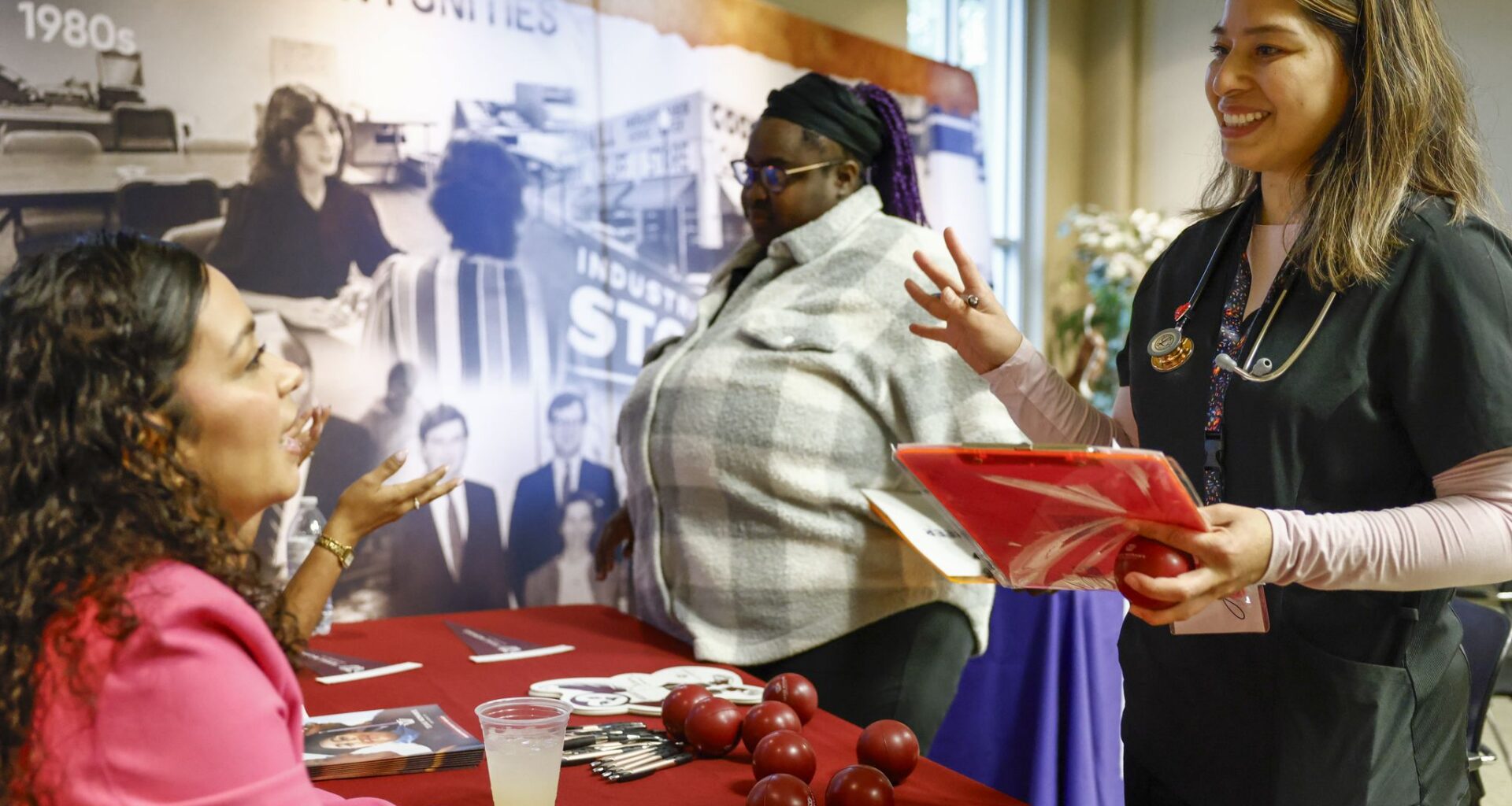
Nancy Sosa introduced herself to recruiters and healthcare officials while classmates rotated among employers from Parkland Health, Texas Health Resources and other organizations at Goodwill Industries of Dallas.
Sosa, a 39-year-old former executive chef and chocolatier, is one of 15 students in Goodwill Dallas’ new certified clinical medical assistant program. Though she spent years working in kitchens, Sosa said she had long wanted to work in healthcare and was drawn to the field by a lifelong fascination with the human body and a desire to help others.
On that recent afternoon, the cohort received its first face-to-face opportunity with potential employers weeks before graduation.
“I love everything,” Sosa said of the program. “I always have time for studying. I always have time to review my modules.”
Goodwill Dallas, Workforce Dallas, TWU Ventures and training provider Skilltrade are piloting a workforce model that brings employers into the process before students complete the 20-week program.
Jason Aubrey, founder and chief executive of Skilltrade, said too many workforce programs stop at certification, leaving graduates to navigate the job search on their own rather than connecting them directly to employers, externships and interviews.
“There’s a number of programs or training providers that, I use the term, ‘train and pray,’” Aubrey said. “Just train someone, offer career services, help them update their resume, and show them a list of employers that are hiring.”
Connecting employers with potential workers
Instead, Aubrey said, the goal is direct employer engagement before graduation through externships, interviews and conversations with hiring managers.
“I think that handoff, or lack thereof, is a missed opportunity to yield better outcomes,” he said.
Evelyn Salazar, another student in Goodwill’s new workforce training program, said she previously completed a certified medical assistant program more than a decade ago. The earlier training gave her technical skills but little support once classes ended.
“I felt like I was on my own towards the end,” Salazar said. The previous program lacked the employer mixers, tutoring options or structured job-placement efforts comparable to those built into the Goodwill program.
Elizabeth Henry, a workforce-training graduate from United Way’s Pathways to Work initiative, described a similar challenge. While praising the programs that helped her transition into phlebotomy, she said many other training efforts fail to bridge the gap between graduation and employment.
“The goal is to get people in gainful employment,” Henry said. “If you don’t get a job afterwards, your work is kind of in vain.”
The organizers of Goodwill’s initiative said success will ultimately be measured by how many students complete the program and move into jobs, externships or interviews, with the long-term goal of building a reliable talent pipeline for healthcare employers.
Growing need for healthcare workers
The approach comes as hospitals and clinics across North Texas continue struggling to fill frontline support roles such as medical assistants and patient care technicians.
At the mixer, recruiters spoke with students about schedules, previous work experience and externship opportunities while organizers emphasized that employers were there to evaluate real hiring prospects.
Texas Health officials said the Goodwill program uses curriculum aligned with the health system’s own workforce training programs, helping employers better understand graduates’ skill levels. Parkland Health officials similarly said hiring leaders and recruiters actively participate in mixers like this to identify potential candidates.
“This is not a check-the-box exercise,” said Lynn McBee, the city’s workforce czar who leads Workforce Dallas. “We are looking for talent because we need it, and we want to be that supplier of a really good workforce.”
Texas’ healthcare workforce shortages stem from multiple factors, including an aging population, pandemic-related worker losses and population growth that has outpaced workforce development, advocates say.
But shortages are often tied as much to workplace adjustment as to certification itself, said Ivan Esquivel, clinic director at Brother Bill’s Helping Hand.
“It’s hard to train what it looks like to work in a very professional setting,” Esquivel said. Skills such as receiving constructive criticism, time management, and understanding priorities tend to come with experience, he said.
Esquivel, whose West Dallas nonprofit clinic primarily serves Hispanic families managing chronic illnesses such as diabetes and hypertension, said many workers also struggle with transportation and childcare instability.
“If they don’t have a car, it’s almost like not having a cell phone,” he said. “You can’t go to work, you can’t pick up your kids.”
However, Esquivel said programs like the Goodwill pathway create opportunities many adults never thought they would have.
“Programs like the Goodwill program give them a second chance,” he said. “They provide hope to a lot of these people that maybe thought, ‘I’m just going to be in the hood my whole life.’”
Sosa understands that feeling. Though she spent years working in kitchens and specializing in chocolate work, she said she always wanted to move into healthcare.
“Ever since I was a kid, I was very interested in the human body, how it works,” she said.
She found the program through a flyer online and immediately applied.
Now she studies constantly, sometimes waking in the middle of the night thinking about healthcare.
“The other day, at 2:30 in the morning, I’m reading about drawing blood,” Sosa said.
The mixer made the pathway feel more tangible, Sosa said, but she also wants more hands-on clinical training before graduation. That tension sits at the center of the experiment unfolding inside the Goodwill classroom.
Organizers are trying to build a workforce model that does more than hand people certificates. Employers are being brought into the process earlier, students are being connected to externships sooner, and training providers are trying to adapt curriculum around real hiring needs.
Goodwill Dallas and its partners are already preparing to scale the effort. A second certified clinical medical assistant cohort is expected to begin in July.
Sosa said the chance to sit across from employers before graduation already feels different from previous workforce experiences.
“I’m so ready to continue with the program,” she said. “It’s addicting.”
This reporting is part of the Future of North Texas, a community-funded journalism initiative supported by the Commit Partnership, Communities Foundation of Texas, The Dallas Foundation, the Dallas Mavericks, the Dallas Regional Chamber, Deedie Rose, Lisa and Charles Siegel, the McCune-Losinger Family Fund, The Meadows Foundation, the Perot Foundation, the United Way of Metropolitan Dallas and the University of Texas at Dallas. The News retains full editorial control of this coverage.