
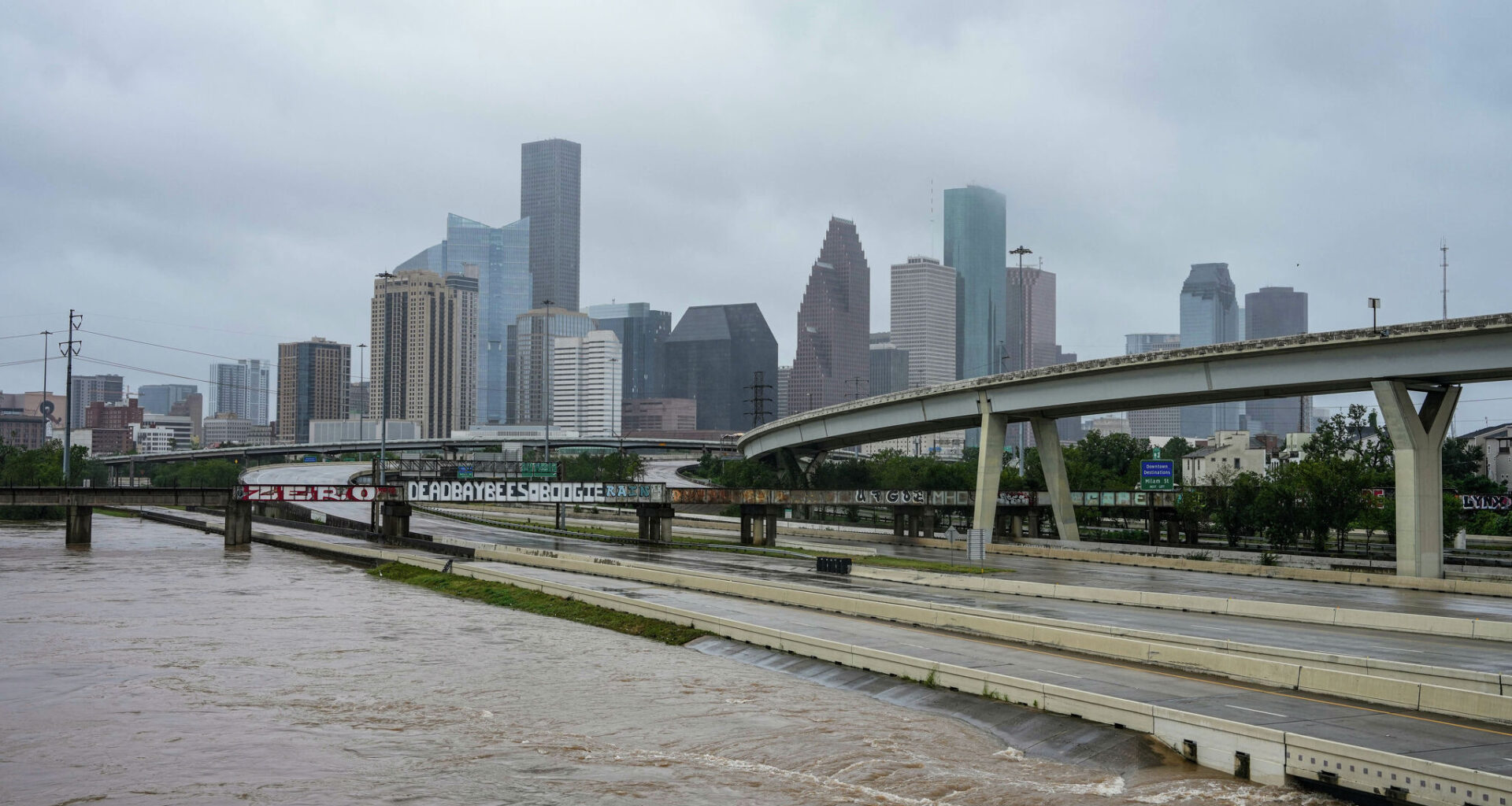
Severe flooding is seen next to the I-10 freeway after Hurricane Beryl made landfall in Houston on July 8, 2024. Researchers say repeated disasters can amplify existing inequities for vulnerable communities.
Raquel Natalicchio/Staff photographerHarris County is ranked as the nation’s most at-risk county for weather and climate disasters, according to a NOAA assessment.A 2024 UCLA report found that same-sex couples are disproportionately concentrated in counties facing elevated climate risks, especially in the South.Researchers say current data likely underrepresents LGBTQ people experiencing housing insecurity, particularly transgender individuals and LGBTQ people of color.
In Houston, one weather disaster often feels like the prelude to the next. In the past 10 years, we had Harvey, then the February 2021 freeze, the 2024 derecho and Hurricane Beryl. Between those headline-grabbing disasters are quieter emergencies: flash floods that strand commuters, weeks of relentless heat and the occasional tornado.
A 2024 report from UCLA’s Williams Institute found that same-sex couples disproportionately live in U.S. counties that face elevated climate risks. Harris County, which carries NOAA’s highest rating for combined weather and climate risk, and its large LGBTQ population make the findings particularly relevant in Southeast Texas.
Article continues below this ad
“We know that climate change exacerbates existing disparities and inequalities,” said Ari Shaw, senior fellow and director of international programs at the Williams Institute. “One of the things we know from decades of research is that, in many cases, LGBTQ people are experiencing discrimination and exclusion in many different parts of their lives.”
HOUSTON’S SHIFTING CLIMATE: Three emerging and troubling climate trends that show Houston’s extreme weather future.
Those inequities can shape where people live, their financial security and, ultimately, how they prepare for and recover from disasters.
Because census data sets do not broadly include sexual orientation or gender identity information, researchers used same-sex couples as a proxy, combining census data with climate risk assessments from NASA and FEMA.
Article continues below this ad
They found that same-sex couples are disproportionately concentrated in counties facing elevated climate risks.
What the findings could mean for Harris County
Few places are better positioned to explore those questions than Harris County.
The report notes that the South is home to more LGBTQ people than any other region of the country, placing many residents in areas increasingly vulnerable to climate-related hazards.
Philip Karjeker and his husband, Shelton, walk along the rainbow crosswalks at Westheimer Road and Taft Street in Houston during an Oct. 11, 2025, protest over the planned removal of the colorful intersection. The crosswalks, located in Montrose, were among Houston’s best-known LGBTQ landmarks and have since been removed.
Jason Fochtman/Houston Chronicle
For Harris County, the report doesn’t offer definitive answers about how disasters affect LGBTQ residents. Instead, it identifies questions that deserve closer examination in one of the nation’s most weather-vulnerable communities.
Article continues below this ad
Why researchers think these disparities exist
Shaw said the findings shouldn’t be interpreted as evidence that LGBTQ people simply choose to live in higher-risk places.
“Many of the cities most at risk to the effects of climate change are locations that have historically been more supportive and welcoming toward LGBTQ people,” Shaw said.
But that’s only part of the story.
“The concentration of LGBTQ people in these high-risk areas also reflects patterns of discrimination in zoning, federal housing policy that excluded same-sex couples and employment discrimination that has limited economic security and housing options,” Shaw said.
Article continues below this ad
HEAT DASHBOARD: Houston launches city data dashboard to track heat-related ER visits, health risks.
“These same low-income urban areas have impervious surfaces, high housing density and low-lying infrastructure that make them more vulnerable to flooding, extreme heat and storms.”
Those vulnerabilities don’t necessarily disappear once a disaster begins.
Shaw pointed to documented instances of transgender people being denied access to emergency shelters because identification documents did not match their gender identity. He also cited examples of LGBTQ residents encountering barriers to disaster relief and interruptions in access to HIV medication following disasters.
Article continues below this ad
Harris County’s repeated encounters with hurricanes, flooding, prolonged power outages and dangerous heat make it an important place to explore the questions raised by the report.
Why the data remain incomplete
Researchers say the findings are only as complete as the available data allow.
The study relies on same-sex couples as a proxy for the broader LGBTQ population, a limitation that likely underrepresents transgender people, LGBTQ youth, single adults and people experiencing housing insecurity.
“Because it relies on cohabitating same-sex couples, the study likely reflects people with greater housing stability and higher socioeconomic status,” Shaw said. “I think we may not be capturing LGBTQ people who experience housing insecurity and poverty, particularly transgender people and LGBTQ people of color.”
“One of the things I would love to see is a more general inclusion of data collection on how climate is impacting LGBTQ populations,” Shaw said. “We have to have data to know how climate is affecting LGBTQ populations.”
Shaw recommended taking steps toward closing housing and social inequities.
“Zoning policies should account for LGBTQ populations and include nondiscrimination protections in housing so everyone can access safe, stable housing in areas that don’t increase their vulnerability to climate,” he said.
He added that “disaster relief and recovery policies should include nondiscrimination protections based on sexual orientation and gender identity so everyone can access the resources they need.”
“We’re all affected by climate change,” he said. “But what we see is that it’s communities at the margins that experience discrimination that are even more impacted by these disasters. It’s important that we understand how climate change amplifies those disparities so that we can better develop policies and programs to ensure everyone is included in the responses.”