
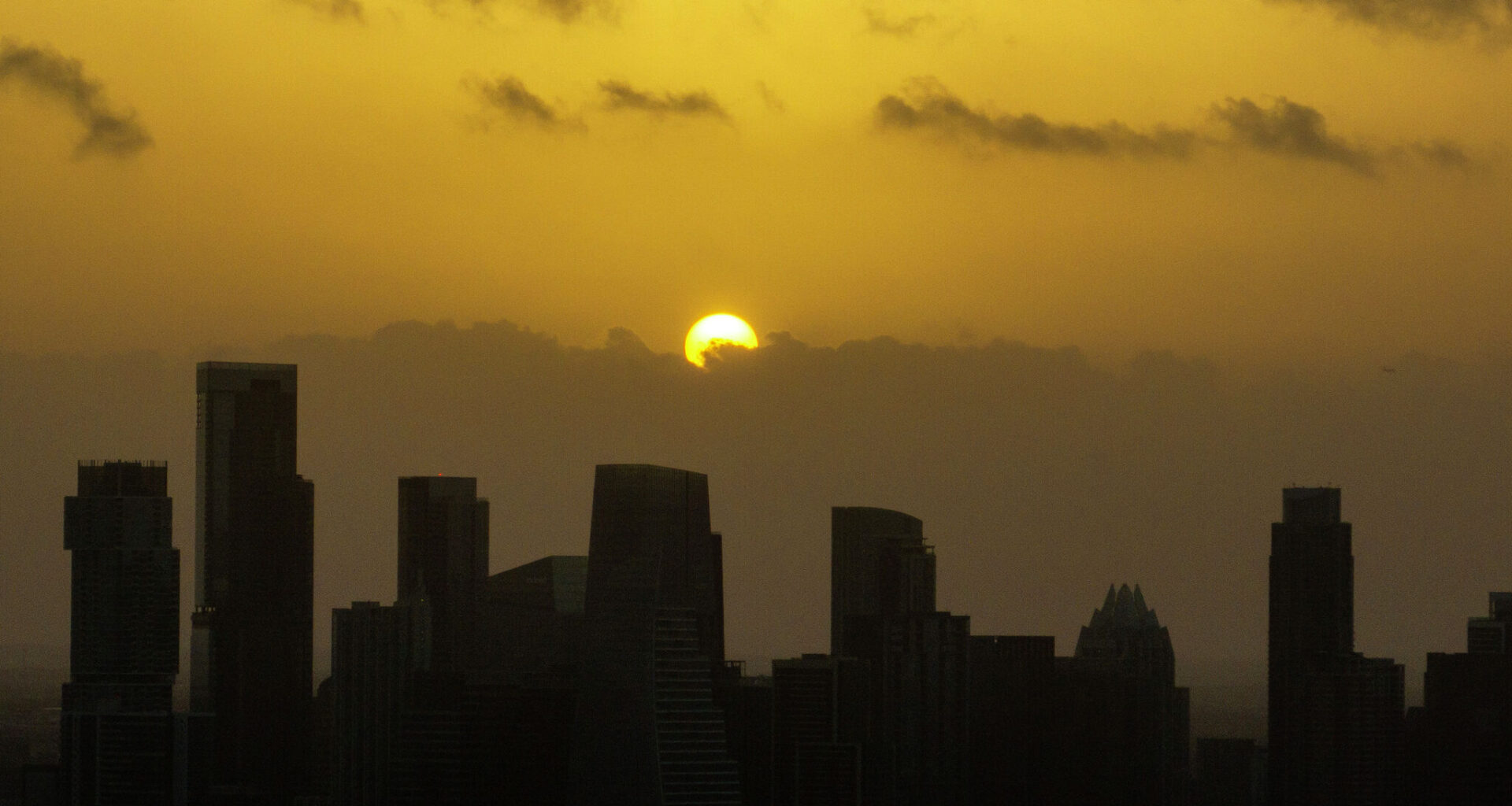
The sun rises behind a plume of Saharan dust in Austin on Monday. Air quality is expected to reach the “unhealthy for sensitive groups” category across South and Southeast Texas on Monday, according to the Texas Commission on Environmental Quality.
Jay Janner/American-Statesman
Here’s a weather riddle: What annual Texas visitor can make asthma sufferers miserable while also helping produce gorgeous sunsets? The answer: Saharan dust.

Like clockwork, from June through August, high winds over northwest Africa pick up substantial amounts of desert dust from the Sahara and carry it westward more than 5,000 miles, through the Caribbean Sea, and eventually onto the Texas Gulf Coast.
Article continues below this ad
Saharan dust becomes a mass of dry, dusty air containing mineral dust from the Sahara — the largest hot desert in the world, covering more than 3 million square miles. Winds reaching up to 35 mph lift an estimated 100 million tons of dust into the atmosphere each year.
The dust is then carried across the Atlantic Ocean, reaching various parts of the world, depending on the prevailing wind patterns.
Hurricane-busting dust
During the summer months, meteorologists closely track the flow of dust in the Saharan Air Layer, because it can influence the development of tropical cyclones.
Article continues below this ad
Hurricanes and other tropical cyclones require a combination of warm ocean waters, a system of low air pressure, moist air that cools as it rises, and light winds in the upper atmosphere. When a plume of Saharan dust moves across the Atlantic, those favorable conditions can be disrupted.
According to the National Oceanic and Atmospheric Administration, the Saharan Air Layer is a layer of warm, dry air with strong winds, which can suppress hurricane formation and weaken existing storms. The dry, stable air limits the rising motion needed for clouds and thunderstorms to develop.
When the SAL reaches the United States, it often creates a more stable atmosphere that reduces cloud cover. NOAA also notes that some locations can experience their hottest days of the summer when Saharan dust is overhead, as increased sunshine and fewer storms allow temperatures to climb.
Article continues below this ad
Health concerns
This dust also can have a significantly affect your health and overall air quality.
This dust can worsen respiratory health and overall air quality. According to the Texas Commission on Environmental Quality, these dust particles are less than 2.5 micrometers in size, which means these exceptionally fine particles can be inhaled deeply into your lungs and aggravate respiratory problems.
The sun rises behind a plume of Saharan dust in Austin on Monday. Air quality is expected to reach the “unhealthy for sensitive groups” category across South and Southeast Texas on Monday, according to the Texas Commission on Environmental Quality.
Jay Janner/Austin American-Statesman
Numerous scientific studies have linked particulate pollution exposure to a variety of problems including:
Article continues below this ad
Aggravated asthma
Decreased lung function
Increased respiratory symptoms
Premature death in people with heart or lung disease
In general, it’s important that people with asthma and other chronic lung problems take precautions to reduce exposure by limiting their time outdoor during dust events.
Benefits of the dust
Saharan dust also plays a vital role in Earth’s climate and ecosystems. According to NASA, airborne particles absorb and reflect sunlight, altering the amount of solar energy that reaches Earth’s surface.
Article continues below this ad
This weather satellite photo shows Saharan dust blowing off the western coastline of North Africa.
NASA
The dust contains a variety of minerals, including iron, phosphorus, manganese, and even trace amounts of uranium. These nutrients are essential for plant growth and help support photosynthesis in both terrestrial and marine ecosystems.
Get your camera ready
Dust from Africa can also create breathtaking sunrises and sunsets. As sunlight passes through the dust-filled atmosphere, shorter wavelengths of light are scattered away, allowing the longer red, orange, and yellow wavelengths to become more visible, producing vibrant colors across the sky.
Article continues below this ad