
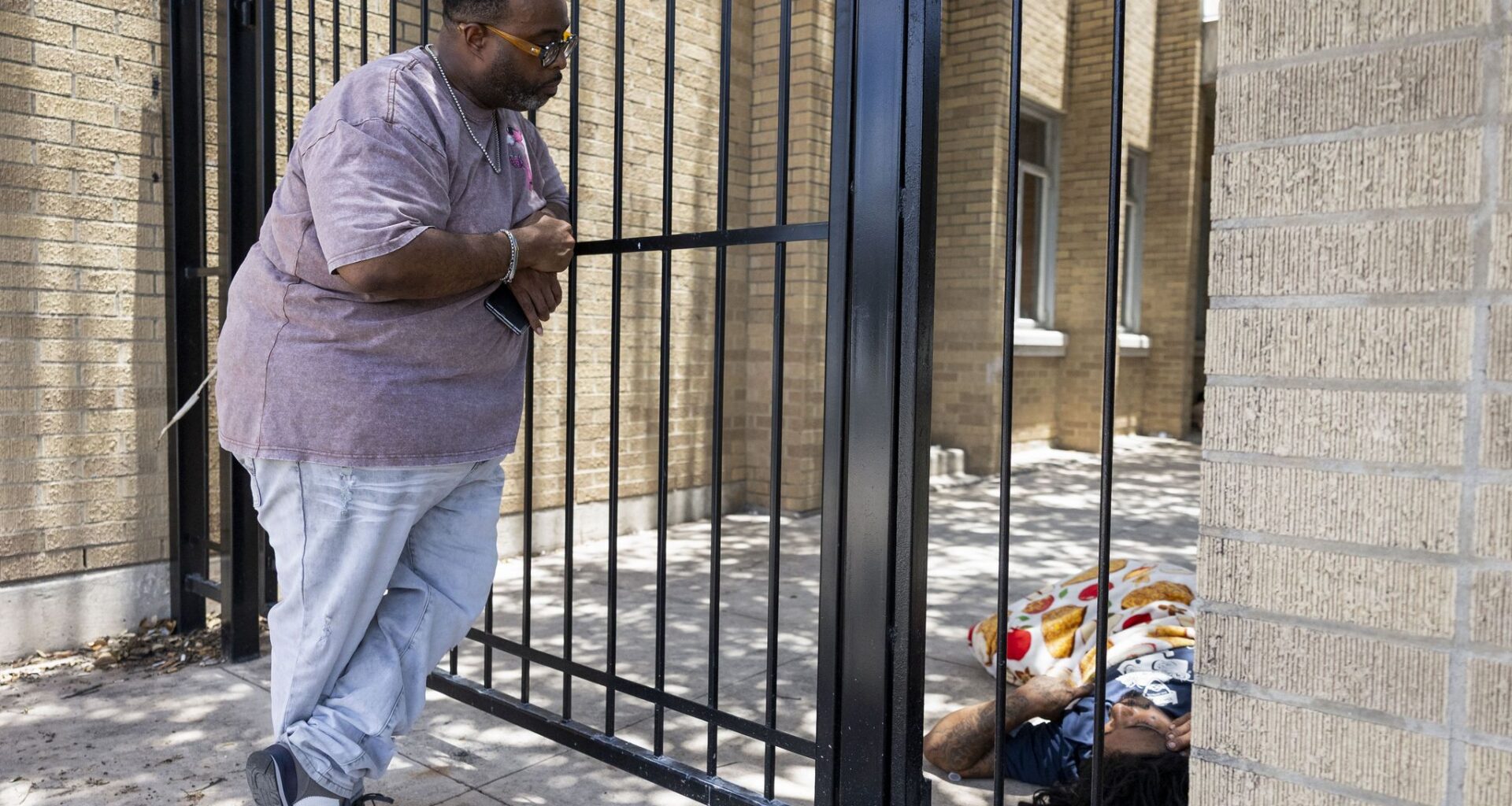
Tarvis Brown and Roger Arreola drove to homeless encampments under downtown highway overpasses on a recent Wednesday afternoon, carefully scanning for faces they recognized amid the tents.

The pair work at Christian Assistance Ministry’s downtown campus and run CAMpassion Care, which provides psychiatric care and medication to people living on the streets.
If a person who regularly stops by the campus — which primarily serves homeless San Antonians — for a shower or meal and appears to have mental health problems, Brown and Arreola jump into action.
Article continues below this ad
They turn the nonprofit’s small chapel into a clinic twice a week, using thick black curtains to partition the room so a psychiatric nurse practitioner can meet privately with patients, diagnose them and prescribe medication. A therapist is also on standby for those who need to talk.
Most people in the program regularly go to CAM’s center-city campus, located on McCullough Avenue, for pills or shots for a variety of mental illnesses, including schizophrenia and bipolar disorder.
But when patients don’t show up for a while, CAM staffers seek them out under bridges and highway overpasses, and on city sidewalks, bringing them with sack lunches and their pills.
Article continues below this ad
Close to Home, which tracks local homelessness trends and statistics, found that 3,625 people were experiencing homelessness in 2025. The number of people living on the streets has grown by almost 10% from 2022 to 2025.
Just over 51 percent of people who live on the streets in Bexar County self-reported a mental health condition, and 49% said they used drugs or consumed alcohol.
“You didn’t think I was going to find you, did you?” Brown joked as he approached Miguel Guerrero at Corazon Ministries’ day center downtown. The campus, which abuts CAM’s, also provides meals and recreational space for homeless people.
Guerrero, 26, was napping on the ground in the shaded courtyard, covered by a fuzzy white blanket with apples printed on it. His head rested on a white towel.
Article continues below this ad
The two talked briefly about Guerrero’s medication and his desire to get off the streets. Brown and Arreola passed medication and the brown-bag lunch through the fence of the day center. Brown encouraged Guerrero to return to CAM’s campus to talk more about treatment.
That was Brown and Arreola’s third and final stop Wednesday afternoon. They had already pulled over under Interstate 37 to talk with Christina Barrera about returning to the clinic soon for the medication she had previously received there.
Tarvis Brown, director of the CAMpassion Care Clinic, left, checks up on Johnathan Rayray on June 10.
Katina Zentz/San Antonio Express-News
Miguel Guerrero pauses during a check-in with Tarvis Brown on June 10.
Katina Zentz/San Antonio Express-News
Tarvis Brown checks up on Christina Barrera under an overpass on June 10.
Katina Zentz/San Antonio Express-News
They also pulled over near Hays Street Bridge on the near East Side to catch up with Johnathan Rayray. (He said that’s his legal name.) The 26-year-old frequents the CAM campus but has yet to commit to its psychiatric care program. Still, Brown tries to talk with Rayray every chance he gets to encourage him to get treatment.
Article continues below this ad
Brown said he has learned that it can take months to build relationships and convince people that they could benefit from CAM’s program.
“It’s one chisel on a big old rock,” said Brown, director of CAMpassion Care. “Just one chisel at a time, and we’ll get there.”
‘Most vulnerable place’
CAMpassion Care was launched in January 2025 with a $350,000 grant from the FirstDay Foundation, which gives money and provides management services to local nonprofits. Organizers have also collected private donations, and Dawn White-Fosdick, CAM president and CEO, said she is applying for additional grants to keep the effort afloat for the long-term.
Article continues below this ad
CAM has treated 140 patients.
Between January 2025 and early March of this year, 40 moved on to longer-term treatment and mental healthcare outside of CAM, found housing or shelter that took them off the streets, or returned to their families, according to the nonprofit.
The most common diagnoses are schizophrenia, bipolar disorder and substance abuse.
Nurse practitioner Sara Koenig-Langston operates a mental health practice in New Braunfels and visits San Antonio twice per week to help run CAMpassion Care. She said many of the patients she sees at the San Antonio campus are living with a combination of mental illnesses. Some are using illegal drugs to cope with their symptoms.
Article continues below this ad
Koenig-Langston, a former homeless drug user who has been clean for 25 years, said she doesn’t require CAMpassion Care patients to be sober before receiving psychiatric care. She first treats what’s often the root of their substance abuse — psychosis — with pills or injections. It often helps patients slow their drug usage and stabilize their mood so they’re more willing to seek longer-term treatment and sobriety.
Curtis Nunnery, right, speaks with Tarvis Brown after he received care at the CAMpassion Care Clinic on June 2.
Katina Zentz/San Antonio Express-News
Curtis Nunnery, left, speaks with Dr. Sara Koenig-Langston at the CAMpassion Care Clinic on June 2.
Katina Zentz/San Antonio Express-News
Debbie Jennings, a nurse and a consultant, stands by a curtain at the CAMpassion Care Clinic on June 2.
Katina Zentz/San Antonio Express-News
The program intentionally puts few burdens on patients. Koenig-Langston said paperwork is minimal, medication is delivered to CAM, where patients already come for other services, and the wait times to see her are short.
Article continues below this ad
“Mental health is one of the most vulnerable places that people find themselves in, and it’s one of the most stigmatized that people have,” she said. “So when people are willing to come in and share some of the most vulnerable things that they’ve been through in the most vulnerable place that they are, and let me listen to them and be a part of their team, it’s really cool.”
The medication is free to the patients treated through CAMpassion Care. Brown signs visitors up for health insurance on the subsidized federal marketplace to pay the bulk of their health care expenses, and the nonprofit covers their co-pays when needed.
‘Gonna die on the streets’
Josiah Thompson, 40, was one of CAMpassion Care’s earliest patients.
Article continues below this ad
He was homeless for about a decade, mostly in San Antonio, and became a regular at CAM.
Thompson said he started using methamphetamine sporadically when he was 14, and that it eventually developed into a full-on addiction.
“It was my crutch, and it became my cross to bear,” he said.
Getting a job became a challenge when he was homeless because his government-issued ID and Social Security cards were stolen.
Article continues below this ad
“I figured I was gonna die on the streets,” Thompson said.
“Tarvis wasn’t willing to accept that,” he added. “He convinced me that I should give life another shot and that I could really make it.”
Thompson is nine months sober. He left CAM’s program to go to rehab and is now at a sober-living home in Austin. He works as a rotisserie chicken cook at H-E-B.
When Thompson entered the CAMpassion Care program, he said he was being treated for bipolar disorder. In rehab he was told he was on the autism spectrum. He said he no longer takes medication for his mental health but has learned coping mechanisms to better deal with his emotions.
Article continues below this ad
The program has meant a lot to Thompson’s mother, LaFawn Thompson, who lives in New Braunfels and often lost contact with her son for long stretches when he was living on the streets.
For a time, she got updates on her son through a local church volunteer who sent photos and health status updates. Then she started hearing from Brown when her son started to participate in CAMpassion Care.
“I probably wouldn’t have my son if it wasn’t for them,” she said, her voice cracking.
‘Lifelong journey’
Seeking healthcare is challenging, said San Antonio’s chief mental health officer, Jessie Higgins. But it’s even harder for people struggling with mental illness to find care because mental health crises can wreck a person’s motivation. Living on the streets also makes it tough for people to make it to appointments at traditional clinics.
Article continues below this ad
Sean Jones waits inside the CAMpassion Care Clinic on June 2.
Katina Zentz/San Antonio Express-News
Sean Jones, right, speaks with Tarvis Brown at the CAMpassion Care Clinic on June 2.
Katina Zentz/San Antonio Express-News
Debbie Jennings, a nurse and a consultant, hugs Sean Jones after he received care at the CAMpassion Care Clinic on June 2.
Katina Zentz/San Antonio Express-News
“One of the things that’s so amazing about the program at CAM is that they recognized there were people literally on their front doorstep every day who trust CAM,” Higgins said.
Article continues below this ad
“Those were not folks that were going to be able to access care in the traditional way,” she added.
The work can be challenging, which is why White-Fosdick, CAM’s CEO, thinks there is a shortage of people offering such services. The goal is to help people who have lived on the streets because of mental illness find housing, she said.
“It really involves being engaged with each person as an individual,” she said. “There’s no big silver bullet. And the case management and long-term impact of their mental health, many times, is a lifelong journey.”