
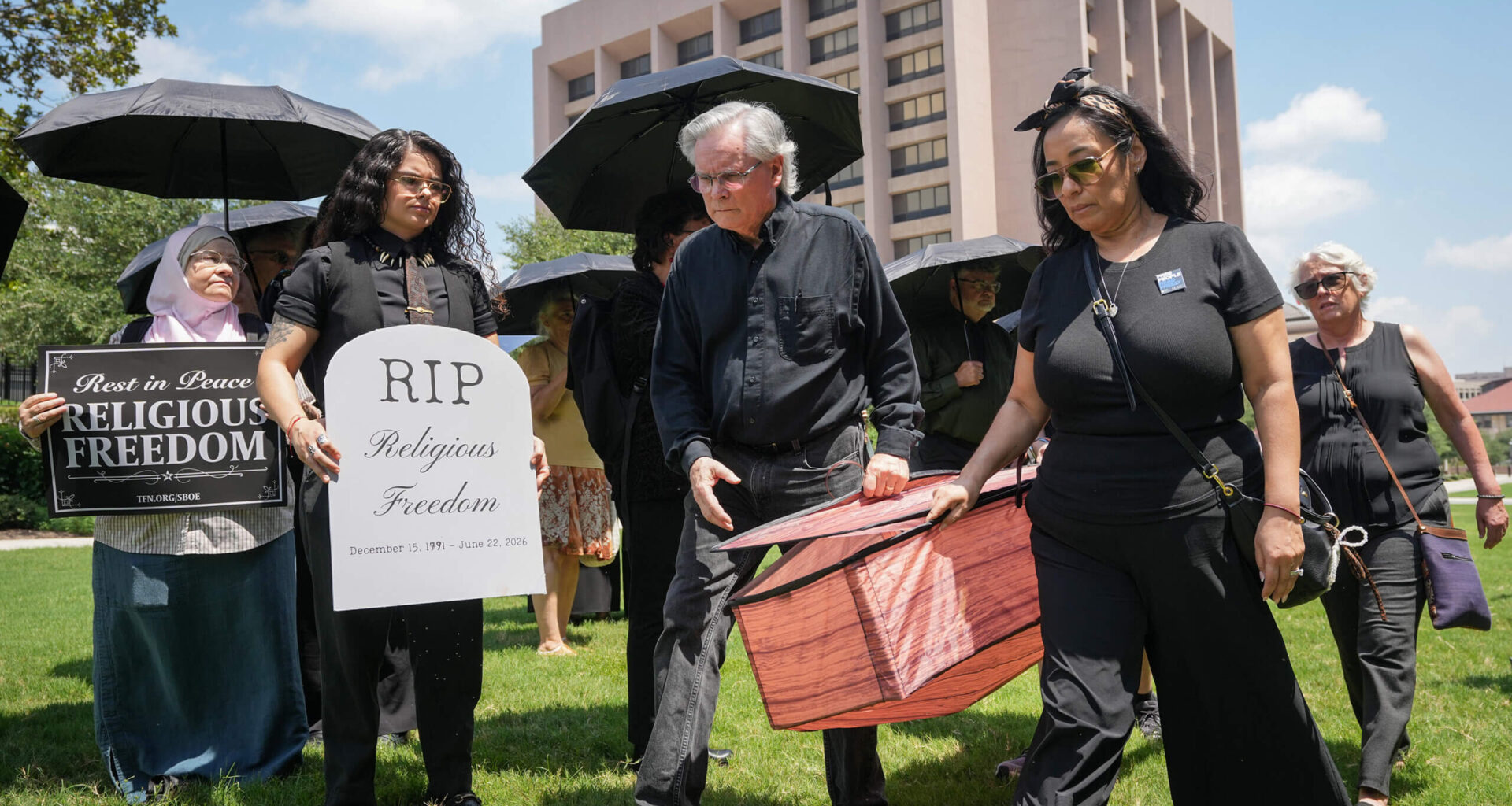
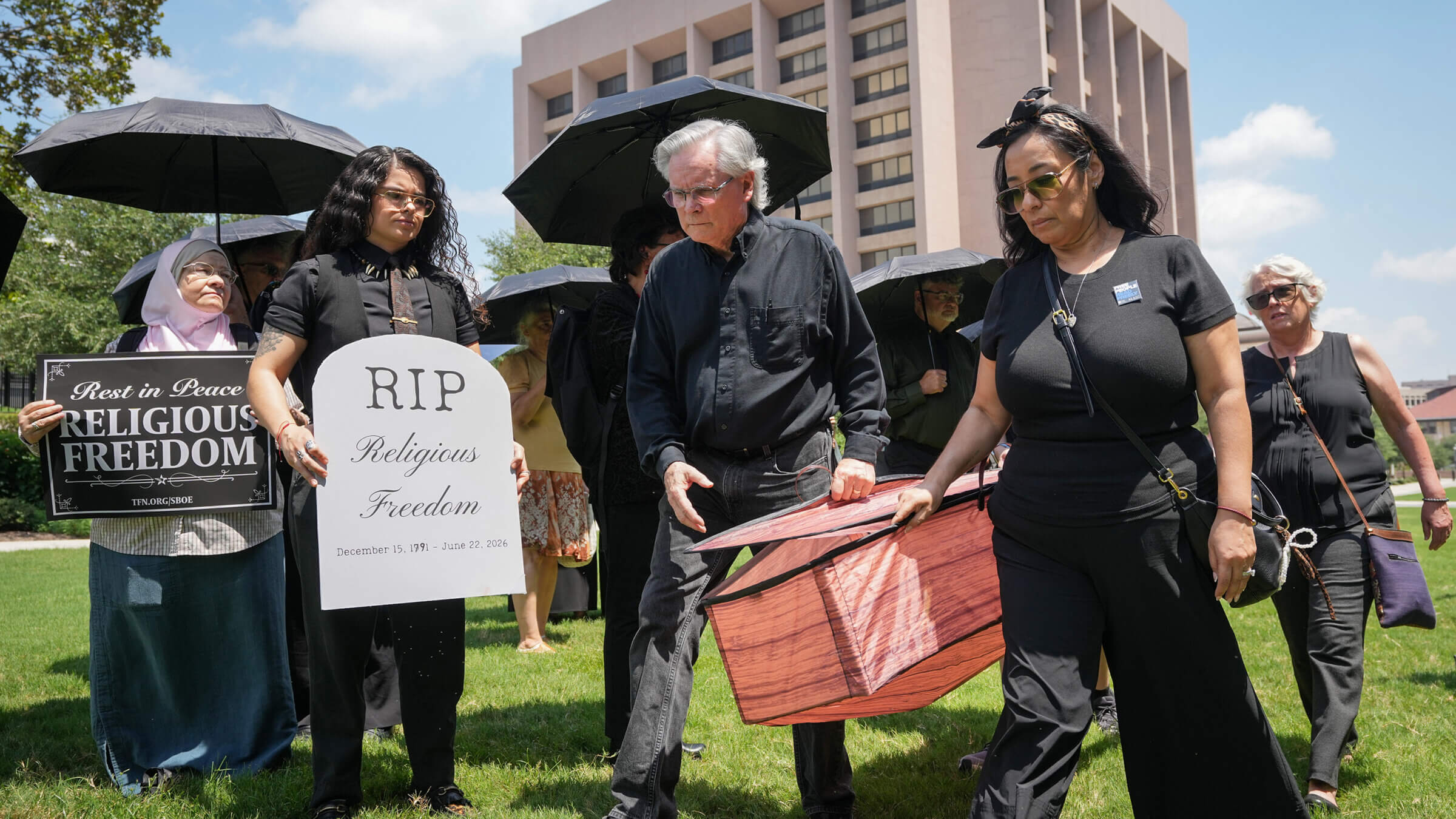
Interfaith protesters held a funeral-themed demonstration for religious freedom outside the building where the Texas State Board of Education voted to require the biblical reading list. Photo by Jay Janner/The Austin American-Statesman via Getty Images

By Hannah Feuer
June 29, 2026
Among the many faiths practiced by millions of Texas students, a new statewide required reading list that includes biblical passages draws from just two traditions: Protestant Christianity and Judaism.
Yet Texas rabbis say Jews had no role in shaping how Judaism appears in the curriculum, and they disagree with how the lone Jewish text is presented. Rather than teaching about Judaism on its own terms, they argue, the lessons filter Jewish texts through a Christian perspective.
The reading list, which is expected to go into effect in 2030, will have public school students across the state reading passages from the New Testament and mostly Christian translations of the Hebrew Bible alongside literary classics. Of the curriculum’s six Hebrew Bible readings, just one uses a Jewish translation.
Approved Friday in a 9-5 vote by the Texas State Board of Education, the curriculum introduces Bible readings as early as first grade, when students will read the Parable of the Prodigal Son as told by Jesus.
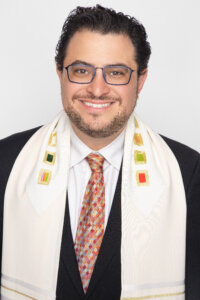 Rabbi Joshua Fixler Courtesy of Joshua Fixler
“You can see from the list of texts that it is not meant to be inclusive of Jews,” Joshua Fixler, associate rabbi at Congregation Emanu-El in Houston, told the Forward. “If it were more inclusive of Judaism, that wouldn’t make it better, because it would still be the state lifting up one or two religious traditions over all others.”
The move is the latest in a series of efforts to expand the role of Christianity in public education, and more broadly, to challenge the separation of church and state as a bedrock principle of American law. Texas also requires classrooms to display the Ten Commandments, allows schools to hire religious chaplains as mental health counselors, and lets schools set aside a daily time period for Bible readings and “voluntary prayer.”
Supporters of the reading list, such as the conservative think tank Texas Public Policy Foundation, argue teachers will present the Bible as a historical and literary text — not as dogma.
“Teaching students essential excerpts from the Bible so that they may be well-read is not ‘sermonizing’ any more than reading Greek mythology encourages paganism,” Matthew McCormick, an education analyst at the Texas Public Policy Foundation, wrote in a blog post supporting the list.
Questionable Choices
According to David Segal, a rabbi based in Houston and policy counsel for the Baptist Joint Committee for Religious Liberty, that distinction between historical and literary text and dogma contradicts the list’s design. The curriculum compels teachers to use overwhelmingly Protestant translations, he said, inherently favoring certain interpretations over others.
There are hundreds of English Bible translations, each carrying different theological implications. The Texas Board of Education drew from three Protestant Christian versions, plus one passage from the Jewish Publication Society’s 1917 translation of the Tanakh — a version many rabbis consider outdated.
“The choice of a singular translation, and particularly those translations, is one of the things that verges on an unconstitutional preference of one religion over another,” Segal said.
Even the reading list’s lone Jewish text is unsettling, rabbis say. Chapter three of the Book of Lamentations, reflects on the destruction of the First Temple and interprets it as divine punishment for the Israelites’ sins.
Segal said he was puzzled by its inclusion. More concerning, he said, the text appears alongside Holocaust literature. Pairing the chapter with Night by Elie Wiesel and The Survivor by Primo Levi raises troubling questions about whether eighth grade students might be led to interpret the Holocaust as divine punishment from God, he said.
“If you asked me to compile a list of, like, Bible greatest hits that I’d want to teach K-12 for cultural literacy, nowhere on that list would appear Lamentations,” he said. “And that’s coming from someone who actually loves teaching that book to adults.”
Alongside Anne Frank’s diary and the poem Blessed is the Match by Hannah Senesh, seventh graders will read a Christian translation of the 23rd Psalm, which describes God as a loving protector who guides his people through life’s hardship. Because it comes from the King James Version, the reading list refers to it by its Christian title: the Shepherd’s Psalm.
Others have raised concerns about the age-appropriateness of the material — and whether teachers will be equipped to deal with the thorny questions it raises.
Caryn Tamber-Rosenau, a professor of Jewish studies at the University of Houston, teaches a college class on the Hebrew Bible. She said she believes in the value of teaching religious texts, but she cautioned that the method matters.
“Some of these texts present incredibly difficult historical, literary, and especially theological questions,” she said. “How are teachers going to mediate those things for sixth graders?”
That points to a broader concern, Segal said: Despite supporters describing the curriculum as reflecting “Judeo-Christian values,” he is unaware of any Jewish organizations or leaders that have endorsed the reading list.
Members of the Texas Board of Education who voted in favor of the curriculum did not respond to the Forward’s requests for comment.
“It’s not really very Judeo, because all but one of the Hebrew Bible selections are presented in the form of a Christian translation,” Segal said. “Christians have every right to understand it that way within their own theology and belief and doctrine, but it’s a problem when the state is assigning that version.”
Did you know that only 2% of Forward readers donate to support our nonprofit newsroom? That 2% make it possible for millions to read the Forward without a paywall or subscription — removing any barriers to the full and fair Jewish story.
But while the Forward is free to read, it isn’t free to produce. Big stories — like deep dives into the antisemitism data, political scoops or reporting trips to college campuses — take months of research and fact-checking. All while we keep you informed of what you need to know each day.
Support our mission to tell the Jewish story fully and fairly.
