
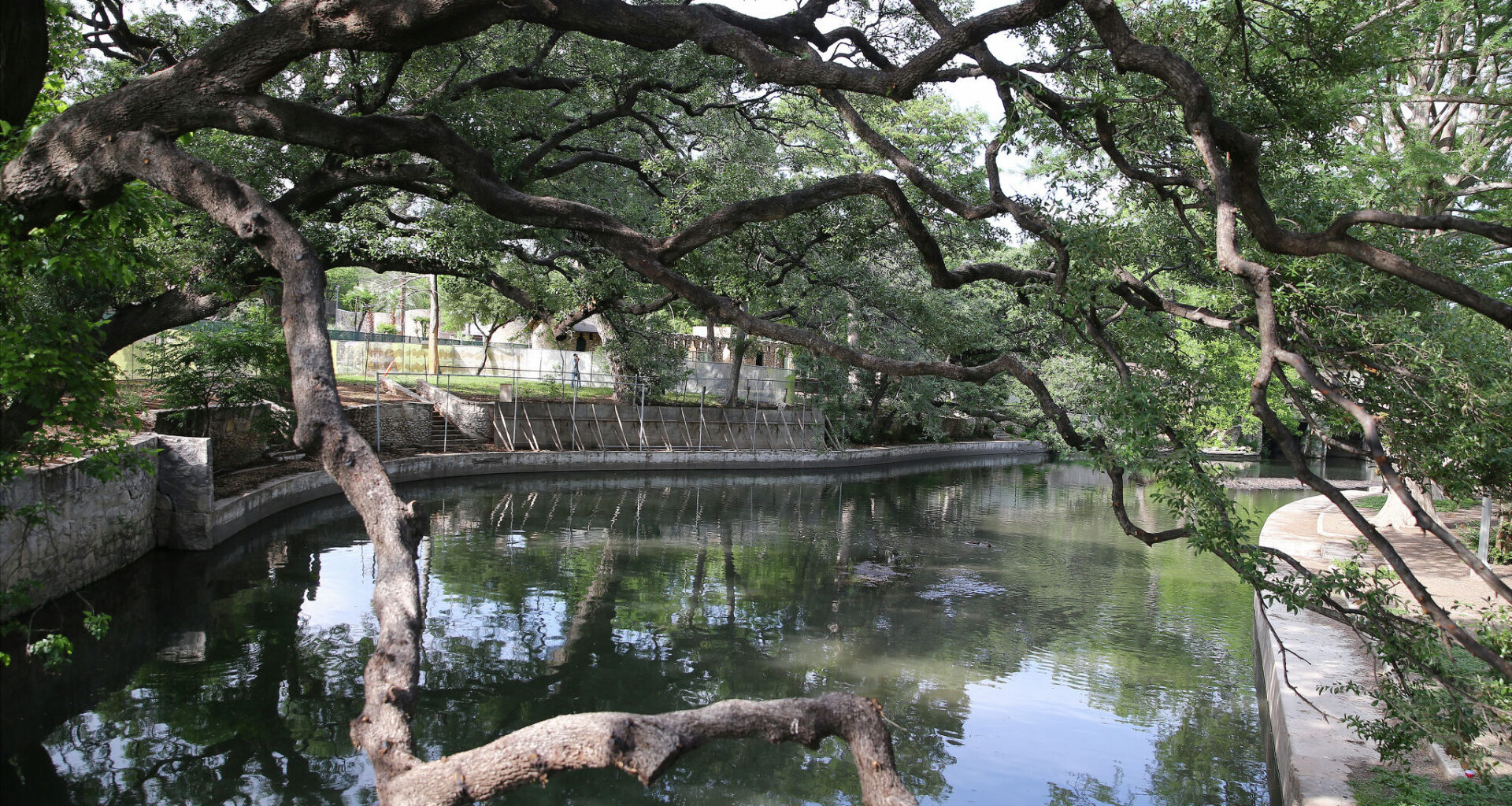
Lawyers for a Native American tribe are asking the U.S. Supreme Court to step into a dispute between the tribe and the city of San Antonio over redeveloping sections of Brackenridge Park that have long been used for religious practices.
The petition, filed by Plano-based First Liberty Institute and the University of Texas School of Law’s Law and Religion Clinic, asks the Supreme Court to review a December decision by the 5th U.S. Circuit Court of Appeals that ruled in favor of the city.
The Supreme Court is not required to accept the petition. The high court typically hears only 100 to 150 of the 7,000 or so cases it is asked to review each year, according to federal court officials.
At issue is whether the city can move forward with removing trees from a section of Brackenridge Park that is used in Native American religious ceremonies.
The dispute began after the San Antonio City Council approved a $3.5 million park construction project to repair crumbling river walls that were built in the 1920s and stabilize the foundation of an 1870s pump house.
The area in San Antonio where Brackenridge Park sits has for centuries been used by numerous Native American tribes, who consider it a sacred site. Some Native Americans view the double-crested cormorant, a species of bird that is present in that area, as part of the spiritual tradition that is vital to their worship.
A lawsuit seeking to stop the project was filed in 2023 by San Antonio residents Gary Perez and Matilde Torres, who are members of the Lipan-Apache Native American Church and the Pakahua/Coalhuiltecan Peoples of Mexico and Texas. They contended that the city’s tree removal and bird management policies planned for the north end of the park would unconstitutionally deny them access to Lambert Beach, a sacred area along a bend in the San Antonio River.
U.S. District Judge Fred Biery ruled that the city could continue the bird-deterrent operations related to the renovation project and could remove several trees, but he required the city to grant access to another area in the park that was fenced off so the Native American church members could conduct ceremonies on certain dates.
That ruling was appealed to the 5th U.S. Circuit Court of Appeals, which affirmed Biery’s decision. The appeals court ruled that the Texas Constitution’s religious service protections provision does not extend to the government’s preservation and management of publicly owned lands.
Attorneys for the Native American plaintiffs are asking the Supreme Court to review that ruling, and argue in the petition that courts “are not arbiters of theological truth. The Free Exercise Clause forbids courts from overruling a religious practitioner’s beliefs, while the Establishment Clause prohibits government officials from announcing religious dogma.”
Steven Collis, professor and director of the UT Law and Religion Clinic, said “bulldozing” a religious site is the definition of burdening religious practice.
“Both the courts and the city are aware that our clients can worship nowhere else but this site, yet both have told them they are mistaken in their religious beliefs and can just go somewhere else,” Collis said in a written statement. “That violates the religion clauses of the First Amendment, as does refusing to do available, less-destructive alternatives.”
In a written statement, the San Antonio City Attorney’s Office said the city stands by its position, which has already been upheld by the trial court and the 5th Circuit.