
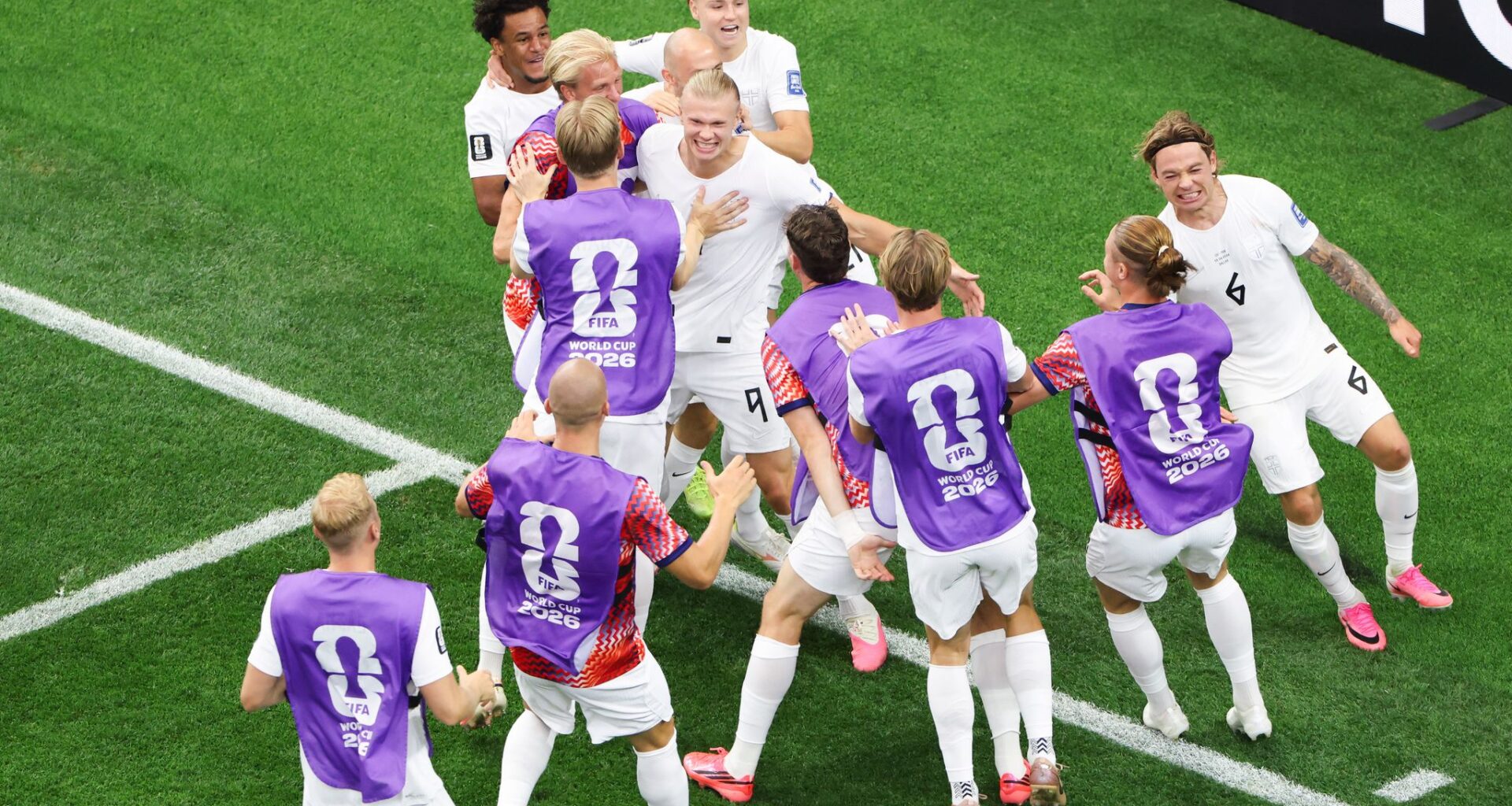
Norway forward Erling Haaland (9) celebrates with teammates after breaking the tie during the second half of a FIFA World Cup round of 32 match between Ivory Coast and Norway in Arlington, TX, Tuesday, June 30, 2026. Norway defeated Ivory Coast, 2-1.
Juan Figueroa/The Dallas Morning News
ARLINGTON — There was a moment, a half-second or so, where Norway’s massive striker Erling Haaland wasn’t sure of himself. But, just like that, it was gone.

In the 86th minute of the first World Cup knockout game played at this grass-filled soccer pitch known as Dallas Stadium, Patrick Berg made a perfect cross past two Ivory Coast defenders, delivering the game-winning goal on a platter for Haaland, who gave the ball the lightest touch with his left foot. As the ball rolled toward the net, Haaland flinched and started to chase it down himself, thinking he had not quite got enough on it but he just as quickly realized he had done all that was needed for a 2-1 Norway victory Tuesday afternoon.
This was the sixth of nine matches to be played here, and to say D-FW soccer fans and the many thousands of visitors passing through the gates have been fortunate is a considerable understatement.
Article continues below this ad
Three goals from the GOAT, Argentina’s Lionel Messi, including the one that, even if it’s only until 2030 when France’s Kylian Mbappe just might track him down, made him the World Cup’s all-time leader. Two goals from England superstar Harry Kane, a gratifying start for the country that most accurately claims soccer as its creation, even if subsequent games have raised doubts about whether the 60-year-old World Cup drought is coming to an end for the Three Lions.
And now a game-winner from Haaland who, at age 18, scored nine goals in a 12-0 Under-20 World Cup win over Poland and spoke afterward of having choked on a would-be 10th. Haaland scored two goals in each of Norway’s first two wins, then sat out the game with France along with other key contributors with all eyes focused on the knockout stage.
That was proved a correct decision. Norway needed all it could supply to the bitter end against Ivory Coast, whose speed was a problem from the start and who had tied the game at the 74th minute mark on an incredible give-and-go goal by Amad Diallo. If that momentarily took the breath out of the determined Viking rowers all around the stadium Tuesday, it may have been particularly galling for Haaland, who plays for Manchester City in the Premier League.
Diallo, at least nine inches shorter than Haaland, plays for Manchester United.
Article continues below this ad
And that’s how Ivory Coast came to be a lot more than an African anomaly in this round. Of the 10 African clubs that earned spots in the 48-team field, nine advanced to the knockout stage. Tunisia — the first African nation to win a World Cup game back in 1978 against Mexico — was the lone failure this year.
That’s nine, up from zero at the 2018 World Cup in Russia, although that stat is misleading. This is the biggest field ever for a World Cup by a considerable margin. All previous knockout stages consisted of no more than 16 teams, meaning we are another round away from reaching that point in this particular World Cup.
We will see another African squad here Friday afternoon when Egypt plays Australia. On Monday, Morocco, which became the first African country ever to play in the World Cup semifinals in Qatar four years ago, advanced past the Netherlands in a late shootout victory. So there’s at least one African representative participating in the round of 16 and presumably will be more.
And Diallo playing for Manchester United is emblematic of why this is happening. Several hundred talented African players are learning and developing in Europe’s top leagues and youth programs. Of Ivory Coast’s 26 rostered players, 24 play in Europe. For Morocco, it’s 20 of 26, and the winning goal against the Dutch was scored by Ismael Saibari, who has spent his entire professional career in the Netherlands.
So, in its own way, Tuesday’s battle became a Manchester Derby with Haaland not just getting the final kick and the last laugh, but nearly scoring twice more in the final minutes as he made his 6-foot-5 presence felt around the Ivory Coast goal. When the game ended, more than half the African team could be seen lying prostrate near the Norwegian goal. Their fans were clearly outnumbered but their team had given all it had against a foe that’s on a surprising mission of its own.
Article continues below this ad
This is the first World Cup that Norway has qualified for since 1998. For the most part, frustratingly, one imagines, they have left the soccer success to their Swedish rivals. Not this time around.
Norway has little history on its side, but it does have size. Over 90 minutes Tuesday, size and strength wore down the speedier team and Norway will try to do the same against Brazil this weekend.
Meanwhile, three games to play here and the star power keeps on delivering.